How Compound Interest Works
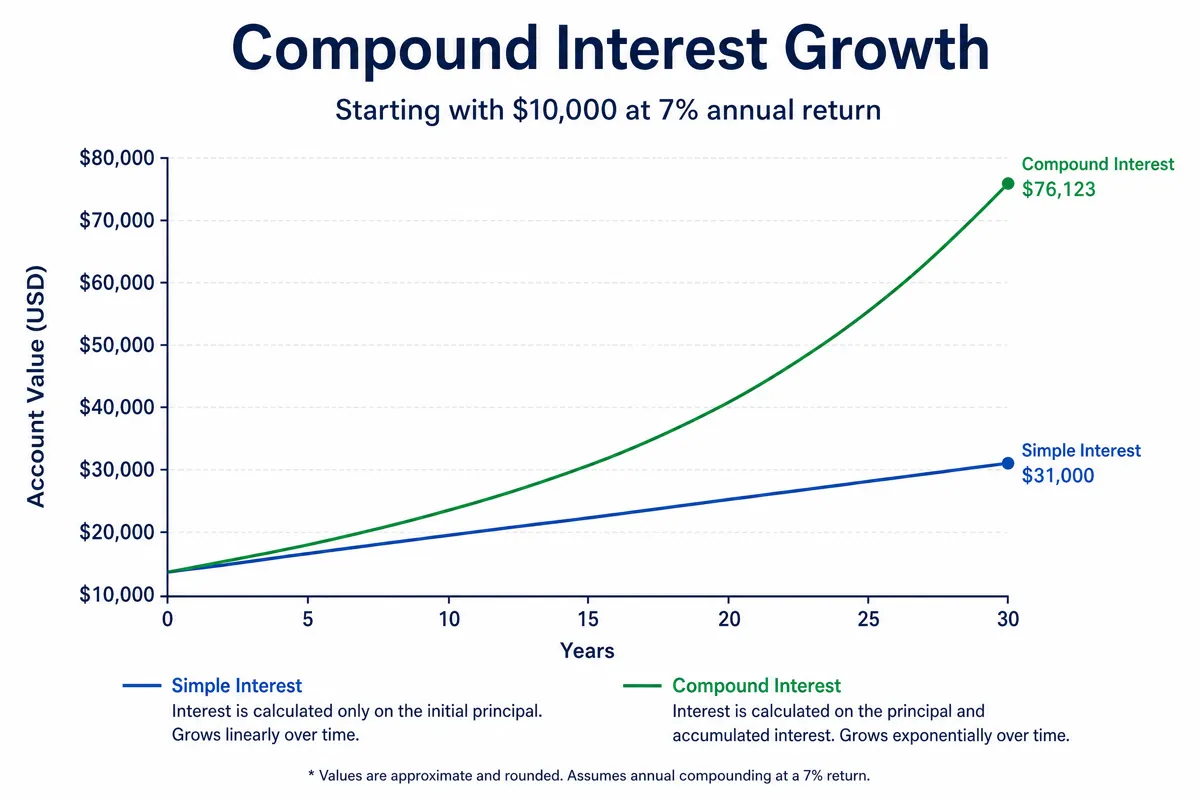
Compound interest is interest calculated on both the initial principal and the accumulated interest from previous periods. Unlike simple interest (which only earns on the original principal), compound interest creates a snowball effect — your money earns interest on its interest, leading to exponential growth over time.
Albert Einstein reportedly called compound interest the "eighth wonder of the world." Whether or not the attribution is accurate, the math is undeniable: given enough time, even modest savings can grow into substantial wealth.
The Compound Interest Formula
The formula for compound interest with regular contributions is:
A = P(1 + r/n)^(nt) + PMT × [((1 + r/n)^(nt) - 1) / (r/n)]
- A = future value (what you'll have)
- P = initial principal (starting amount)
- r = annual interest rate (as a decimal)
- n = number of times interest compounds per year
- t = number of years
- PMT = regular contribution amount
Why Compounding Frequency Matters
The more frequently interest compounds, the faster your money grows. Here's how $10,000 at 7% annual interest looks after 20 years with different compounding frequencies:
- Annually: $38,697
- Quarterly: $39,412
- Monthly: $40,387
- Daily: $40,552
The difference between annual and daily compounding is about $1,855 — meaningful, but not dramatic. The real power comes from consistent contributions and time in the market, not the compounding frequency.
Want to see how compound interest helps you reach a specific goal? Try our Savings Goal Calculator to find the monthly contribution needed for your target.
The Power of Starting Early
Consider two investors, both targeting retirement at age 65 with a 7% annual return:
- Investor A starts at 25, invests $300/month for 40 years. Total contributions: $144,000. Final balance: approximately $718,000.
- Investor B starts at 35, invests $600/month for 30 years. Total contributions: $216,000. Final balance: approximately $680,000.
Investor A contributes $72,000 less but ends up with $38,000 more — purely because of the extra 10 years of compounding. This illustrates why financial advisors stress starting as early as possible, even with small amounts.
See how compounding powers your retirement savings with our Retirement Calculator, or read 5 Real-Life Examples of Compound Interest for concrete scenarios.
Realistic Return Rate Assumptions
When planning your investments, consider these historical benchmarks:
- S&P 500 (stocks): ~10% average annual return (before inflation), ~7% after inflation.
- Bonds: ~4-5% average annual return.
- High-yield savings: ~4-5% in 2024-2026, historically closer to 1-2%.
- Real estate: ~8-12% including rental income and appreciation.
For long-term planning (20+ years), using 7% accounts for inflation and gives a more conservative, realistic projection of your purchasing power.
Already have investments? Use our Investment Return Calculator to measure your actual annualized performance.
Compound Interest vs. Simple Interest
With simple interest, $10,000 at 7% earns $700 per year, every year — totaling $24,000 in interest over 20 years.
With compound interest(monthly), the same $10,000 grows to $40,387 — earning $30,387 in interest. That's 27% more growth from compounding alone, with no additional contributions.
Tips to Maximize Compound Growth
- Start immediately — even small amounts benefit enormously from additional time.
- Automate contributions — set up automatic transfers so you invest consistently regardless of market conditions.
- Reinvest dividends — dividend reinvestment plans (DRIPs) compound your returns without effort.
- Minimize fees — a 1% annual fee can reduce your final balance by 25% or more over 30 years. Choose low-cost index funds.
- Avoid withdrawals — every withdrawal resets your compounding clock. Let time do the heavy lifting.
Frequently Asked Questions
What's a good rate of return to assume?
For stock market investments over 20+ years, 7% (inflation-adjusted) is a commonly used conservative estimate. For a savings account or CDs, use the current advertised rate, keeping in mind that rates fluctuate over time.
How often should I contribute?
Monthly contributions are the most common approach and align with most people's pay schedules. The key is consistency — whether weekly, biweekly, or monthly, regular contributions matter more than the exact frequency.
Does compound interest work against me with debt?
Yes. Credit card debt compounds daily at rates of 15-25%+. A $5,000 credit card balance at 20% APR making only minimum payments would take over 30 years to pay off and cost more than $9,000 in interest. This is why paying off high-interest debt should be a priority.