Guides / Home Buying
How Much House Can I Afford? Complete Guide by Income Level
The biggest financial decision most people will ever make, and the one where gut feelings fail the most. This guide replaces guesswork with real formulas, income-based tables, and a step-by-step framework to find your true comfortable range.
TL;DR - Quick Answer
- Conservative estimate: 2.5 - 3x your annual household income
- Lender maximum: Often up to 4-5x income (but not recommended)
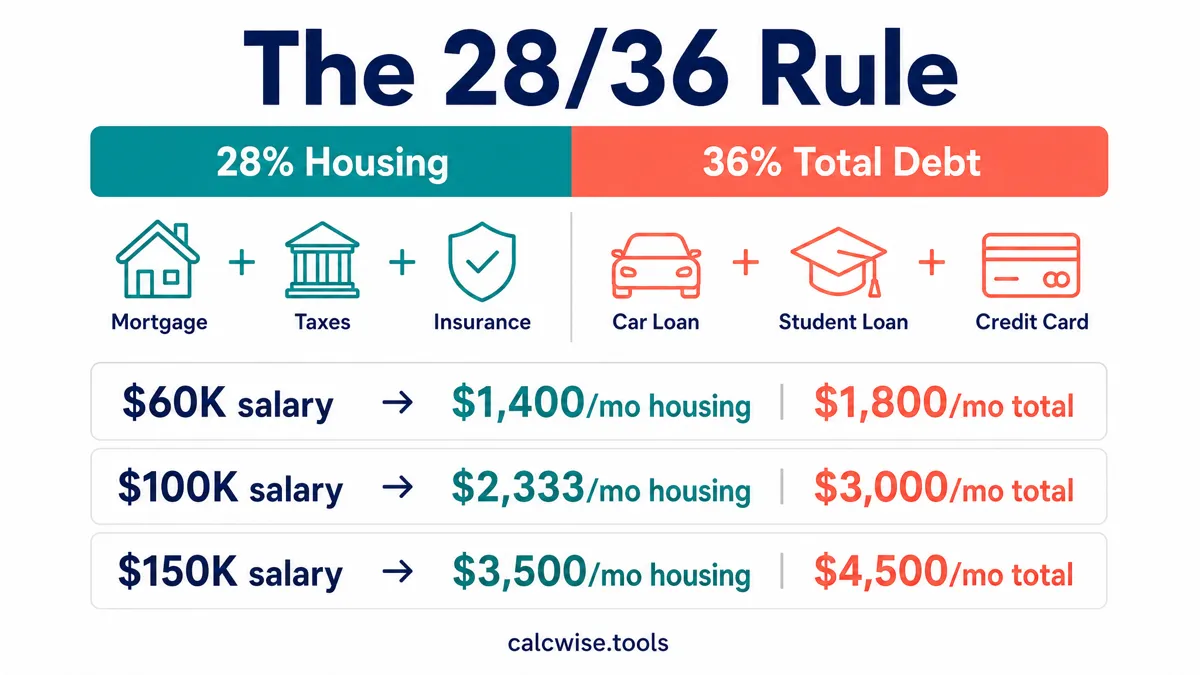
- The 28/36 rule: Keep housing costs under 28% of gross income, total debt under 36%
- Bottom line: Your comfortable amount is usually 20-30% below what a lender will approve
Use our Mortgage Calculator to run your exact numbers.
The Rules Lenders Actually Use
Banks don't just look at your income. They use specific debt-to-income (DTI) ratios to determine your maximum borrowing capacity. Understanding these ratios is the first step to knowing your true budget.
Front-End Ratio (28% Rule)
Your total monthly housing expense (mortgage principal + interest + property taxes + homeowner's insurance + HOA fees) should not exceed 28% of your gross monthly income.
Example: $6,000/month income → $1,680 max housing payment
Back-End Ratio (36% Rule)
Your total monthly debt payments (housing + car loans + student loans + credit card minimums + other obligations) should not exceed 36% of gross monthly income.
Example: $6,000/month income → $2,160 max total debt
If you have $400/month in car + student loans → Max housing = $1,760
Important Caveat
Some lenders will approve DTI ratios as high as 43% (or even 50% for FHA). Just because you're approved doesn't mean it's comfortable. These higher ratios leave almost no room for savings, emergencies, or lifestyle expenses. With the average homeowner's insurance premium rising roughly 10% year-over-year in 2025-2026, it's more important than ever to leave a buffer in your budget.
Home Affordability by Income Level
The table below shows approximate home prices you can afford at each income level. Assumptions: 20% down payment, 6.25% interest rate (fall 2026 average), 30-year fixed mortgage, property tax 1.2%, insurance 0.55%. Rates have eased from the 7%+ peaks of late 2023, giving buyers roughly 5-8% more purchasing power compared to a year ago.
| Annual Income | Monthly Housing Budget (28%) | Comfortable Home Price | Max Lender Approval |
|---|---|---|---|
| $50,000 | $1,167 | $180,000 | $230,000 |
| $75,000 | $1,750 | $280,000 | $355,000 |
| $100,000 | $2,333 | $375,000 | $475,000 |
| $125,000 | $2,917 | $465,000 | $590,000 |
| $150,000 | $3,500 | $555,000 | $710,000 |
| $200,000 | $4,667 | $740,000 | $945,000 |
*"Comfortable" = conservative 28% front-end DTI with no other significant debts. "Max Lender Approval" = 36-43% DTI. Real numbers vary by location, credit score, and current rates.
Detailed Breakdowns by Income Level
The table above gives you quick reference numbers. These three income tiers walk through the full math — monthly gross income, maximum housing and debt payments under the 28/36 rule, realistic home price ranges, and the costs that tables alone cannot capture.
$75,000 Income
At $75,000 per year, your gross monthly income is $6,250. Under the 28% rule, your maximum monthly housing payment (mortgage, taxes, insurance, and HOA) is $1,750. Under the 36% back-end rule, your total debt ceiling — including housing — is $2,250 per month. If you carry no other debts, the full $1,750 goes toward housing. With a $400/month car payment, your housing budget drops to $1,850 under the back-end rule, but the 28% front-end cap of $1,750 still applies.
With a conventional loan at 10% down and a 6.25% rate (fall 2026 average), expect a home price range of roughly $285,000 to $340,000 depending on your debts, credit score, and local tax rates. A 10% down payment on $310,000 means $31,000 upfront plus closing costs (typically 2-5% of the loan, or $5,600-$14,000). Because you are below 20% down, private mortgage insurance (PMI) adds approximately $90 to $160 per month until you reach 20% equity — typically 5-7 years of on-time payments.
At a Glance
- Gross monthly income: $6,250
- Max housing (28%): $1,750/month
- Max total debt (36%): $2,250/month
- Home price range: $285,000 - $340,000
Loan Details (6.25%)
- Down payment: 10% (~$31,000)
- PMI: ~$90 - $160/month
- Loan type: Conventional
- Comfortable target: ~$280,000
$100,000 Income
A $100,000 salary translates to $8,333 per month in gross income. The 28% rule gives you a maximum housing budget of $2,333 per month, and the 36% back-end rule caps total debt at $3,000. At this income level, the comfortable home price range is approximately $390,000 to $450,000 with 20% down, 6.25% interest rate, and typical property tax and insurance rates. Lenders may pre-approve you for $475,000 or more — but that maximum leaves almost no margin for savings, maintenance, or lifestyle expenses.
The key at this income level: do not max out. Targeting 25% of gross income ($2,083/month) instead of 28% preserves roughly $250/month for retirement contributions, emergency savings, or unexpected costs. On a $350,000 mortgage at 6.25% over 30 years, total interest paid equals approximately $426,000 — meaning you pay more in interest over the life of the loan than the home's purchase price. A $400,000 home at the top of your range pushes that interest total above $490,000. Compared to when rates were 7%, a $100K earner now saves roughly $55/month on a $350K mortgage — not transformative, but it adds up to $19,800 over the life of the loan.
At a Glance
- Gross monthly income: $8,333
- Max housing (28%): $2,333/month
- Recommended (25%): $2,083/month
- Home price range: $390,000 - $450,000
Cost of Borrowing (6.25%)
- $350K mortgage at 6.25%: ~$426K total interest
- Monthly P&I on $350K: ~$2,155
- Max lender approval: ~$475,000
- Comfortable target: ~$375,000
$150,000 Income
At $150,000 per year, gross monthly income reaches $12,500. Maximum housing under the 28% rule is $3,500 per month, with total debt capped at $4,500 under the 36% rule. The comfortable home price range is approximately $555,000 to $640,000. Homes above $802,650 (the 2026 conforming loan limit in most counties, up from $766,550 in 2025) require jumbo financing, which typically demands higher credit scores (often 700+), larger down payments (15-20%), and interest rates 0.25-0.5% above conventional loans.
At this income level, the mortgage interest deduction becomes meaningfully valuable — potentially saving $3,500-$5,500 per year in federal taxes on a $500,000+ mortgage, though the benefit depends on whether you itemize deductions and your marginal tax bracket. Total homeownership costs extend well beyond the mortgage: on a $580,000 home at 6.25%, expect roughly $2,858/month in P&I, $580 in property taxes, $266 in insurance (0.55% of home value), and $483/month set aside for maintenance — a true monthly cost of approximately $4,187, or 33.5% of gross income before HOA fees or PMI.
At a Glance
- Gross monthly income: $12,500
- Max housing (28%): $3,500/month
- Max total debt (36%): $4,500/month
- Home price range: $555,000 - $640,000
Additional Considerations
- Jumbo threshold: $802,650 (2026, most areas)
- Tax deduction: ~$3,500 - $5,500/year
- True monthly cost on $580K home: ~$4,187
- Comfortable target: ~$555,000
Real Case Study: The Johnsons, $95K Combined Income
Their Situation
- Combined gross income: $95,000/year
- Monthly gross: $7,917
- Existing debts: $450/month (car + student loans)
- Savings for down payment: $45,000
- Credit score: 740
- Target area: Suburban, property tax ~1.3%
The Math
- 28% of gross: $2,217/month for housing
- 36% of gross: $2,850 total debt capacity
- Available for housing: $2,850 - $450 = $2,400
- Limiting factor: 28% rule → $2,217
- Loan amount at 6.25%: ~$298,000
- + Down payment ($45K): ~$343,000 home
What They Did
The Johnsons were pre-approved for $405,000, but they chose a $320,000 home in early 2026, locking in a 6.3% rate. This gave them breathing room of ~$420/month — enough for retirement savings, an emergency fund contribution, and occasional travel. Their monthly P&I on a $275,000 loan comes to $1,695, with total housing costs (taxes, insurance, maintenance) at $2,180. Six months in, they've had zero months where bills felt tight, even after a job transition and an unexpected $1,800 HVAC repair.
Hidden Costs Most Buyers Forget
The sticker price is just the beginning. Here's what a $350,000 home actually costs you monthly:
| Expense | Monthly Cost | Notes |
|---|---|---|
| Mortgage (P&I) | $1,724 | $280K loan, 6.25%, 30yr |
| Property Tax | $350 | 1.2% of home value |
| Homeowner's Insurance | $160 | ~0.55% of home value (up from 0.5% in 2024) |
| PMI (if <20% down) | $145 | ~0.5-1% of loan/year |
| Maintenance & Repairs | $292 | 1% of home value/year |
| HOA (if applicable) | $200 | National median ~$200/month |
| True Monthly Cost | $2,871 | 67% more than just P&I |
5-Step Framework to Find Your Comfortable Number
Calculate your actual take-home pay
Use after-tax, after-deduction income — not gross. This is what you actually have to work with each month. Include both earners if dual income.
List every recurring monthly expense
Car payments, student loans, subscriptions, childcare, groceries, utilities, health insurance. Be brutally honest — most people underestimate by 20-30%. Use our DTI ratio guide to understand how lenders evaluate your debt load.
Subtract non-negotiable savings
Retirement contributions (at minimum enough for employer match), emergency fund building, and any other savings goals. These are not optional.
The remainder is your housing budget
Include ALL housing costs: mortgage payment, taxes, insurance, HOA, maintenance fund (~1% of home value per year). Not just the mortgage number.
Work backwards to a home price
Plug your housing budget into our Mortgage Calculator to see what home price fits. This bottom-up approach is more accurate than any rule of thumb.
5 Expensive Mistakes to Avoid
1. Spending your full pre-approval amount
Pre-approval shows the maximum a bank will lend, not what you can comfortably afford. Think of it as a speed limit, not a speed target.
2. Ignoring the true cost of ownership
Maintenance, repairs, and upgrades average 1-3% of home value per year. A $400K home needs $4,000-$12,000/year in upkeep. Budget for it upfront.
3. Draining your emergency fund for the down payment
Keep 3-6 months of expenses separate from your down payment. The last thing you want is a surprise repair in month two with zero savings.
4. Forgetting about interest rate impact
A 1% rate increase on a $300K loan adds ~$170/month ($61,000 over 30 years). Fall 2026 rates are around 6.25%, but could shift by closing. If rates rise to 7.25% before your lock expires, a $350,000 budget shrinks by about $25,000 in purchasing power.
5. Not accounting for lifestyle changes
Planning for kids? Career change? One partner staying home? Buy for your future finances, not just today's dual income.
Calculate Your Exact Numbers
Stop guessing. Plug in your income, debts, and down payment to see your real monthly payment and total cost.
Frequently Asked Questions
How much house can I afford on a $60,000 salary?
With a $60K salary, lenders typically approve a mortgage between $170,000 and $185,000 using the 28/36 rule. At current rates near 6.25% (as of fall 2026), your monthly housing budget is roughly $1,400. Your actual amount depends on debts, down payment, credit score, and local property tax rates.
What is the 28/36 rule for mortgages?
The 28/36 rule states that you should spend no more than 28% of your gross monthly income on housing costs (mortgage, taxes, insurance) and no more than 36% on total debt payments including housing.
How much should I put down on a house?
While 20% is the traditional recommendation (to avoid PMI), many buyers put 3-10% down. FHA loans allow as little as 3.5%. A larger down payment means lower monthly payments and less interest paid over time. On a $350,000 home, 20% down ($70,000) saves you roughly $145/month in PMI costs compared to 5% down.
Does my credit score affect how much house I can afford?
Yes. A higher credit score gets you a lower interest rate, which directly increases your buying power. A score of 760+ typically gets the best rates. The difference between a 620 and 760 score can be 1-1.5% in rate, which translates to $50,000-100,000 in purchasing power on a 30-year loan.
Should I use my maximum approved mortgage amount?
Financial advisors generally recommend staying well below your maximum approval. Lender maximums don't account for your lifestyle, savings goals, or unexpected expenses. A comfortable range is 2.5-3x your annual income.
Is fall 2026 a good time to buy a house?
With 30-year fixed rates averaging around 6.25% in September 2026 — down from the 7%+ peaks of late 2023 — buyers have slightly more purchasing power than in recent years. A buyer at $100K income gains roughly $15,000-$20,000 in additional buying power compared to when rates were 7%. However, the best time to buy depends on your personal financial readiness, not market timing. Make sure you have a stable income, adequate savings (down payment plus 3-6 months of expenses), and a manageable debt load before focusing on rate movements.
Related Guides
15-Year vs 30-Year Mortgage: Which Saves You More Money?
Compare 15-year vs 30-year mortgages with real numbers on a $350K loan. See monthly payments, total interest, break-even analysis, and who should choose each term.
Rent vs Buy in 2026: How to Make the Right Decision
Should you rent or buy in 2026? Break-even analysis at 7% rates, hidden costs of buying, a real case study, and a step-by-step decision framework.
How Much Down Payment Do You Need for a House in 2026?
Find out how much down payment you need for a house in 2026. Compare conventional, FHA, VA, and USDA loan minimums with real dollar amounts, PMI costs, and savings strategies.