How This Debt Payoff Calculator Works
Enter your current debt balance, interest rate, and monthly payment to see when you'll be debt-free. Then add an extra payment amount to see how much faster you could eliminate your debt and how much interest you'd save.
Debt Payoff Strategies
Two popular approaches to paying off multiple debts:
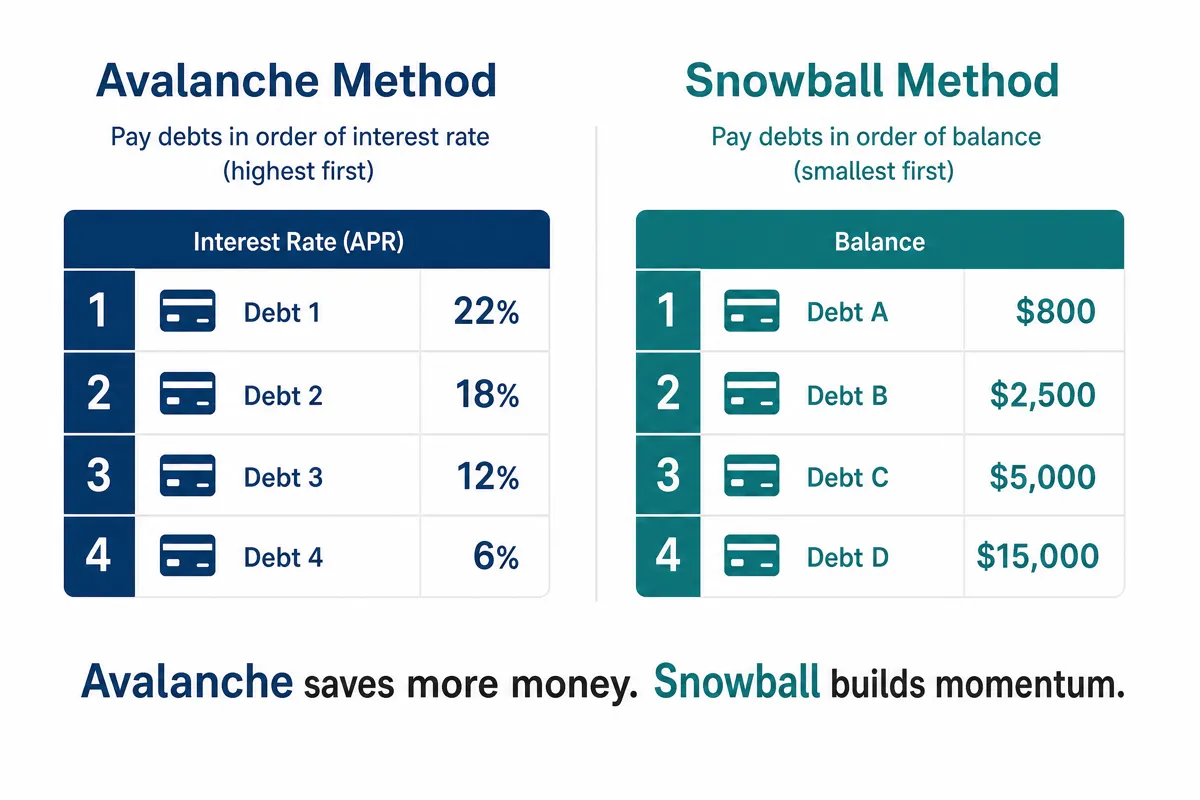
The Avalanche Method (Saves the Most Money)
Pay minimums on all debts, then put every extra dollar toward the debt with the highest interest rate. Once that's paid off, move to the next highest rate. This method minimizes total interest paid and is mathematically optimal.
The Snowball Method (Best for Motivation)
Pay minimums on all debts, then put extra money toward the smallest balance first. The quick wins of eliminating smaller debts create momentum and motivation. Studies show people using this method are more likely to become debt-free because the psychological wins keep them going.
Learn the full comparison in our guide: Debt Avalanche vs Snowball: Which Gets You Debt-Free Faster?
Case Study: Avalanche vs Snowball on $28,000 of Debt
James, a 35-year-old engineer, owes $28,000 across three accounts: a $12,000 credit card at 22.99% APR ($240 minimum), a $6,000 store card at 19.99% APR ($120 minimum), and a $10,000 auto loan at 6.9% APR ($198 minimum). His total minimums are $558 per month. After trimming dining and streaming subscriptions, he frees up $400 extra and commits $958 per month to debt payoff.
Using the avalanche method, James attacks the 22.99% card first while paying minimums elsewhere. That card clears in about 14 months; he then rolls the full $958 toward the 19.99% balance. In this scenario, he becomes debt-free in roughly 31 months and pays about $4,180 in total interest on the original $28,000.
With the snowball method, he pays off the $6,000 store card first for a quick win, then the $10,000 auto loan, then the $12,000 card. The timeline stretches to about 33 months with roughly $4,720 in interest — about $540 more than avalanche. James chooses avalanche because the $540 savings matters more to him than an early psychological win, but either path beats making minimums only, which would keep him in debt for 7+ years and cost over $9,000 in interest. Run your own balances in this calculator, or compare consolidation offers with our Loan Comparison Calculator.
The True Cost of Minimum Payments
Credit card companies set minimum payments intentionally low — often 1-2% of the balance or $25, whichever is greater. This keeps you in debt longer and maximizes their interest revenue.
Example: A $10,000 credit card balance at 19.9% APR with only minimum payments would take over 35 years to pay off and cost approximately $16,000 in interest — more than the original balance. Increasing the payment to $300/month cuts the timeline to 44 months and total interest to about $3,100.
For credit card-specific strategies, try our Credit Card Payoff Calculator which models minimum payments vs. fixed payments, and read How to Pay Off Credit Card Debt Fast for a month-by-month action plan.
How Extra Payments Reduce Interest
Every extra dollar goes directly to reducing your principal balance. With less principal, the next month's interest charge is lower, which means more of your regular payment goes to principal too. This creates an accelerating payoff effect:
- Lower balance → less interest accrues
- Less interest → more of your payment reduces balance
- Faster balance reduction → even less interest next month
Even $50 or $100 extra per month can save thousands in interest and years off your debt timeline.
Where to Find Extra Money for Debt Payoff
- Audit subscriptions: most people have $50-$200/month in subscriptions they barely use.
- Side income: freelancing, selling unused items, or a part-time gig. Direct 100% of extra income to debt.
- Tax refund: the average US tax refund is ~$3,000. Applied to debt, this could save $1,000+ in interest.
- Negotiate rates: call your credit card company and ask for a lower rate. A drop from 22% to 16% saves significant interest.
- Balance transfer: a 0% APR promotional card gives you 12-21 months of interest-free payoff time (watch for transfer fees).
Frequently Asked Questions
Should I save or pay off debt?
If your debt interest rate exceeds your savings rate (which it almost always does for credit cards), prioritize debt payoff. Every dollar of debt at 20% costs you more than a dollar saved at 5% earns. The exception: maintain a small emergency fund ($1,000-$2,000) so unexpected expenses don't force you back into debt.
Once you're debt-free, start building wealth with our Savings Goal Calculator.
Does paying off debt improve my credit score?
Yes, significantly. Reducing your credit utilization ratio (how much of your available credit you're using) is one of the fastest ways to boost your score. Going from 80% utilization to 30% can improve your score by 50-100 points within a billing cycle.
What about debt consolidation?
Consolidation loans make sense if you can get a significantly lower interest rate and you're committed to not accumulating new debt. They simplify multiple payments into one and can reduce total interest. However, they don't solve the spending habits that created the debt.
Which debts should I pay off first if rates are similar?
When two debts sit within 1-2 percentage points of each other (for example, 18.9% vs 19.5%), the dollar difference in interest is small. In that case, snowball order — smallest balance first — often finishes one account 2-3 months sooner and frees a minimum payment you can roll into the next debt. If one rate is 5+ points higher (22% vs 7% on a car loan), avalanche almost always wins by hundreds of dollars.
How do I stay motivated during a long payoff?
Set milestone targets every $2,500-$5,000 of progress and track your "interest saved to date" in this calculator each month. James in our case study above celebrated each paid-off statement with a $20 coffee, not a $200 dinner — small rewards that do not add new balances. Pair that habit with automating the extra $400 on payday so the money never sits in checking where it is easy to spend.