Guides / Debt Strategy
How to Pay Off $10,000 in Credit Card Debt: 5 Proven Strategies
$10,000 in credit card debt at 22% APR is not a life sentence — but paying only the minimum turns it into one. Left untouched, that balance takes 27 years to eliminate and costs $16,800 in interest alone. This guide runs five specific strategies with real numbers so you can pick the fastest path to zero for your budget and personality.
Last updated: August 2026
TL;DR - Quick Answer
- Minimum payments are a trap: $10,000 at 22% APR with $200/month minimums takes 27 years and costs $16,800 in interest
- Fastest low-cost option: 0% balance transfer at $476/month for 21 months — total cost $10,300 ($300 transfer fee, $0 interest)
- Best no-transfer option: Fixed $500/month payment — debt-free in 24 months, $2,340 in interest
- Fastest overall: Side income adding $1,000/month — paid off in 11 months, roughly $980 in interest
Use our Debt Payoff Calculator and Credit Card Payoff Calculator to model your exact balances and target date.
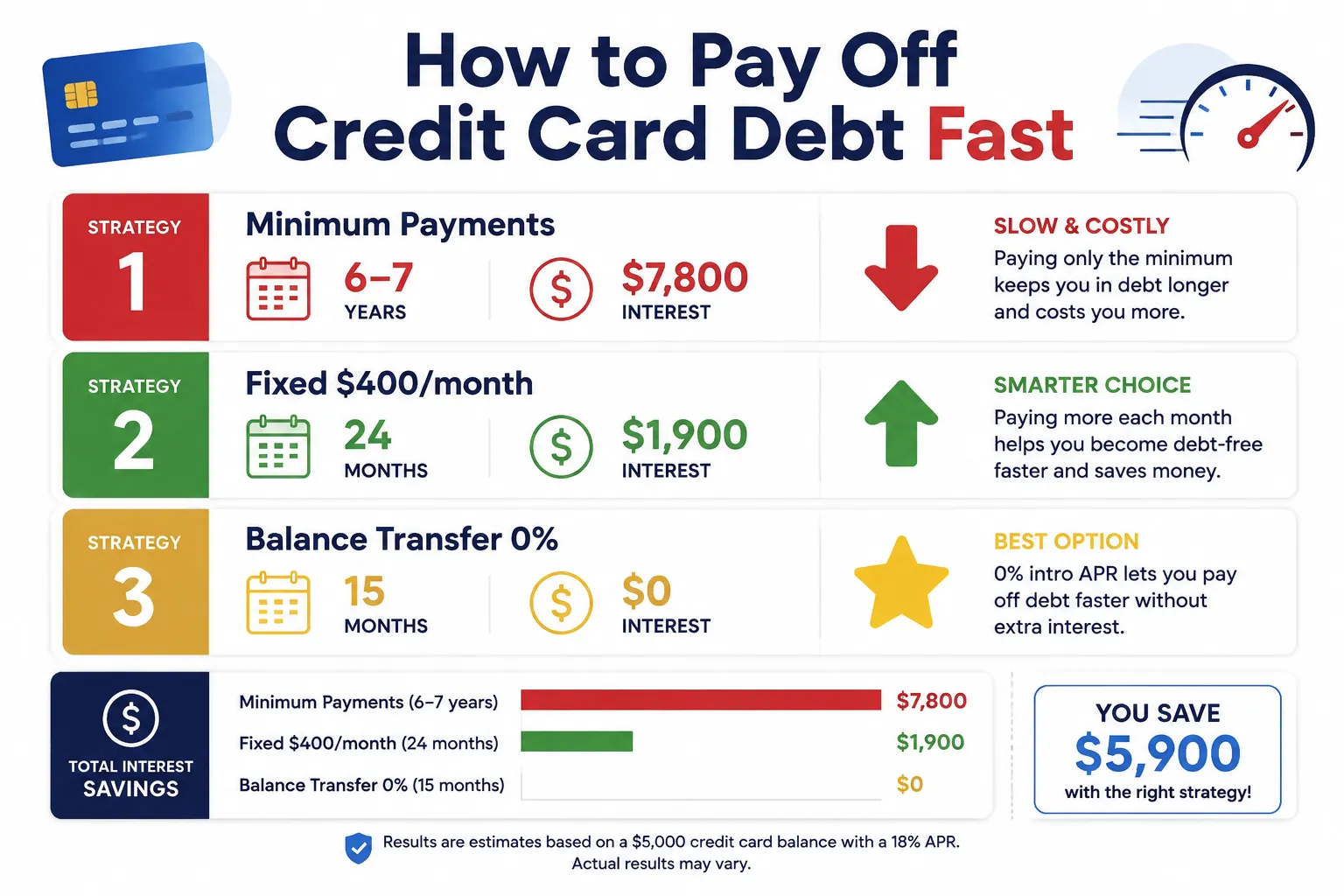
The True Cost of Paying Only the Minimum
Credit card issuers set minimum payments at roughly 1-2% of your balance, plus any accrued interest. On a $10,000 balance at 22% APR, your minimum payment starts around $200/month — and most of that goes to interest, not principal.
Here is how the math works against you:
On a $200 minimum payment, only $16.67 goes toward the principal in month one. As the balance slowly drops, the minimum shrinks too — stretching payoff over decades. At this pace:
- Time to payoff: 27 years (324 months)
- Total interest paid: $16,800
- Total amount repaid: $26,800 on a $10,000 purchase
That $16,800 in interest is money that never bought you anything — no groceries, no rent, no vacation. It is pure cost for borrowing $10,000. Every strategy below exists to escape this trap as quickly as your budget allows.
Key Insight
The gap between minimum payments and a fixed $500/month plan is staggering: 27 years and $16,800 in interest versus 24 months and $2,340. That is $14,460 saved simply by committing to a consistent, higher payment — no balance transfer or loan required.
5 Proven Strategies to Pay Off $10,000 Fast
All five scenarios start with the same $10,000 balance at 22% APR unless noted. Strategy 4 uses a three-card portfolio totaling $10,000. Compare each option against your monthly budget and how quickly you need to be debt-free.
Strategy 1: Aggressive Fixed Payment ($500/Month)
The simplest approach: pick a fixed monthly payment and never go below it, regardless of what the minimum drops to. On $10,000 at 22% APR, paying exactly $500 every month eliminates the balance in 24 months with $2,340 in total interest.
- Monthly payment: $500 (fixed, never lower)
- Months to payoff: 24
- Total interest: $2,340
- Total cost: $12,340
Month 1 breaks down as $183.33 in interest and $316.67 toward principal. By month 12, the balance sits at approximately $5,340 and monthly interest has dropped to $98 — meaning more of each $500 payment attacks principal. This strategy requires no new accounts, no credit checks, and no transfer fees. If you can spare $500/month, start here.
Strategy 2: Balance Transfer to a 0% APR Card
A 0% introductory APR balance transfer card pauses interest charges for 12-21 months, letting every dollar go toward principal. Transfer the full $10,000 to a card offering 0% for 21 months, pay a 3% transfer fee ($300), and commit to $476/month.
- Monthly payment: $476
- Months to payoff: 21
- Total interest: $0
- Transfer fee (3%): $300
- Total cost: $10,300
This is the lowest total-cost strategy on the list — $2,040 less than the aggressive fixed payment approach. The critical rule: pay off the entire balance before the 0% period expires. Any remaining balance after month 21 typically jumps to 20-25% APR retroactively on some cards. Set a calendar reminder for month 18 and confirm you are on track. You will need a credit score of roughly 670+ to qualify for the best 0% offers in 2026.
Strategy 3: Debt Consolidation Loan at 8%
A personal loan replaces high-rate credit card debt with a fixed-rate installment loan. On $10,000 borrowed at 8% over 36 months, your payment is $313/month — lower than the balance transfer — and you know exactly when you will be debt-free.
- Monthly payment: $313
- Months to payoff: 36
- Total interest: $1,272
- Total cost: $11,272
Consolidation trades speed for affordability. You pay $1,272 in interest versus $2,340 with the $500/month fixed approach, but the timeline stretches to three years. This works well if $500/month strains your budget or you want a single automatic payment instead of juggling multiple card due dates. Cut up the old cards after consolidating — 78% of people who consolidate without closing accounts run balances back up within two years.
Strategy 4: Debt Snowball (Smallest Card First)
If your $10,000 is spread across multiple cards, the debt snowball method targets the smallest balance first for quick psychological wins. Here is a realistic three-card portfolio with $500/month total available:
| Card | Balance | APR | Min Payment |
|---|---|---|---|
| Store card | $1,800 | 24.99% | $36 |
| Visa | $2,200 | 22.99% | $44 |
| Mastercard | $6,000 | 19.99% | $120 |
| Total | $10,000 | — | $200 |
Pay $200 in minimums across all three cards, then send the remaining $300 to the $1,800 store card. When the store card clears in month 6, roll its full $336 payment ($36 minimum + $300 extra) to the Visa. When Visa clears in month 13, roll everything to the Mastercard.
- Monthly payment: $500 total ($200 minimums + $300 extra)
- Months to payoff: 26
- Total interest: $2,580
- Total cost: $12,580
Snowball costs $240 more in interest than targeting the highest-rate card first (avalanche), but you eliminate the store card in month 6 and the Visa in month 13 — two visible wins before the final push. If you have abandoned debt plans before, those early zero-balance moments can be the difference between finishing and quitting.
Strategy 5: Side Income Blast (+$1,000/Month Extra)
Temporarily increasing income is the fastest way out. On $10,000 at 22% APR, paying the $200 minimum plus $1,000 in side income each month ($1,200 total) clears the balance in 11 months with approximately $980 in interest.
- Monthly payment: $1,200 ($200 minimum + $1,000 side income)
- Months to payoff: 11
- Total interest: $980
- Total cost: $10,980
Realistic side income sources for $1,000/month: freelance writing or design ($40-60/hour, 20 hours/month), rideshare or delivery driving ($800-$1,200/month part-time), tutoring ($30-50/hour), or selling unused items plus ongoing resale (eBay, Facebook Marketplace). The side income blast is not permanent — it is an 11-month sprint. Once the balance hits $0, redirect that $1,000 toward building an emergency fund so you never carry a credit card balance again.
Strategy Comparison: All 5 Options Side by Side
Use this table to match a strategy to your monthly budget and target timeline. The baseline minimum-payment row shows what happens if you do nothing differently.
| Strategy | Monthly Payment | Months to Payoff | Total Interest | Total Cost |
|---|---|---|---|---|
| Minimum payments only | ~$200 (declining) | 324 (27 years) | $16,800 | $26,800 |
| Aggressive fixed payment | $500 | 24 | $2,340 | $12,340 |
| Balance transfer (0% APR) | $476 | 21 | $0* | $10,300 |
| Debt consolidation (8%) | $313 | 36 | $1,272 | $11,272 |
| Debt snowball (3 cards) | $500 | 26 | $2,580 | $12,580 |
| Side income blast | $1,200 | 11 | $980 | $10,980 |
*Balance transfer total cost includes $300 transfer fee (3% of $10,000). All calculations assume $10,000 starting balance at 22% APR unless noted. Figures are approximate — use our calculators for your exact debts.
Case Study: Rachel, 29, $52K Salary in Denver
Her Situation
- Gross salary: $52,000/year ($3,250/month take-home)
- Total credit card debt: $10,200 across 3 cards
- Minimum payments: $204/month combined
- Available for debt payoff: $500/month total
- Rent: $1,350/month (studio apartment)
- Credit score: 712 (good — qualifies for 0% transfer)
Her 3 Cards
- Target RedCard: $1,400 at 26.99% ($28 min)
- Chase Freedom: $2,800 at 23.99% ($56 min)
- Capital One Quicksilver: $6,000 at 21.99% ($120 min)
Rachel's Analysis
Rachel ran all five strategies through the Credit Card Payoff Calculator. Minimum payments would cost her $17,136 in interest over 27 years. The $500/month fixed plan cleared debt in 25 months at $2,490 in interest. The balance transfer at $486/month ($10,200 + $306 transfer fee, spread over 21 months) cost $306 total — saving $2,184 versus the fixed payment approach.
She considered snowball for the motivational wins but the $1,400 Target card would not clear until month 7 — too slow compared to wiping everything at once via transfer. Consolidation at 8% over 36 months ($319/month) was affordable but added 15 extra months of payments compared to the transfer.
Rachel's Chosen Strategy: 0% Balance Transfer
Rachel applied for a Citi Simplicity card offering 0% APR for 21 months on balance transfers. She transferred all $10,200, paid the $306 fee (3%), and set up automatic payments of $486/month. She cut up all three original cards and removed them from her Apple Wallet to prevent new charges.
| Month | Payment | Remaining Balance | Interest Paid |
|---|---|---|---|
| Start | — | $10,506 | $0 |
| 1 | $486 | $10,020 | $0 |
| 6 | $486 | $7,596 | $0 |
| 12 | $486 | $5,172 | $0 |
| 18 | $486 | $2,748 | $0 |
| 21 | $486 | $0 | $0 |
Rachel will be debt-free in May 2028 — 21 months from her August 2026 start date. Total cost: $10,506 ($10,200 principal + $306 transfer fee). Starting in month 22, she redirects the $486/month toward a $5,000 emergency fund, reaching that goal in 10 more months.
Your Step-by-Step Plan to Pay Off $10,000
Follow these seven steps in order. Skipping step 1 or step 2 is how most payoff plans fail within the first 90 days.
List every card with balance, APR, and minimum payment
Log into each account and write down the exact numbers. Include store cards, gas cards, and any card you have not used in months. Rachel's list totaled $10,200 across three cards with $204/month in minimums.
Stop adding new charges immediately
Remove cards from your wallet and online checkout profiles. Paying $500/month toward debt while charging $300/month in new purchases is running on a treadmill. Use a debit card or cash until every balance reads $0.00.
Build a $1,000 starter emergency fund
Save $1,000 before attacking debt aggressively. Without any buffer, one $800 car repair goes right back on a credit card at 22%. This takes 2-3 months if you save $350-$500/month, then redirect the full amount to debt.
Choose your strategy from the comparison table
Match your monthly budget to a strategy. Under $350/month: consolidation loan. $400-$550/month: balance transfer or fixed payment. $1,000+/month available: side income blast. Multiple small cards and a history of quitting: snowball.
Set up automatic payments on payday
Schedule your debt payment to transfer on the same day your paycheck arrives. Rachel set $486 to auto-pay her Citi card on the 1st and 15th ($243 each). Automating removes willpower from the equation — the money leaves before you can spend it.
Track progress monthly and adjust if needed
Check your balance on the first of each month. If you receive a tax refund, bonus, or windfall, apply it directly to principal — do not treat it as spending money. A $1,200 tax refund applied in month 3 shaves two months off a 21-month balance transfer plan.
Redirect payments to savings once debt-free
When the final balance hits $0, immediately redirect your former debt payment to an emergency fund (target 3-6 months of expenses) and then toward retirement or other goals. You were living without that $486-$1,200/month — keep the habit, change the destination.
4 Mistakes That Keep You in Credit Card Debt
Missing the balance transfer deadline
A 0% transfer only works if you pay off the balance before the promotional period ends. On $10,000 remaining after month 21 at 24.99% APR, you suddenly owe $2,499/year in interest. Set calendar alerts at months 12, 18, and 20. If you are behind at month 18, increase payments or explore a second transfer.
Consolidating without closing old cards
Moving $10,000 to an 8% personal loan while keeping three credit cards open invites relapse. Those cards still have $20,000+ in combined available credit sitting there. Close them or lock them away after consolidating. One new charge at 22% undoes months of progress.
Treating side income as bonus spending money
Earning an extra $1,000/month from freelancing only works if every dollar goes to the credit card. Deposit side income directly to the card the same day it arrives. If it hits your checking account, it will get absorbed by lifestyle creep within two months.
Paying debt before building any emergency buffer
Sending 100% of savings to debt with $0 in the bank means one unexpected expense sends you right back to square one. The 2-3 months spent saving $1,000 first costs roughly $40 in extra interest — far less than a $800 relapse that adds another year to your payoff timeline.
Payoff Plan by Balance Size
Your optimal strategy depends heavily on how much you owe. A $2,000 balance calls for a different playbook than $15,000. Here is a breakdown by common balance levels, with payoff timelines at 22.9% APR unless noted.
$2,000 Balance
A $2,000 balance is the most common entry point for first-time credit card debtors — usually the result of a single unexpected expense like a car repair, medical bill, or emergency travel. At 22.9% APR, paying $100/month clears the balance in 24 months with roughly $380 in interest. That is manageable on most budgets without restructuring your entire financial life.
This balance is small enough to brute-force with disciplined fixed payments. Consolidation loans and transfer fees often cost more than they save at this level. A 0% balance transfer with a 3% fee ($60) saves about $320 in interest if you clear the balance within 12 months — but only if you actually follow through. For most people at $2,000, simply paying $100-$150/month and avoiding new charges is the fastest path to zero.
| Monthly Payment | Months to Payoff | Total Interest | Total Cost |
|---|---|---|---|
| ~$40 (minimum) | 108+ (9+ years) | ~$1,900 | ~$3,900 |
| $100 | 24 | ~$380 | ~$2,380 |
| $150 | 15 | ~$250 | ~$2,250 |
| $200 | 11 | ~$175 | ~$2,175 |
$5,000 Balance
At $5,000, credit card interest becomes genuinely expensive. Paying only the minimum (~$100/month on a $5,000 balance at 22.9% APR) stretches payoff across 19 years and costs roughly $6,800 in interest — more than the original purchase. This is the turning point where minimum payments stop being a nuisance and start being a financial emergency.
If your $5,000 is split across multiple cards, the avalanche method (highest APR first) is the most effective approach. Direct every extra dollar to the card charging the highest rate while paying minimums on the rest. At $300-$500/month total, most people clear a $5,000 portfolio in 11-20 months depending on how aggressively they pay.
| Monthly Payment | Months to Payoff | Total Interest | Total Cost |
|---|---|---|---|
| ~$100 (minimum) | 228 (19 years) | ~$6,800 | ~$11,800 |
| $200 | 32 | ~$1,390 | ~$6,390 |
| $300 | 20 | ~$855 | ~$5,855 |
| $500 | 11 | ~$460 | ~$5,460 |
$10,000 Balance
A $10,000 credit card balance sits above the national average and puts real pressure on monthly cash flow. Minimum payments of roughly $200/month at 22.9% APR take 27 years to eliminate and cost approximately $14,600 in interest. At this level, the strategies in this guide — balance transfers, consolidation loans, and aggressive fixed payments — all become worth serious consideration.
A personal loan at 10% APR over 24 months on $10,000 costs roughly $1,075 in interest ($11,075 total). The same balance on a credit card at 19.9% APR paid off over 24 months at $500/month costs about $2,614 in interest — a difference of $1,539. Consolidation makes the most sense when you need a lower fixed payment and cannot qualify for a 0% balance transfer.
| Monthly Payment | Months to Payoff | Total Interest | Total Cost |
|---|---|---|---|
| ~$200 (minimum) | 324 (27 years) | ~$14,600 | ~$24,600 |
| $300 | 44 | ~$3,155 | ~$13,155 |
| $500 | 24 | ~$1,860 | ~$11,860 |
| $800 | 14 | ~$1,030 | ~$11,030 |
$15,000 Balance
$15,000 in credit card debt creates significant financial pressure. Minimum payments of roughly $300/month at 22.9% APR stretch payoff across 30 years and cost approximately $21,000 in interest — you repay $36,000 on $15,000 borrowed. At this level, a structured plan is not optional. Hoping the balance shrinks on its own is how people end up carrying debt into retirement.
Start by calling your card issuers and requesting an APR reduction. Many will lower your rate by 2-5 percentage points if you have a history of on-time payments. If you qualify, a 0% balance transfer on a portion of the balance can save thousands — but only if you are disciplined enough to pay off the transferred amount before the promotional period ends. Combine a transfer with a fixed payment plan of $600-$900/month to clear the full balance in under three years.
| Monthly Payment | Months to Payoff | Total Interest | Total Cost |
|---|---|---|---|
| ~$300 (minimum) | 360 (30 years) | ~$21,000 | ~$36,000 |
| $400 | 53 | ~$5,960 | ~$20,960 |
| $600 | 31 | ~$3,420 | ~$18,420 |
| $900 | 19 | ~$2,050 | ~$17,050 |
Calculate Your Credit Card Payoff Plan
Every debt situation is different. Enter your exact balances, APRs, and monthly budget to see how long each strategy takes and how much interest you will pay — or save.
Frequently Asked Questions
How long does it take to pay off $10,000 in credit card debt?
It depends entirely on your monthly payment. Paying only the minimum ($200/month on a typical $10,000 balance at 22% APR) takes 27 years and costs $16,800 in interest. A fixed $500/month payment clears the debt in 24 months with $2,340 in interest. Adding $1,000/month in side income on top of minimums pays it off in 11 months. A 0% balance transfer card with $476/month eliminates it in 21 months with zero interest.
Is a balance transfer or debt consolidation loan better for $10,000?
A 0% APR balance transfer wins on total cost if you can pay off the balance before the promotional period ends. On $10,000, a 21-month 0% transfer at $476/month costs $300 in transfer fees and $0 in interest — total cost $10,300. An 8% consolidation loan over 36 months at $313/month costs $1,272 in interest — total cost $11,272. Choose balance transfer if you can commit to the higher monthly payment; choose consolidation if you need a lower, fixed payment over a longer term.
Should I use the debt snowball or avalanche method for credit cards?
For credit card debt, avalanche (highest rate first) saves the most money. On three cards totaling $10,000 with $500/month available, avalanche costs approximately $2,340 in interest over 24 months. Snowball (smallest balance first) costs about $2,580 in interest over 26 months — $240 more, but delivers faster visible wins. If you have quit debt plans before, snowball's psychological momentum may be worth the extra cost. See our full comparison in the debt avalanche vs snowball guide.
How much should I pay monthly to pay off $10,000 fast?
Aim for at least 5% of the balance per month ($500 on $10,000) to make meaningful progress. At 22% APR, $500/month pays off the debt in 24 months with $2,340 in interest. To finish in under one year, you need roughly $950-$1,200/month depending on your APR. Use our Credit Card Payoff Calculator to find the exact payment for your target date and interest rate.
Can I pay off credit card debt while saving for other goals?
Build a starter emergency fund of $1,000-$2,000 first, then redirect every extra dollar to credit card debt. Credit cards at 18-25% APR guarantee a return no savings account can match. Once credit card debt is eliminated, redirect your former payment ($500-$1,200/month) toward savings goals like a house down payment or retirement. On a $52,000 salary, becoming debt-free in 21 months frees up $476/month that previously went to credit card payments.
Related Guides
Debt Avalanche vs Snowball Method: Which Gets You Debt-Free Faster?
Compare debt avalanche and snowball methods with a real $38,000 debt portfolio. See which saves more money and which keeps you motivated to finish.
The 50/30/20 Budget Rule Explained with Real Examples
Learn the 50/30/20 budget rule with real examples at $50K, $75K, and $100K income. Includes a case study, category breakdowns, and when the rule doesn't work.