Guides / Retirement Planning
401(k) vs Roth IRA: Which Retirement Account Is Better for You?
The 401(k) vs Roth IRA debate is not about picking one winner — it is about understanding how each account taxes your money differently and which fits your current income, career trajectory, and retirement timeline. This guide breaks down the 2026 rules, runs the numbers on a real case study, and shows you the hybrid strategy most financial planners recommend.
Last updated: August 2026
TL;DR - Quick Answer
- 401(k) in 2026: Contribute up to $23,500 pre-tax; employer match is free money you should never leave on the table
- Roth IRA in 2026: Contribute up to $7,000 after-tax; all qualified withdrawals are tax-free in retirement
- 401(k) wins when: You are in a high tax bracket now, your employer offers a match, or you earn above Roth income limits ($161K single / $240K married)
- Roth wins when: You are early in your career in a lower bracket, expect higher taxes in retirement, or want tax diversification and penalty-free access to contributions
- Best strategy for most people: Get the full 401(k) match, max the Roth IRA, then fill remaining capacity in the 401(k)
Model your retirement with our Retirement Calculator, Compound Interest Calculator, and Income Tax Calculator.
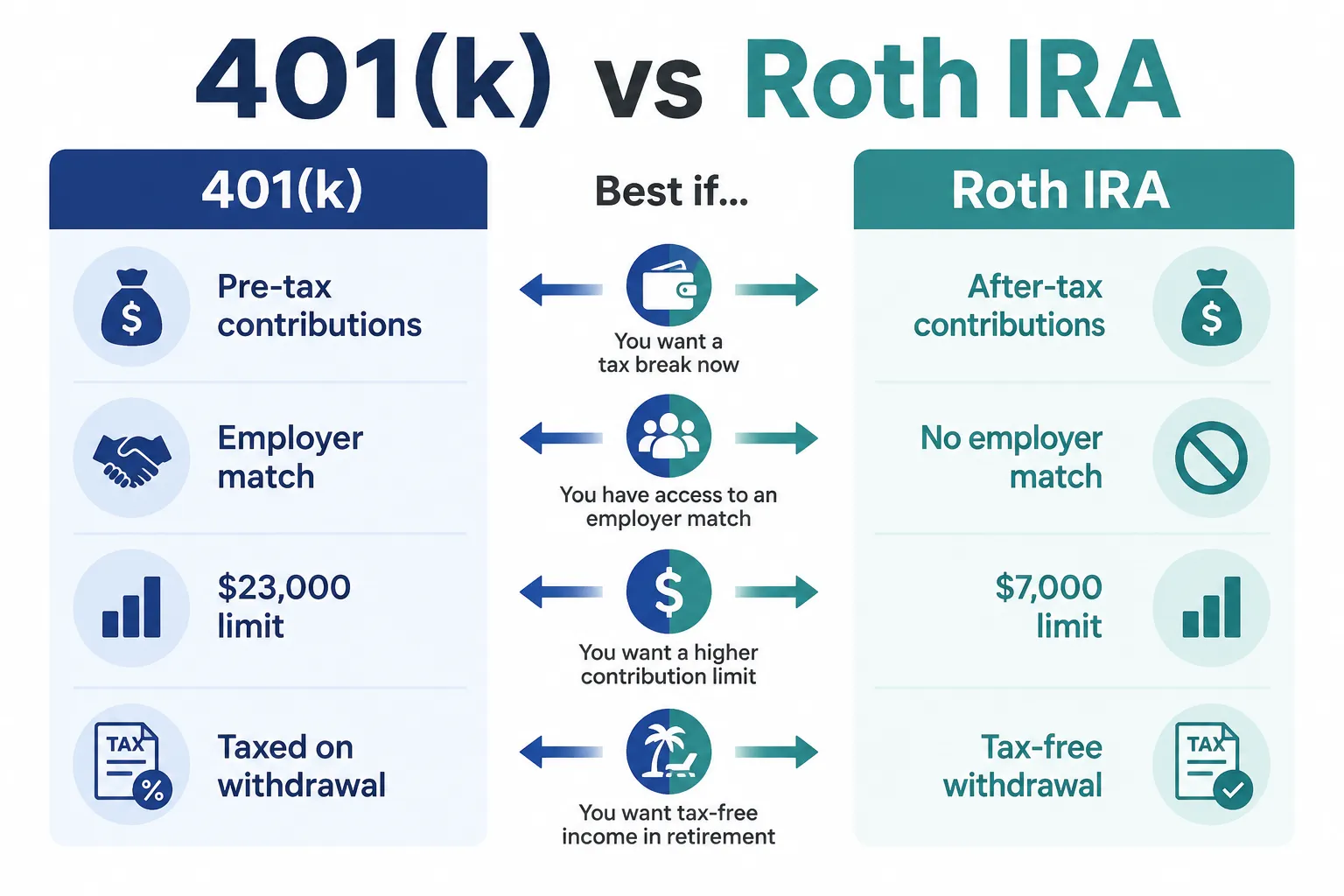
Key Differences: Pre-Tax vs After-Tax
The fundamental split between a 401(k) and a Roth IRA comes down to when you pay taxes. A traditional 401(k) reduces your taxable income today — you contribute pre-tax dollars, investments grow tax-deferred, and you pay ordinary income tax on every dollar you withdraw in retirement. A Roth IRA flips that timeline: you contribute after-tax dollars now, investments grow tax-free, and qualified withdrawals in retirement are completely tax-free.
That timing difference sounds abstract until you put real numbers on it. A $23,500 contribution to a traditional 401(k) for someone in the 22% federal bracket saves $5,170 in taxes this year. The same person putting $7,000 into a Roth IRA gets no deduction — but every dollar of growth over the next 30 years comes out untaxed.
2026 Contribution Limits
The IRS sets separate limits for each account type. These limits apply to your employee contributions — employer matching dollars do not count against your personal cap.
401(k)
$23,500
Employee contribution limit. Workers age 50+ can add a $7,500 catch-up contribution for a total of $31,000.
Roth IRA
$7,000
Combined limit for Roth and traditional IRA contributions. Age 50+ catch-up adds $1,000 for a total of $8,000.
Combined, a worker under 50 can funnel up to $30,500 per year into tax-advantaged retirement accounts — plus whatever employer match their company adds on top. That is a meaningful gap from the Roth IRA alone, which is one reason the 401(k) remains the primary retirement vehicle for most Americans.
401(k) vs Roth IRA: Full Comparison
Use this table as a quick reference when deciding where to allocate your next retirement dollar. The right column is not always better — context determines the winner.
| Feature | 401(k) (Traditional) | Roth IRA |
|---|---|---|
| Contribution limit (2026) | $23,500 ($31,000 age 50+) | $7,000 ($8,000 age 50+) |
| Tax treatment | Pre-tax in, taxed on withdrawal | After-tax in, tax-free out |
| Employer match | Yes — often 50-100% of first 3-6% | No employer involvement |
| Income limits | None for participation | Phase-out above $161K single / $240K married |
| Withdrawal rules | Penalty before age 59½ (10% + taxes) | Contributions anytime; earnings after 59½ + 5-year rule |
| Required minimum distributions | Yes — starting at age 73 | No RMDs during owner's lifetime |
| Investment options | Limited to plan menu (often 15-30 funds) | Full brokerage choice (stocks, ETFs, bonds) |
| Loans | Some plans allow 401(k) loans | No loan provision |
When a 401(k) Wins
A traditional 401(k) is the better choice in several specific situations. If any of these describe you, prioritize maxing your 401(k) before directing extra dollars to a Roth IRA.
You Are in a High Tax Bracket Now
If you are earning $150,000+ and sitting in the 24-32% federal bracket, every pre-tax 401(k) dollar saves you $2,400-$3,200 in immediate taxes. If you expect to retire into a lower bracket — drawing $80,000/year from a paid-off home in a no-income-tax state puts you in the 12-22% range — you are effectively prepaying taxes at a higher rate by choosing Roth over traditional. The 401(k) lets you defer that bill.
Your Employer Offers a Match
Employer matching is the single highest-return investment available to most workers. A typical match — 50% of contributions up to 6% of salary — on a $95,000 income adds $2,850 per year in free money. That is an instant 50% return before any market growth. No Roth IRA contribution can replicate that. Always contribute at least enough to capture the full match before funding a Roth IRA.
The Match Math
On a $95,000 salary with a 50% match up to 6%: contributing 6% ($5,700) triggers a $2,850 employer deposit. Over 30 years at 7% average return, that match alone grows to approximately $287,000 — money you never would have had without the 401(k).
You Earn Above Roth IRA Income Limits
In 2026, direct Roth IRA contributions phase out for single filers with modified adjusted gross income above $161,000 and married couples above $240,000. If you are above those thresholds, a Roth IRA is not an option without a backdoor conversion strategy. Your 401(k) becomes the primary tax-advantaged account by default — and its $23,500 limit is more than three times the Roth cap anyway.
You Need the Higher Contribution Ceiling
Aggressive savers who want to put away more than $7,000 per year in tax-advantaged accounts have no choice but the 401(k). Pair it with an HSA ($4,300 individual / $8,550 family in 2026) and you can shelter up to $32,050 per year before touching taxable accounts.
When a Roth IRA Wins
Roth accounts shine in the opposite scenarios — lower income today, higher expected taxes tomorrow, and when flexibility matters as much as raw contribution limits.
Early Career, Lower Tax Bracket
A 28-year-old earning $55,000 sits in the 12% federal bracket. Paying 12% tax on Roth contributions now — when they are likely at their lifetime tax low — is far cheaper than paying 22-24% on traditional 401(k) withdrawals decades later. Every year you are in the 12-22% bracket is a Roth opportunity. The tax you pay today is the lowest rate you will ever lock in on that money.
You Expect Higher Taxes in Retirement
If you believe tax rates will rise — due to national debt, policy changes, or your own income growth — paying taxes now at today's rates is a hedge. A $7,000 Roth contribution today that grows to $56,000 over 30 years at 7% comes out entirely tax-free. The same growth in a traditional 401(k) would trigger roughly $12,320-$18,480 in federal taxes on withdrawal, depending on your retirement bracket.
Tax Diversification
Retirees with only traditional 401(k) balances face a tax bill on every withdrawal — including Social Security, which becomes partially taxable once other income exceeds thresholds. A Roth IRA balance gives you a tax-free bucket to draw from strategically. You can pull Roth money to stay below a tax bracket threshold, reduce Medicare IRMAA surcharges, or qualify for ACA premium subsidies during early retirement before Medicare at 65.
Flexibility and No RMDs
Roth IRA contributions (not earnings) can be withdrawn at any time without penalty. And unlike a 401(k), there are no required minimum distributions — you can let a Roth compound untouched and pass it to heirs tax-free.
Case Study: Priya, 32, Product Manager in Austin
Priya earns $95,000 as a product manager at a tech company in Austin, Texas. Texas has no state income tax, so her federal bracket (22% marginal, roughly 14% effective) drives the analysis. Her employer matches 50% of contributions up to 6% of salary. She has $44,000 in her 401(k) and $9,000 in a Roth IRA, and she can allocate $1,625 per month ($19,500/year) toward retirement beyond the match.
Current Situation
- Age: 32 (target retirement: 62)
- Salary: $95,000/year
- 401(k) balance: $44,000
- Roth IRA balance: $9,000
- Employer match: 50% up to 6% ($2,850/year at full match)
- Available for retirement savings: $19,500/year + match
- Assumed return: 7% average annual
Two Strategies Compared
- Strategy A (401(k)-heavy): $19,500 to 401(k) + $2,850 match = $22,350/year pre-tax
- Strategy B (Hybrid): $5,700 to 401(k) (match) + $7,000 Roth IRA + $6,800 to 401(k) + $2,850 match = $22,350/year total
30-Year Projection: Strategy A (401(k)-Heavy)
- Existing $44,000 growing at 7% for 30 years: $44,000 x 1.07^30 = $335,073
- $22,350/year invested for 30 years at 7%: approximately $2,247,000 in total contributions + growth
- Total pre-tax balance at 62: ~$2,582,073
- Estimated taxes on withdrawal at 18% effective rate: ~$464,773
- After-tax spendable amount: ~$2,117,300
30-Year Projection: Strategy B (Hybrid with Roth IRA)
- Existing 401(k) $44,000 + Roth $9,000 = $53,000 growing at 7% for 30 years: $53,000 x 1.07^30 = $403,495
- $15,350/year to 401(k) (including match) for 30 years at 7%: approximately $1,543,000
- $7,000/year to Roth IRA for 30 years at 7%: approximately $703,000 (all tax-free)
- Total balance at 62: ~$2,649,495
- Roth portion ($703,000 + growth on $9,000): ~$820,000 completely tax-free
- 401(k) portion after 18% effective tax: ~$1,505,000 spendable
- After-tax spendable amount: ~$2,325,000
What Priya Should Do
Strategy B leaves Priya with roughly $207,700 more in after-tax retirement wealth over 30 years — not because Roth magically earns more, but because she pays 22% tax on $7,000 now while she is in a moderate bracket, rather than paying a potentially higher rate on a much larger withdrawal decades later. The hybrid approach also gives her a $820,000 tax-free bucket for flexible withdrawals, ACA subsidy management if she retires before 65, and no RMDs on the Roth portion. At her income level, Strategy B is the clear winner — but the 401(k) match remains non-negotiable in either scenario.
The Hybrid Strategy Most Experts Recommend
For the majority of workers, the answer to 401(k) vs Roth IRA is not either/or — it is a sequenced approach that captures the best features of both accounts. Follow this priority order with every paycheck:
Get the full 401(k) employer match
Contribute at least enough to trigger 100% of your employer match. On a $95,000 salary with a 50% match up to 6%, that means contributing $5,700 to receive $2,850 in free money. This step is non-negotiable regardless of your tax bracket or age.
Max your Roth IRA ($7,000 in 2026)
If your income is below the Roth limits ($161,000 single / $240,000 married), fund the full $7,000 Roth IRA next. You gain tax-free growth, flexible contribution access, and no RMDs. Open the account at a low-cost brokerage with broad index fund options.
Return to your 401(k) and max it out
After the match and Roth IRA are funded, direct remaining retirement savings back to your 401(k) until you hit the $23,500 limit. If you already contributed $5,700 for the match, you have $17,800 of remaining 401(k) capacity. This maximizes your total tax-advantaged savings at $30,500 per year.
Overflow into taxable brokerage or HSA
If you still have surplus savings after maxing both accounts, fund an HSA if you have a qualifying high-deductible health plan ($4,300 individual / $8,550 family in 2026), then invest in a taxable brokerage with low-cost index funds. Taxable accounts provide the bridge for early retirement before age 59½.
Annual Savings Checklist
For a single filer earning $95,000 with a 50% match up to 6%: $5,700 (401k match) + $7,000 (Roth IRA) + $17,800 (remaining 401k) = $30,500 personal contributions + $2,850 employer match. At 7% over 30 years, that totals roughly $3.4 million before taxes.
How Your Tax Bracket Should Drive the Decision
The entire 401(k) vs Roth IRA calculation hinges on one comparison: your marginal tax rate today versus your expected marginal rate in retirement. When today's rate is higher, choose traditional. When tomorrow's rate is expected to be higher, choose Roth.
| Current Marginal Rate | Recommended Priority | Why |
|---|---|---|
| 10-12% | Roth IRA first | Lock in the lowest rate you will ever pay |
| 22-24% | Hybrid (both) | Tax diversification; rates may rise by retirement |
| 32%+ | 401(k) first | Large immediate deduction; likely lower rate in retirement |
| Above Roth limits | 401(k) + backdoor Roth | Direct Roth unavailable; max 401(k) then convert |
Use our Income Tax Calculator to estimate your marginal rate and compare it to your expected retirement rate. If the gap is 5+ points, lean toward the lower-rate account.
Run Your Retirement Numbers
Compare 401(k) and Roth IRA growth side by side with your actual salary, contribution rate, and employer match. See how tax treatment changes your spendable balance at retirement.
Frequently Asked Questions
Should I contribute to a 401(k) or Roth IRA first?
Contribute enough to your 401(k) to capture your full employer match first — that is an immediate 50-100% return. Then max a Roth IRA ($7,000 in 2026) if your income is below the limits ($161,000 single / $240,000 married filing jointly). After that, return to your 401(k) and contribute up to the $23,500 limit. This hybrid approach captures free employer money, builds tax-free Roth assets, and maximizes total tax-advantaged savings.
Can I have both a 401(k) and a Roth IRA?
Yes, and most people should. A 401(k) and Roth IRA are separate accounts with separate contribution limits. In 2026 you can contribute up to $23,500 to a 401(k) and $7,000 to a Roth IRA — $30,500 total — as long as your income is below the Roth IRA phase-out thresholds. Having both gives you tax diversification: pre-tax 401(k) withdrawals and tax-free Roth withdrawals in retirement.
Is a Roth IRA better than a 401(k) for taxes?
It depends on your current versus expected future tax rate. A traditional 401(k) saves taxes now but you pay ordinary income tax on withdrawals. A Roth IRA offers no deduction now but all qualified withdrawals are tax-free. If you are in a low tax bracket early in your career (12-22%), Roth often wins. If you are in a high bracket now (32%+) and expect a lower bracket in retirement, the traditional 401(k) usually wins.
What happens if I earn too much for a Roth IRA?
In 2026, Roth IRA contributions phase out for single filers with modified adjusted gross income between $161,000 and $176,000, and for married couples filing jointly between $240,000 and $250,000. Above those ranges, direct Roth contributions are not allowed. High earners can use a backdoor Roth IRA (contribute to a traditional IRA, then convert to Roth), though the pro-rata rule applies if you hold existing traditional IRA balances.
Does a Roth IRA have required minimum distributions (RMDs)?
No. Roth IRAs have no RMDs during the original account owner's lifetime, which makes them powerful estate planning tools. Traditional 401(k) accounts require RMDs starting at age 73 under current law (SECURE 2.0). Roth 401(k) accounts also had RMDs, but starting in 2024 Roth 401(k) balances are exempt from RMDs — though rolling to a Roth IRA remains a common strategy for flexibility.
Related Guides
How Much Do I Need to Retire at 55? A Complete Breakdown
Find out how much you need to retire at 55. Covers the 4% rule, healthcare costs before Medicare, portfolio targets by lifestyle, and a step-by-step plan.
How to Start Investing with $1,000: A Beginner's Step-by-Step Guide
Start investing with just $1,000. Learn which account to open, what to buy (VTI, VOO, VTSAX), and how $100/month grows to six figures over time.