Guides / Retirement Planning
How Much Do I Need to Retire at 55? A Complete Breakdown
Retiring at 55 sounds like freedom — but it requires a portfolio large enough to cover 30-40 years of expenses, a decade of healthcare before Medicare kicks in, and a withdrawal strategy that avoids early withdrawal penalties. This guide gives you the exact numbers, a real case study, and a step-by-step plan to get there.
Last updated: October 2026
TL;DR - Quick Answer
- Most people need: $1.5 million - $2.5 million to retire at 55 comfortably
- The 4% rule: Withdraw 4% of your portfolio annually ($80,000/year from a $2 million portfolio)
- Healthcare gap: Budget an extra $350,000-$550,000 for the 10 years before Medicare at 65 (costs rose after enhanced ACA credits expired)
- Conservative target: Use 3.5% withdrawal rate for a 35-40 year retirement horizon
Run your numbers with our Retirement Calculator, FIRE Calculator, and Compound Interest Calculator.
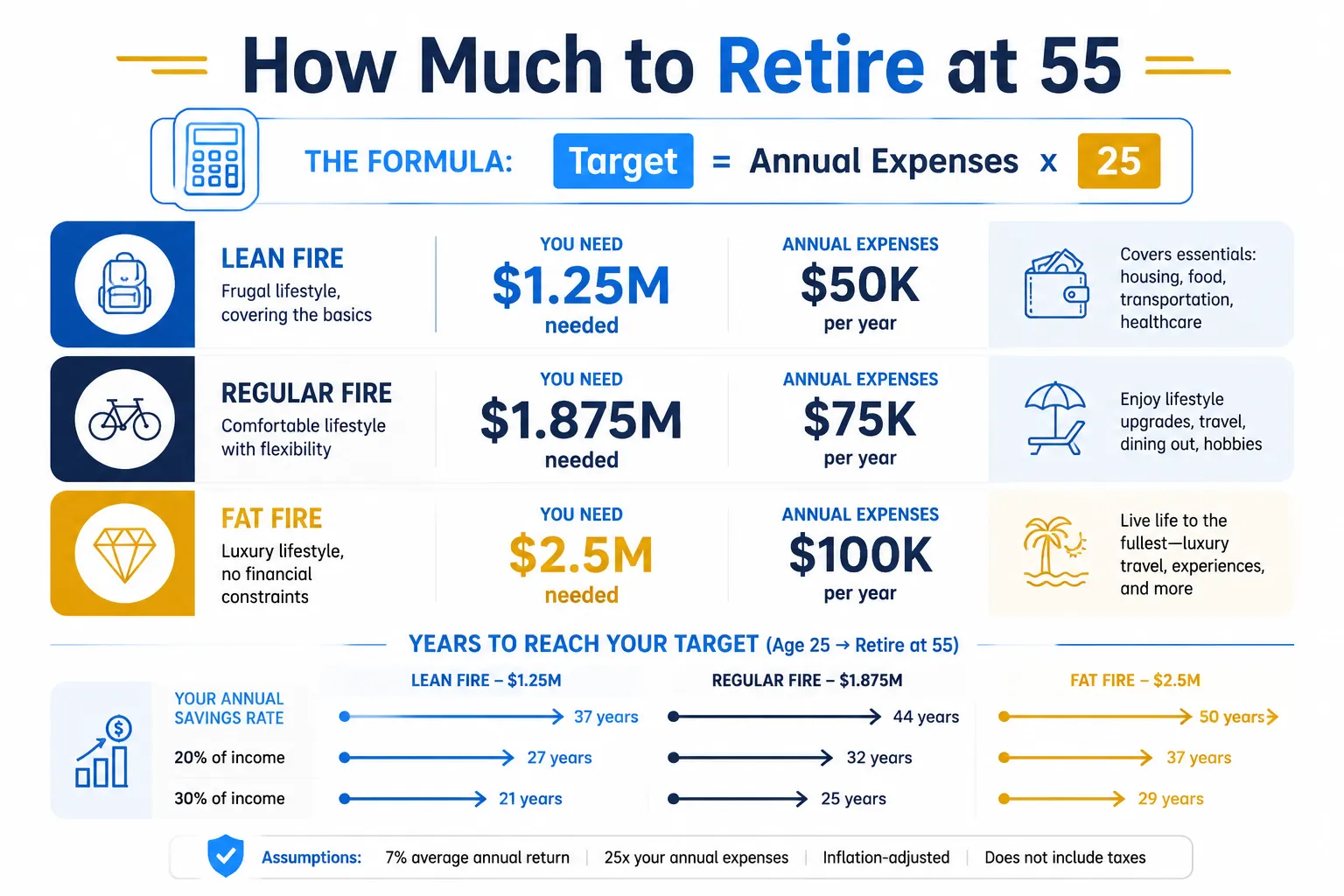
The Math Behind Retiring at 55
Every retirement number starts with one question: how much will you spend each year? Once you know that, you can work backward to the portfolio size you need. The most widely cited framework is the 4% rule — but retiring at 55 requires adjustments that most standard retirement advice ignores.
The 4% Rule Explained
The 4% rule says you can withdraw 4% of your portfolio in the first year of retirement, then adjust for inflation each year, with a high probability your money lasts 30 years. The formula is simple:
Example: $80,000/year spending → $80,000 / 0.04 = $2,000,000
This rule comes from the Trinity Study, which tested withdrawal rates against historical US stock and bond returns. A 4% withdrawal rate succeeded 95%+ of the time over 30-year periods. The key word is 30 years.
Why 55 Means a 30-40 Year Horizon
Retire at 65 and you need your money to last roughly 25-30 years. Retire at 55 and you are planning for 35-40 years — possibly longer if you have longevity in your family. Every additional year of retirement increases the risk of a bad sequence of returns (a market crash early in retirement) depleting your portfolio.
The practical adjustment: use a 3.25-3.5% withdrawal rate instead of 4%. That changes the math significantly:
| Annual Spending | At 4% Rule | At 3.5% Rule (Safer) |
|---|---|---|
| $50,000 | $1,250,000 | $1,428,571 |
| $80,000 | $2,000,000 | $2,285,714 |
| $120,000 | $3,000,000 | $3,428,571 |
The Healthcare Gap Before Medicare
Medicare eligibility begins at 65. Retire at 55 and you are on your own for a full decade of health insurance — the single biggest financial wildcard for early retirees. Employer-sponsored coverage disappears, and with the expiration of enhanced ACA premium tax credits, unsubsidized marketplace premiums for someone in their late 50s now run $681-$1,325 per month depending on age and state, with the national average for a 60-year-old at $822/month for a standard Silver plan (2026 InsuranceCostGuide data).
The 10-Year Penalty (2026 Update)
At an average of $850/month for a single early retiree (ages 55-64 blended average), the 10-year gap before Medicare costs roughly $102,000 in premiums alone for an unsubsidized Silver plan — and significantly more for couples or in high-cost states. Add deductibles, copays, dental, and vision and the total easily reaches $150,000-$200,000. Capitalize that at 3.5% and you need an additional $430,000-$570,000 in your portfolio just for healthcare. After the enhanced ACA credits expired, this figure jumped roughly 26% compared to 2025 estimates.
Required Portfolio by Lifestyle Level
The table below shows total portfolio targets for three common retirement lifestyles. Figures include a healthcare reserve for ages 55-64 and use a 3.5% withdrawal rate for the longer retirement horizon.
| Lifestyle | Annual Spending | Base Portfolio (3.5%) | Healthcare Reserve | Total Target |
|---|---|---|---|---|
| Modest | $50,000/yr | $1,428,571 | $430,000 | $1,858,571 |
| Comfortable | $80,000/yr | $2,285,714 | $500,000 | $2,785,714 |
| Affluent | $120,000/yr | $3,428,571 | $570,000 | $3,998,571 |
*Modest lifestyle assumes paid-off housing in a lower cost-of-living area. Comfortable includes travel and dining out. Affluent assumes maintaining a higher standard of living, potentially in a major metro. Healthcare reserve reflects 2026 post-enhanced-credit ACA premiums ($681-$1,325/month depending on age) plus out-of-pocket costs for 10 years, capitalized at 3.5%.
What Each Lifestyle Looks Like in Practice
A modest $50,000/year budget might include a $1,800/month mortgage-free housing cost, $600/month for groceries and dining, $500/month for transportation, $400/month for healthcare (post-Medicare), and $700/month for everything else. This works well in cities like Pittsburgh, Indianapolis, or Raleigh — less so in San Francisco or New York.
A comfortable $80,000/year budget adds international travel ($8,000/year), a newer car replacement fund, higher dining and entertainment spending, and a buffer for home maintenance. This is the target most dual-income professionals aim for.
An affluent $120,000/year budget supports maintaining your pre-retirement lifestyle: premium healthcare, multiple trips per year, helping adult children, and living in a higher cost-of-living area without downsizing.
Case Study: Robert, 42, Software Engineer in Seattle
Current Situation
- Age: 42 (target retirement: 55)
- Salary: $165,000/year
- 401(k) balance: $198,000
- Roth IRA: $52,000
- Taxable brokerage: $45,000
- Total invested: $295,000
- Monthly savings: $3,500 ($2,042 401k + $625 Roth + $833 taxable)
- Mortgage: $2,800/month (12 years remaining)
Retirement Target
- Desired spending: $85,000/year (comfortable, mortgage-free)
- Portfolio needed (3.5% rule): $2,428,571
- Healthcare reserve (10 years): $500,000
- Total target: $2,928,571
- Years until 55: 13
- Assumed return: 7% average annual
Projection at Current Pace
- $295,000 growing at 7% for 13 years: $295,000 x 1.07^13 = $708,847
- $3,500/month ($42,000/year) invested for 13 years at 7%: ~$884,000 in contributions + growth
- Projected portfolio at 55: ~$1,592,847
- Mortgage paid off by 54, freeing $2,800/month ($33,600/year)
Gap Analysis
Robert's projected $1,592,847 falls short of his $2,928,571 target by $1,335,724. At 3.5% withdrawal, his projected portfolio would generate $55,750/year — enough for a modest lifestyle but $29,250 short of his $85,000 comfort target. The gap is wider than in prior years primarily because the healthcare reserve increased to $500,000 following the 2026 expiration of enhanced ACA premium tax credits. Even accounting for the mortgage payoff reducing his spending need to roughly $51,400/year ($85,000 - $33,600), he would still need ~$1,468,571 — leaving a gap of roughly $1,335,724 when healthcare is included.
Robert's Action Plan
- 1. Increase savings to $5,200/month — redirect the $2,800 mortgage payment after payoff plus boost contributions now. This closes the gap to within $400,000.
- 2. Build a taxable bridge account — target $350,000 in taxable index funds by 55 to fund ages 55-59½ without touching 401(k) or IRA (avoiding the 10% early withdrawal penalty).
- 3. Start a Roth conversion ladder at 50 — convert $40,000/year from traditional IRA to Roth for 5 years, creating penalty-free access to converted principal after the 5-year seasoning period.
- 4. Consider a partial retirement at 55 — consulting 2 days/week at $200/hour ($1,600/week, ~$80,000/year) covers healthcare and reduces portfolio withdrawals to near zero for the first 5 years.
- 5. Evaluate relocating at 55 — moving from Seattle to a lower cost-of-living area like Boise or Phoenix could cut annual spending from $85,000 to $65,000, reducing the target portfolio by $571,428.
Healthcare: The Biggest Wildcard for Early Retirees
If you retire at 65, Medicare handles most of your healthcare costs. Retire at 55 and you enter the most expensive decade of private health insurance — premiums spike in your late 50s, and you have no employer subsidy to soften the blow.
| Age Range | Monthly Premium (Individual) | Annual Total (Premiums + Out-of-Pocket) |
|---|---|---|
| 55-59 | $681 - $939 (unsubsidized Silver) | $10,200 - $16,000 |
| 60-64 | $822 - $1,325 (unsubsidized Silver) | $13,000 - $20,000 |
| 60 (KFF benchmark) | $1,326 (benchmark Silver, national avg.) | $15,914 (premiums only) |
| 65+ (Medicare) | $185 - $560 (Part B + D + Medigap) | $4,500 - $8,000 |
For a couple retiring at 55, double the individual estimates. A 57-year-old couple on a Silver-tier ACA plan in 2026 typically pays $2,400-$3,200/month ($28,800-$38,400/year) without subsidies — a significant jump from prior years after the enhanced premium tax credits expired at the end of 2025 (KFF reports unsubsidized premiums rose roughly 26% in 2026). ACA premium tax credits phase out entirely at 400% of the federal poverty level — $62,600 for a single filer and $128,600 for a family of four in 2026. Exceed that threshold by even $1 and subsidies vanish completely (it is a cliff, not a gradual phase-out).
Strategy: Manage Your MAGI
Early retirees often live off taxable brokerage accounts and Roth contributions (which do not count as income) to keep Modified Adjusted Gross Income below the 400% FPL cliff ($62,600 single / $128,600 family in 2026). Staying below this threshold can save $12,000-$20,000 per year in healthcare costs — which, capitalized at 3.5%, represents $343,000-$571,000 in portfolio value. HSA contributions ($5,400 for singles 55+ in 2026) also reduce MAGI, potentially pushing you back under the cliff.
Step-by-Step Plan to Retire at 55
Calculate your exact retirement number
Track every dollar you spend for 3 months. Multiply by 12, add 10-15% buffer, then divide by 0.035 (conservative withdrawal rate). Add $360,000-$450,000 for healthcare. That is your target. A $75,000/year spender needs roughly $2,500,000 total.
Maximize tax-advantaged accounts
In 2026, contribute the maximum to your 401(k) ($24,500, or $32,500 with the $8,000 age-50+ catch-up — and $35,750 if you are ages 60-63 under the new SECURE 2.0 super catch-up), Roth or traditional IRA ($7,500, or $8,600 with catch-up), and HSA if eligible ($4,400 individual / $8,750 family, plus $1,000 catch-up at 55+). Capture every dollar of employer match — it is an instant 50-100% return. For someone over 50 with family HSA coverage, these three accounts alone allow up to $50,850/year in tax-advantaged savings.
Build a taxable bridge account
You cannot access 401(k) or IRA funds without penalty until 59½ (with limited exceptions). Fund a taxable brokerage with low-cost index funds — this is your spending money for ages 55-59½. Target 4-5 years of expenses: $80,000/year x 5 = $400,000 in taxable accounts.
Set up a Roth conversion ladder
Starting 5 years before retirement, convert $40,000-$50,000/year from traditional IRA/401(k) to Roth IRA. Pay taxes at your current (lower) rate. After 5 years, each conversion's principal becomes available for penalty-free withdrawal. This bridges the gap between your taxable account depletion and age 59½.
Plan your healthcare strategy
Research ACA plans in your state — note that 2026 premiums rose sharply after the enhanced premium tax credits expired. If retiring before 55, consider COBRA (18 months of employer coverage, typically $600-$700/month for individuals). Structure withdrawals to keep MAGI below $62,600 (single) or $128,600 (family of four) — the 2026 400% FPL subsidy cliff. Budget $700-$1,400/month for ages 55-64 depending on age and state. An HSA-eligible HDHP can also reduce MAGI via deductible HSA contributions ($5,400 for singles 55+ in 2026).
Run annual projections and adjust
Every year, recalculate your projected portfolio at 55 using actual returns and savings. If you are behind, increase savings or push the target date by 1-2 years. If ahead, consider reducing risk by shifting 5-10% from stocks to bonds. Use our Compound Interest Calculator to model different scenarios.
Calculate Your Retirement Number
Stop guessing. Plug in your current savings, monthly contributions, and target retirement age to see exactly where you stand and what it takes to retire at 55.
Frequently Asked Questions
How much money do I need to retire at 55?
Most people need a portfolio of $1.5 million to $2.5 million to retire at 55, depending on annual spending. Using the 4% rule, $50,000/year requires $1.25 million, $80,000/year requires $2 million, and $120,000/year requires $3 million — but early retirees should add $350,000-$550,000 for the 10-year healthcare gap before Medicare at 65. Following the expiration of ACA enhanced premium tax credits at the end of 2025, unsubsidized marketplace premiums for 55-64 year-olds rose roughly 26% in 2026, making healthcare budgeting even more critical.
Can I retire at 55 and still access my 401(k)?
Not without penalties before age 59½, unless you use Rule of 55 (if you leave your employer at 55+) or SEPP/72(t) distributions. Most early retirees fund ages 55-59½ from taxable brokerage accounts and Roth conversion ladders, keeping 401(k) and traditional IRA assets for later years when penalty-free withdrawals are available.
Is the 4% rule safe for a 40-year retirement?
The classic 4% rule was designed for a 30-year retirement and Morningstar's 2026 research now pegs even the 30-year safe rate at 3.9%. Retiring at 55 with a 35-40 year horizon calls for a more conservative 3.25-3.5% withdrawal rate — historical simulations show a 4% rate fails roughly 15-25% of the time over 40 years. A $2 million portfolio at 3.5% yields $70,000/year — safer than $80,000 at 4%. Using Guyton-Klinger guardrails (adjusting spending based on portfolio performance) can raise the safe initial rate by 0.5-1.0%, giving early retirees more spending flexibility without increasing failure risk.
How much does health insurance cost if I retire before 65?
Following the expiration of enhanced ACA premium tax credits in 2026, unsubsidized marketplace premiums for early retirees rose sharply. A 55-year-old now pays roughly $681/month for a Silver plan, rising to $939/month at age 64 — and a 60-year-old averages $822/month before subsidies (InsuranceCostGuide, 2026 data). A couple in their late 50s often pays $1,400-$2,200/month unsubsidized. Budget $160,000-$250,000 total for the 10-year gap until Medicare at 65, depending on subsidy eligibility.
What is the fastest way to reach a $2 million retirement portfolio?
Maximize tax-advantaged accounts first: 401(k) ($24,500/year in 2026, or $32,500 with age-50+ catch-up), IRA ($7,500/year, or $8,600 with catch-up), and HSA ($4,400 individual / $8,750 family, plus $1,000 catch-up at 55+). These three accounts alone allow up to $46,500/year in tax-advantaged savings for someone over 50. Then pour surplus into taxable index funds. At a 7% average return, saving $3,500/month from a $400,000 starting balance reaches $2 million in roughly 12-13 years. Use our Compound Interest Calculator to model your exact timeline.
Related Guides
401(k) vs Roth IRA: Which Retirement Account Is Better for You?
Compare 401(k) vs Roth IRA: contribution limits, tax treatment, income limits, and when each wins. Includes a case study and the optimal hybrid strategy.
Compound Interest: 5 Real-Life Examples That Show Its Power
See compound interest in action with 5 real examples: $500/month for 40 years, credit card debt traps, student loans, and the Rule of 72 explained.