Guides / Investing Basics
Compound Interest: 5 Real-Life Examples That Show Its Power
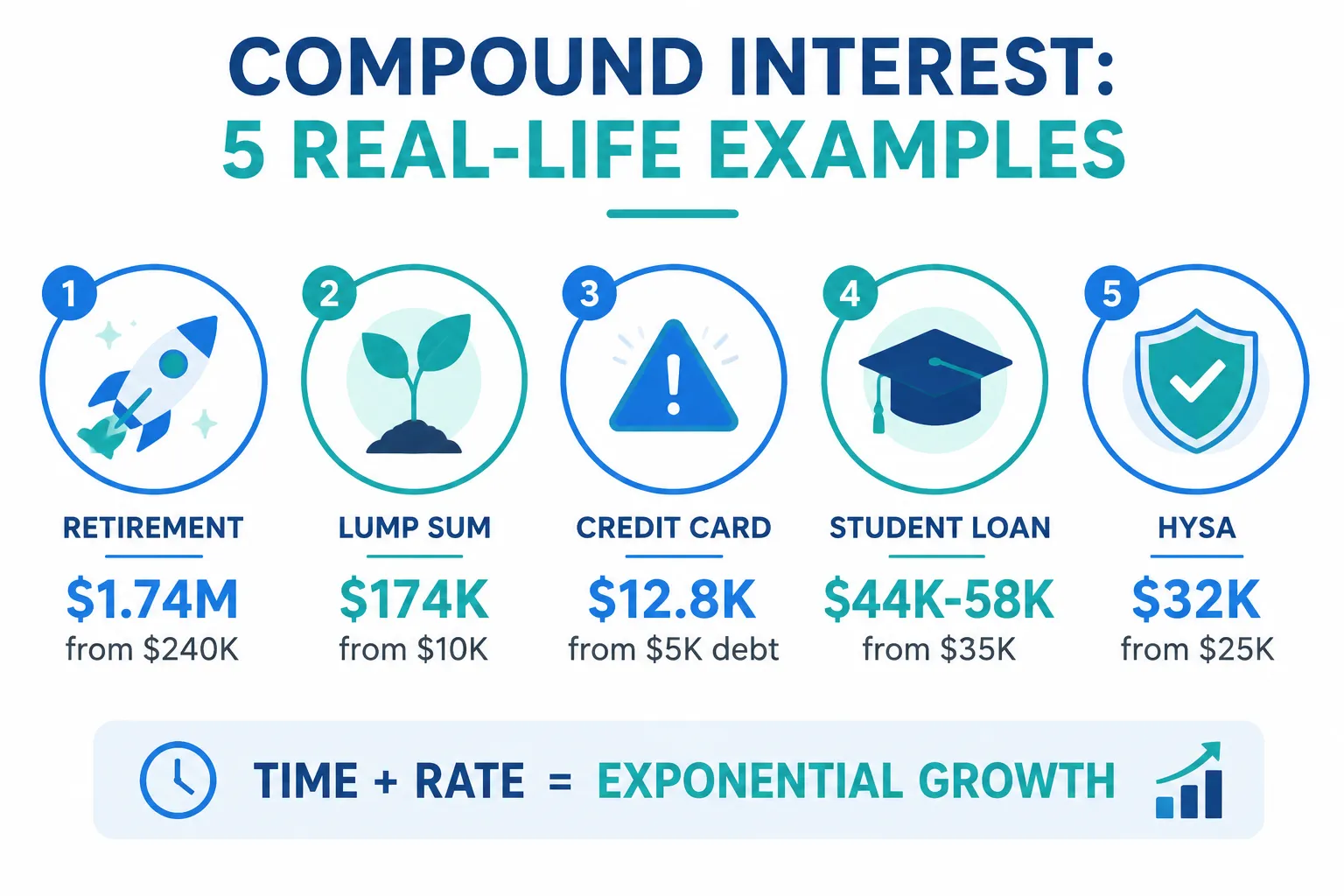
Compound interest is the reason a modest monthly contribution can turn into a seven-figure retirement account — and the reason a $5,000 credit card balance can cost you nearly $13,000. These five compound interest examples from real life show exactly how the math plays out with specific dollar amounts, so you can see where compounding helps you and where it works against you.
Last updated: August 2026
TL;DR - Quick Answer
- Retirement: $500/month from age 25 to 65 at 8% grows to $1.74 million on $240,000 contributed
- Lump sum: $10,000 invested once at 10% for 30 years becomes $174,494
- Credit card debt: $5,000 at 22% with minimum payments costs $12,800 total — compound interest in reverse
- Student loans: Repayment plan choice changes total interest from $8,964 to $22,850 on the same $35,000 balance
- High-yield savings: $25,000 at 5% APY for 5 years grows to $32,010 with no market risk
Model your own scenarios with our Compound Interest Calculator, Retirement Calculator, and Savings Goal Calculator.
The Compound Interest Formula Explained
Every example in this guide uses the same underlying formula. Compound interest means you earn returns not just on your original principal, but on the accumulated interest from prior periods. The standard formula is:
A = P(1 + r/n)nt
- A = final amount (what you end up with)
- P = principal (starting balance)
- r = annual interest rate (as a decimal, so 8% = 0.08)
- n = number of times interest compounds per year (12 for monthly, 365 for daily)
- t = time in years
For recurring monthly contributions — like the retirement example below — the formula extends to include a payment stream. But the core idea is identical: each period's growth becomes part of the base for the next period. Over decades, that snowball effect dominates the outcome far more than the original deposit amount.
Albert Einstein reportedly called compound interest the eighth wonder of the world. Whether or not he actually said it, the math is undeniable — and the five examples below show why.
Example 1: Monthly Retirement Contributions ($500/Month, Age 25 to 65)
This is the compound interest example that personal finance advisors cite most often — and for good reason. A 25-year-old who invests $500 every month into a tax-advantaged account (401(k) or IRA) earning an average 8% annual return builds substantial wealth without ever needing a large lump sum.
The Inputs
- Monthly contribution: $500
- Starting age: 25
- Retirement age: 65 (40 years)
- Average annual return: 8%
- Compounding: monthly
The Outcome
- Total contributed: $240,000
- Investment growth: $1,500,504
- Final balance: $1,745,504
- Growth multiplier: 7.3x your contributions
Notice what happened: you deposited $240,000 over 40 years — roughly $6,000 per year — and compound growth added $1.5 million on top. More than 86% of the final balance came from returns, not from money you saved out of pocket. That is the power of compound interest over a long timeline.
The 8% return assumption reflects the long-term historical average of a diversified stock index fund (S&P 500). Actual returns vary year to year — the market dropped 37% in 2008 and gained 32% in 2013 — but over 40-year periods, 7-10% annualized returns are historically common. Use our Retirement Calculator to adjust the contribution amount, return rate, and timeline for your situation.
Example 2: One-Time $10,000 Investment at 10% for 30 Years
Not everyone can commit to monthly contributions from day one. Sometimes you receive a windfall — an inheritance, a bonus, or proceeds from selling a home — and invest it once. Here is what happens when you leave that money alone to compound.
The Inputs
- Initial investment: $10,000
- Annual return: 10%
- Time horizon: 30 years
- Additional contributions: $0
The Outcome
- Total contributed: $10,000
- Investment growth: $164,494
- Final balance: $174,494
- Growth multiplier: 17.4x your original deposit
Using the formula directly: A = $10,000 × (1.10)30 = $174,494. Your $10,000 doubles to $20,000 in about 7.2 years (Rule of 72), doubles again to $40,000 around year 14, and keeps accelerating from there. By year 30, the annual growth on the portfolio alone ($17,449 in the final year) exceeds the entire original investment.
This example illustrates why financial advisors emphasize investing windfalls rather than spending them. A $10,000 vacation today versus $174,494 at retirement is one of the starkest trade-offs in personal finance — and compound interest is the engine behind it.
Example 3: Credit Card Debt — $5,000 at 22% APR Making Minimum Payments
Compound interest is not always your friend. When you carry credit card debt, the bank applies the same compounding math — but the interest accrues against you. This is one of the most painful compound interest examples in real life because the rates are so high and minimum payments are designed to keep you in debt.
The Inputs
- Starting balance: $5,000
- APR: 22%
- Minimum payment: ~$125/month (typical 2-3% of balance)
- Compounding: daily (standard for credit cards)
The Outcome
- Original balance: $5,000
- Total interest paid: $7,800
- Total amount paid: $12,800
- Time to pay off: approximately 6-7 years
At 22% APR, your debt doubles in roughly 3.3 years if you make no payments (72 ÷ 22 = 3.3). Minimum payments barely outpace the interest charge each month — in the first month alone, $5,000 at 22% generates about $92 in interest. Your $125 payment sends only $33 toward the principal. The next month, interest calculates on $4,967, and the cycle continues.
The lesson is stark: paying off a $5,000 credit card balance saves you $7,800 in compound interest — a guaranteed 22% return that no investment can reliably match. If you have credit card debt and are also investing, you are effectively borrowing at 22% to earn 8-10%. The math almost always favors paying the debt first.
Example 4: Student Loans — $35,000 at 5.5% (Standard vs Income-Driven)
Student loans demonstrate how the same principal and interest rate can produce wildly different total costs depending on your repayment plan. Compound interest still applies — but the timeline and payment structure determine whether you pay $8,964 or $22,850 in interest on the same $35,000 borrowed.
| Plan | Term | Monthly Payment | Total Interest | Total Paid |
|---|---|---|---|---|
| Standard Repayment | 10 years | $379/month | $8,964 | $43,964 |
| Income-Driven (20 years) | 20 years | $198/month (avg.) | $22,850 | $57,850 |
*Based on $35,000 at 5.5% fixed APR. Income-driven payment assumes average monthly payment of $198 over 20 years with remaining balance forgiven. Actual IDR payments vary by income and family size.
The standard 10-year plan attacks the principal aggressively. Each month, a larger share of your $379 payment reduces the balance, which means less interest accrues in the next period — compound interest working in your favor when you pay down fast.
The income-driven plan lowers monthly payments to $198 on average, but the balance shrinks slowly. Interest continues compounding on a larger remaining balance for twice as long. You pay $13,886 more in total interest — even though the monthly payment feels more manageable. For borrowers who qualify for Public Service Loan Forgiveness (PSLF), the extended timeline may still make sense. For everyone else, the standard plan's lower total cost is compelling if the monthly payment fits your budget.
Example 5: High-Yield Savings — $25,000 at 5% APY for 5 Years
Compound interest is not limited to the stock market. High-yield savings accounts (HYSAs) compound daily or monthly, and in 2026 many online banks offer 4.5-5.0% APY with FDIC insurance. This example shows what happens when you park a lump sum and let it grow risk-free.
The Inputs
- Initial deposit: $25,000
- APY: 5.0%
- Time horizon: 5 years
- Compounding: monthly
- Additional contributions: $0
The Outcome
- Total deposited: $25,000
- Interest earned: $7,010
- Final balance: $32,010
- Effective annual gain: $1,402/year
Compare that to a traditional brick-and-mortar savings account paying 0.01% APY: the same $25,000 earns $13 over five years. The HYSA earns $7,010 — more than 500 times as much — because compound interest at a meaningful rate actually has room to work. This is why emergency funds and short-term savings goals belong in HYSAs, not checking accounts or under the mattress.
The trade-off is lower returns than the stock market. That same $25,000 at 8% over 5 years would reach approximately $36,734 — but with volatility and no guarantee. For money you need within 3-5 years (emergency fund, down payment, vacation fund), the HYSA's guaranteed $7,010 in interest is the right tool.
Side-by-Side Comparison: All Five Examples
This table summarizes every compound interest example from real life covered in this guide. Notice the pattern: longer timelines and higher rates amplify the gap between what you put in and what you end up with.
| Example | Rate | Time | You Put In | Final Value / Total Paid | Compounding Effect |
|---|---|---|---|---|---|
| Retirement ($500/mo) | 8% | 40 years | $240,000 | $1,745,504 | +$1,505,504 growth |
| Lump sum ($10,000) | 10% | 30 years | $10,000 | $174,494 | +$164,494 growth |
| Credit card debt | 22% | ~6-7 years | $5,000 borrowed | $12,800 paid | +$7,800 interest cost |
| Student loans (standard) | 5.5% | 10 years | $35,000 borrowed | $43,964 paid | +$8,964 interest cost |
| Student loans (IDR) | 5.5% | 20 years | $35,000 borrowed | $57,850 paid | +$22,850 interest cost |
| High-yield savings | 5% | 5 years | $25,000 | $32,010 | +$7,010 growth |
The Early Start Advantage: Age 25 vs Age 35
The single most important variable in compound interest is time. Waiting 10 years to start investing is not just 10 years of missed contributions — it is 10 years of lost compounding on every dollar you would have invested. Here is what happens when two people contribute the same $500 per month at 8%, but one starts at 25 and the other waits until 35.
| Starting Age | Years Investing | Total Contributed | Final Balance at 65 | Growth from Compounding |
|---|---|---|---|---|
| Age 25 | 40 years | $240,000 | $1,745,504 | $1,505,504 |
| Age 35 | 30 years | $180,000 | $745,180 | $565,180 |
| Difference | 10 years | $60,000 more | $1,000,324 more | $940,324 more |
The 25-year-old contributes only $60,000 more over those extra 10 years — but ends up with over $1 million more at retirement. The 35-year-old would need to contribute approximately $1,170 per month (more than double) to reach the same $1.74 million by age 65. Time is the one input you cannot buy back.
Key Insight
The first $120,000 the 25-year-old contributes (Years 1-20) grows to approximately $592,000 by age 65 — nearly 5x. The last $120,000 contributed (Years 21-40) only grows to about $353,000 — less than 3x. Early dollars have more time to compound, which is why starting now with any amount beats waiting for the "perfect" time to invest a larger sum.
The Rule of 72: Quick Mental Math for Doubling Time
You do not need a calculator to estimate how long compound interest takes to double your money. The Rule of 72 is a shortcut used by financial professionals for decades: divide 72 by the annual interest rate to get the approximate doubling time in years.
Doubling Time (years) = 72 ÷ Annual Interest Rate
| Interest Rate | Rule of 72 Estimate | Real-Life Context | $10,000 Becomes |
|---|---|---|---|
| 5% (HYSA) | 14.4 years | Emergency fund doubling | $20,000 |
| 8% (index fund) | 9 years | Retirement account growth | $20,000 |
| 10% (aggressive portfolio) | 7.2 years | Lump-sum investing | $20,000 |
| 22% (credit card) | 3.3 years | Debt doubling if unpaid | $20,000 owed |
Apply the rule to Example 2: $10,000 at 10% doubles to $20,000 in 7.2 years, doubles again to $40,000 in 14.4 years, and reaches $80,000 around year 21.6. Three doublings in roughly 22 years — and one more doubling in the remaining 8 years pushes the total to $174,494. The Rule of 72 is not perfectly precise (actual doubling at 10% takes 7.27 years), but it is close enough for planning and far faster than running the full compound interest formula.
Growth by Starting Amount
The five examples above cover different financial situations — but they all raise the same question: how much does your starting balance actually matter? The answer is less than most people think. With the same monthly contribution rate and return, a larger lump sum gives you a head start, but consistent contributions over 20-30 years drive the majority of the final balance in every scenario below.
$1,000 Start
Starting with just $1,000 and adding $100 per month at a 7% annual return for 30 years grows to approximately $130,000. Of that total, you contributed $37,000 out of pocket — the remaining $93,000 came entirely from compound growth. That is a 3.5x multiplier on money you actually saved, built from a modest four-figure starting point and a contribution smaller than most car payments.
The starting amount matters less than consistency. By year 10, the same account is worth roughly $19,000 — only $13,000 of which came from your contributions. The first decade establishes the compounding base; the last two decades are where growth accelerates. Someone who waits to save a $10,000 lump sum before investing would need nearly 8 years of $100/month contributions just to match what the $1,000 starter already accumulated — time that cannot be recovered.
$5,000 Start
A $5,000 starting balance with $200 per month at 7% over 20 years reaches approximately $124,000. You invested $53,000 total ($5,000 initial plus $48,000 in monthly contributions), and compound interest generated roughly $71,000 on top — more than the entire amount you put in. The $5,000 head start contributes meaningfully in the early years, but by year 15 the monthly deposits have outpaced the original lump sum in total dollars added.
This scenario mirrors a typical early-career investor: a small rollover from a previous 401(k), a signing bonus, or a year of aggressive saving before committing to regular contributions. The $200/month level is achievable on most household budgets and produces a six-figure portfolio in two decades without requiring exceptional returns or a large windfall to begin.
$10,000 Start
Investing $10,000 upfront and adding $500 per month at 7% for 20 years grows to approximately $301,000. Total out-of-pocket contributions reach $130,000 ($10,000 initial plus $120,000 in monthly deposits), with compound growth adding roughly $171,000. At this contribution level, the portfolio crosses $100,000 around year 9 and $200,000 around year 14 — milestones that feel distant at the start but arrive faster than linear math suggests.
By year 10, a critical tipping point arrives: annual investment growth on the portfolio (approximately $7,500) exceeds the $6,000 you contribute that year in monthly deposits. Your money is now working harder than you are. From this point forward, compound interest contributes more to the balance each year than your contributions — the hallmark of a mature compounding portfolio.
$100,000 Lump Sum
A $100,000 lump sum invested at 7% with $1,000 per month added for 20 years reaches approximately $925,000. You contribute $340,000 total ($100,000 initial plus $240,000 in monthly deposits), and compound interest accounts for roughly $585,000 — nearly twice what you put in. The large starting balance means compounding begins on six figures from day one, so even modest monthly additions amplify an already substantial base.
By year 10, the portfolio is worth approximately $374,000 and generates roughly $26,000 in annual growth — more than double the $12,000 you contribute that year. This scenario reflects someone who received an inheritance, sold a business, or rolled over a sizable retirement account and continues investing systematically. The lump sum provides immediate scale, but the $1,000/month discipline is what pushes the total toward seven figures.
| Starting Amount | Monthly Addition | Years | Final Balance | Total Contributed | Interest Earned |
|---|---|---|---|---|---|
| $1,000 | $100 | 30 | $130,114 | $37,000 | $93,114 |
| $5,000 | $200 | 20 | $124,379 | $53,000 | $71,379 |
| $10,000 | $500 | 20 | $300,851 | $130,000 | $170,851 |
| $100,000 | $1,000 | 20 | $924,801 | $340,000 | $584,801 |
*All scenarios assume 7% annual return with monthly compounding. Actual investment returns vary year to year.
Run Your Own Numbers
Every financial situation is different. Use our free calculators to model compound interest on your savings, investments, debt, and retirement timeline with your actual numbers.
Frequently Asked Questions
What is a real-life example of compound interest working in your favor?
The clearest positive example is monthly retirement investing. Contributing $500 per month from age 25 to 65 at an 8% average annual return grows to approximately $1.74 million — even though you only deposited $240,000 out of pocket. The remaining $1.5 million comes entirely from compound growth on both your contributions and the returns they generate.
How does compound interest hurt you with credit card debt?
Credit cards compound interest against you daily or monthly. A $5,000 balance at 22% APR with minimum payments of roughly $125/month means you pay about $12,800 total over 6-7 years — $7,800 of that is interest. The debt grows faster than minimum payments reduce the principal, which is why carrying a balance is one of the most expensive financial mistakes.
What is the Rule of 72 and how do you use it?
Divide 72 by your annual interest rate to estimate how many years it takes for money to double. At 8%, money doubles in about 9 years (72 ÷ 8 = 9). At 22% (typical credit card APR), debt doubles in roughly 3.3 years. It is a quick mental math shortcut — not exact, but accurate within 1-2 years for rates between 4% and 15%.
How much difference does starting 10 years earlier really make?
Starting at 25 instead of 35 with the same $500/month contribution at 8% until age 65 produces $1.74 million versus approximately $745,000 — a difference of nearly $1 million on identical monthly deposits. The 25-year-old contributes $60,000 more over those extra 10 years, but earns roughly $935,000 more in compound growth because early dollars have decades longer to multiply.
Is compound interest the same for savings accounts and investments?
The math is identical — interest earns interest in both cases — but the rates and risk differ dramatically. A high-yield savings account at 5% APY with FDIC insurance is guaranteed but capped. Stock market investments historically return 8-10% long-term but fluctuate year to year. A $25,000 HYSA at 5% grows to $32,010 in 5 years with zero risk. The same $25,000 in an index fund at 8% could reach $36,734 — but might temporarily drop 20-30% along the way.
Related Guides
How to Save $50,000 in 3 Years: A Realistic Plan
A step-by-step plan to save $50,000 in 3 years on an average salary. Includes monthly targets, budget breakdowns, a real case study, and strategies that actually work.
How to Start Investing with $1,000: A Beginner's Step-by-Step Guide
Start investing with just $1,000. Learn which account to open, what to buy (VTI, VOO, VTSAX), and how $100/month grows to six figures over time.