Guides / Investing Basics
How to Start Investing with $1,000: A Beginner's Step-by-Step Guide
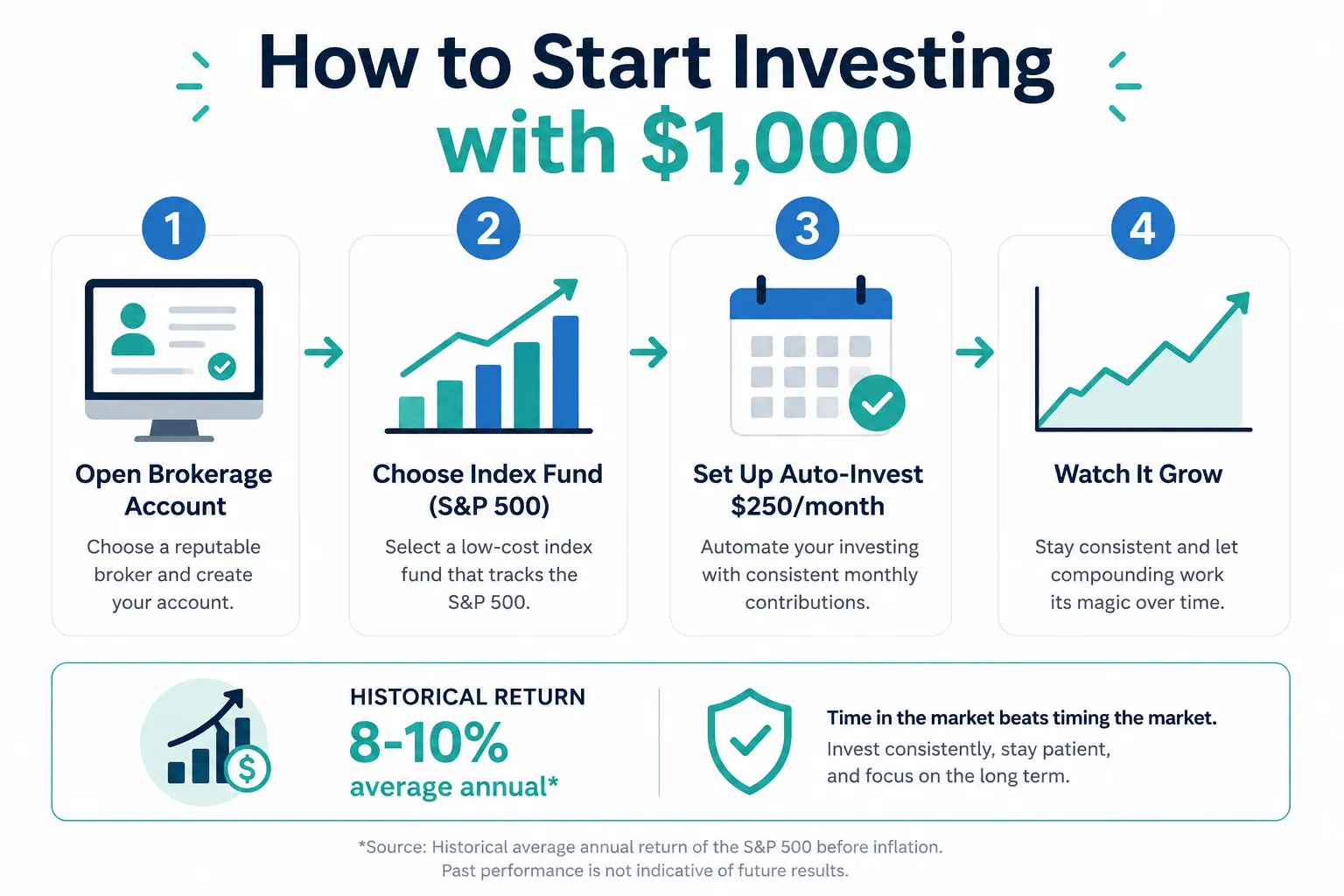
You do not need $10,000 or a finance degree to start building wealth. With $1,000, zero-commission brokerages, and fractional shares, you can own a piece of the entire U.S. stock market today. This guide walks through exactly where to put your money, what to buy, and how to set it up so investing becomes automatic.
Last updated: August 2026
TL;DR - Quick Answer
- Best account: Roth IRA at Fidelity, Schwab, or Vanguard — tax-free growth on every dollar
- Best investment: Broad market index fund like VTI (0.03% expense ratio) or VTSAX — one fund, thousands of companies
- Minimum needed: $1.00 — fractional shares mean no account minimums at major brokerages
- Next step: Set up $50-$100/month auto-invest and forget about it for 20 years
Model your growth with our Investment Return Calculator and Compound Interest Calculator.
Why $1,000 Is Enough to Start Investing
A decade ago, starting with $1,000 meant paying $7-$10 per trade, needing $3,000 minimums for mutual funds, and buying whole shares only. That world is gone. In 2026, the barriers to entry have effectively disappeared.
Fractional shares let you buy $50 of VTI instead of needing $280 for a full share. $0 commissions mean Fidelity, Charles Schwab, and Vanguard charge nothing to buy or sell stocks and ETFs. No account minimums mean you can open a Roth IRA with $1 if you wanted to — though starting with $1,000 gives you meaningful diversification from day one.
| Brokerage | Account Minimum | Stock/ETF Commissions | Fractional Shares |
|---|---|---|---|
| Fidelity | $0 | $0 | Yes ($1 minimum) |
| Charles Schwab | $0 | $0 | Yes ($5 minimum) |
| Vanguard | $0 | $0 | Yes ($1 minimum) |
The math favors starting now over waiting to save more. $1,000 invested at age 25 with an 8% average return grows to $10,063 by age 55 — even with zero additional contributions. Wait until you have $5,000 at age 30 and you lose five years of compounding, dropping that same outcome to $6,848. Time in the market beats timing the market, and $1,000 today beats $5,000 in three years.
Where to Invest Your First $1,000
Your first decision is not what stock to pick — it is what type of account to open. The account wrapper determines how your money is taxed, which directly affects how much you keep over 30 years.
| Account Type | Tax Benefit | 2026 Limit | Best For | Example Fund |
|---|---|---|---|---|
| Roth IRA | Tax-free growth and withdrawals in retirement | $7,000/year | Most beginners (best first choice) | VTI (0.03% ER) or FXAIX (0.015% ER) |
| Taxable Brokerage | None — pay taxes on dividends and gains | Unlimited | After maxing Roth IRA; mid-term goals (5-10 years) | VTI or VTSAX (0.04% ER) |
| Robo-Advisor | Same as underlying account (Roth or taxable) | Varies | Hands-off investors who want automatic rebalancing | Diversified ETF portfolio (+ 0.25% management fee) |
Our Recommendation
Open a Roth IRA at Fidelity and buy FXAIX (Fidelity 500 Index Fund, 0.015% expense ratio) or VTI if you prefer an ETF. The Roth IRA gives you decades of tax-free compounding on a $1,000 start. Skip robo-advisors until your balance exceeds $10,000 — the 0.25% fee costs you $25/year on $10,000 versus $0.30/year with VTI alone.
Roth IRA vs Taxable vs Robo-Advisor: Cost Comparison on $1,000
| Option | Annual Fees on $1,000 | 30-Year Fee Drag (est.) | Effort Required |
|---|---|---|---|
| DIY Roth IRA + VTI | $0.30 (0.03% ER) | ~$450 | 15 minutes to set up |
| DIY Roth IRA + VTSAX | $0.40 (0.04% ER) | ~$600 | 15 minutes to set up |
| Robo-advisor (Betterment/Wealthfront) | $3.40 (0.25% + fund ER) | ~$4,200 | 5 minutes to set up |
| Actively managed fund (1.0% ER) | $10.00 | ~$12,400 | Varies |
*30-year fee drag estimates assume 8% annual growth and constant balance growth. Actual fees compound against returns over time.
What to Buy: Index Funds That Work for Beginners
You need exactly one fund to start. Pick a broad, low-cost index fund that tracks the U.S. stock market (or the S&P 500 as a close proxy). Here are the three best options for a $1,000 starter portfolio, plus a target-date fund if you want zero decisions.
| Fund | Type | Expense Ratio | 10-Year Avg Return | Holdings |
|---|---|---|---|---|
| VOO | S&P 500 ETF | 0.03% | 12.4% | ~500 large U.S. companies |
| VTI | Total Market ETF | 0.03% | 12.2% | ~3,500 U.S. companies |
| VTSAX | Total Market Mutual Fund | 0.04% | 12.2% | Same as VTI (Admiral shares) |
| VLXVX (2065) | Target Date Fund | 0.08% | 10.8%* | Stocks + bonds, auto-rebalanced |
*10-year returns are annualized averages through December 2025. Past performance does not guarantee future results. VLXVX launched in 2020; return reflects since-inception performance.
VOO — Best if you want simplicity
Tracks the S&P 500 — the 500 largest U.S. companies including Apple, Microsoft, Nvidia, and Amazon. At 0.03% expense ratio, you pay $0.30 per year on every $1,000 invested. Over 10 years, VOO returned 12.4% annually, turning $1,000 into approximately $3,220 before any additional contributions.
VTI / VTSAX — Best for maximum diversification
Holds roughly 3,500 U.S. stocks — large, mid, and small cap. VTI is the ETF version (trade anytime); VTSAX is the mutual fund version (same holdings, $3,000 minimum for Admiral shares at Vanguard, but $0 minimum at Fidelity if offered). The 0.03-0.04% expense ratio is among the lowest available anywhere.
Target Date Fund — Best if you want zero maintenance
Pick the fund closest to when you turn 65 (e.g., Vanguard Target Retirement 2065 — VLXVX if you are 23 today). It starts nearly 100% in stocks and automatically shifts toward bonds as you age. The 0.08% fee is slightly higher than VTI, but you never need to rebalance or pick a bond fund. One purchase, done forever.
Case Study: Jordan, 23, $48K First Job, $1,000 Saved
Starting Point
- Age: 23, first full-time job
- Gross salary: $48,000/year ($4,000/month)
- Take-home after taxes: ~$3,200/month
- Savings available: $1,000
- Employer 401(k): No match offered
- Debt: $0 credit card, $12,000 student loans at 5.2%
- Emergency fund: $2,400 (3 months expenses — already set)
What Jordan Did
- Opened a Fidelity Roth IRA (15 minutes online)
- Contributed full $1,000 as initial deposit
- Bought FXAIX (Fidelity 500 Index, 0.015% ER)
- Set up $100/month auto-transfer from checking
- Scheduled auto-invest into FXAIX on the 1st of each month
- Kept student loans at minimum ($127/month)
Projected Portfolio Value (8% Average Annual Return)
Starting with $1,000 plus $100/month contributions, compounded monthly at 8%:
After 10 Years (Age 33)
$20,514
$13,000 contributed + $7,514 growth
After 20 Years (Age 43)
$63,829
$25,000 contributed + $38,829 growth
After 30 Years (Age 53)
$174,816
$37,000 contributed + $137,816 growth
The Tax Advantage
Because Jordan used a Roth IRA, the entire $174,816 at age 53 is tax-free upon withdrawal in retirement. If the same portfolio were in a taxable brokerage account, roughly $137,816 in gains would be subject to 15% long-term capital gains tax — about $20,672 owed to the IRS. The Roth IRA saved Jordan over $20,000 in taxes on the same investment strategy.
4 Common Mistakes When Starting with $1,000
1. Buying individual stocks
Putting $1,000 into 3-5 individual stocks feels exciting but concentrates your risk. Enron, Lehman Brothers, and Blockbuster were all "sure things" until they were not. A single company can drop 50-100% — VTI dropped 34% in 2020 and recovered within months because it held hundreds of companies. With $1,000, diversification is not optional.
2. Trying to time the market
Waiting for a "correction" before investing $1,000 sounds prudent but costs you money. An investor who stayed fully invested in the S&P 500 from 2005-2024 earned 9.8% annually. One who missed the 10 best days (often during crashes) earned just 5.6%. You cannot predict those days. Invest on a schedule regardless of headlines.
3. Not investing at all
The most expensive mistake is keeping $1,000 in a checking account earning 0.01% while inflation runs at 2-3%. After 10 years, $1,000 in checking becomes $1,001 — but its purchasing power drops to roughly $750 in today's dollars. The same $1,000 in VTI at 8% becomes $2,159. Analysis paralysis costs real money every month you wait.
4. Choosing high-fee funds
A 1.0% expense ratio fund costs $10/year on $1,000 versus $0.30 for VTI. That gap widens as your balance grows. On a $50,000 portfolio over 30 years, the difference between a 1.0% fee fund and a 0.03% index fund is approximately $100,000 in lost compound growth. Always check the expense ratio before buying — anything above 0.20% needs a specific justification.
Step-by-Step: Invest Your First $1,000 This Week
Open a Roth IRA (Day 1 — 15 minutes)
Go to fidelity.com, schwab.com, or vanguard.com and open a Roth IRA. You need your Social Security number, bank account info for linking, and employment details. Select "Individual Roth IRA" — not a managed account or robo-advisor unless you specifically want one. There is no minimum deposit to open.
Fund the account (Day 1-3)
Link your checking account and transfer $1,000. ACH transfers typically take 1-3 business days to settle. While waiting, research your fund choice: FXAIX at Fidelity, VTI/VOO at any brokerage, or VTSAX at Vanguard. Do not let the transfer time become an excuse to delay — initiate it today.
Buy your index fund (Day 3-4)
Once cash settles, search for your fund ticker (e.g., FXAIX or VTI) and click Buy. Enter $1,000 (or the full available balance). Select "Market order" for immediate execution. You now own a slice of the U.S. stock market. The entire purchase takes under 2 minutes.
Set up automatic monthly contributions (Day 4)
In your Roth IRA settings, enable automatic investments: transfer $50-$100/month from checking and auto-buy your index fund. Schedule it for 1-2 days after payday. Jordan chose $100/month — that is 3.1% of take-home pay on a $48,000 salary, a sustainable starting rate. Increase by $25 every time you get a raise.
See What Your $1,000 Could Become
Plug in your starting amount, monthly contribution, and expected return to see exactly how compound growth transforms a $1,000 start over 10, 20, or 30 years.
Frequently Asked Questions
Is $1,000 enough to start investing?
Yes. Major brokerages like Fidelity, Schwab, and Vanguard have $0 account minimums and $0 commissions on stock and ETF trades. Fractional shares let you buy into funds like VTI or VOO with any dollar amount. A $1,000 initial investment plus consistent monthly contributions is how most millionaire-next-door investors actually started.
Should I invest $1,000 in a Roth IRA or a taxable brokerage account?
For most beginners under age 50 with earned income, a Roth IRA is the better first choice. You contribute after-tax dollars, but all growth and qualified withdrawals in retirement are tax-free. The 2026 contribution limit is $7,000 per year ($583/month), so your $1,000 fits easily. Use a taxable brokerage only after maxing your Roth IRA and any employer 401(k) match.
What is the best thing to buy with $1,000 as a beginner?
A broad market index fund or ETF. VTI (Vanguard Total Stock Market ETF) at 0.03% expense ratio gives you exposure to roughly 3,500 U.S. companies in one purchase. VOO (S&P 500 ETF) is a solid alternative with a similar cost. Avoid individual stocks, crypto, and actively managed funds with fees above 0.50% — the data consistently shows low-cost index funds outperform most stock pickers over 10+ years.
How much will $1,000 grow if I invest it and add $100/month?
At an 8% average annual return, $1,000 invested today plus $100/month grows to approximately $20,500 in 10 years, $63,800 in 20 years, and $174,800 in 30 years. At 10%, those numbers rise to roughly $23,200, $83,300, and $245,900. Actual returns vary year to year — use our Investment Return Calculator to model different scenarios.
Do I need a financial advisor to start investing with $1,000?
No. For a simple index fund strategy, a robo-advisor or self-directed account at Fidelity, Schwab, or Vanguard is sufficient. Robo-advisors charge 0.25% annually ($2.50 per $1,000) for automated rebalancing. Human advisors typically charge 1% ($10 per $1,000) and rarely make sense until your portfolio exceeds $250,000. At $1,000, DIY with a target-date fund or total market index fund saves you hundreds in fees over a decade.
Related Guides
Compound Interest: 5 Real-Life Examples That Show Its Power
See compound interest in action with 5 real examples: $500/month for 40 years, credit card debt traps, student loans, and the Rule of 72 explained.
401(k) vs Roth IRA: Which Retirement Account Is Better for You?
Compare 401(k) vs Roth IRA: contribution limits, tax treatment, income limits, and when each wins. Includes a case study and the optimal hybrid strategy.