Guides / Loans & Mortgages
How Much Down Payment Do You Need for a House in 2026?
The 20% down payment is one of the most persistent myths in home buying. In reality, the average first-time buyer puts down roughly 8%, and multiple loan programs allow as little as 0-3.5%. The right down payment amount depends on your loan type, credit score, monthly budget, and how much you want to pay in mortgage insurance. This guide breaks down every option with real dollar amounts on a $400,000 home so you can decide exactly how much to save.
Last updated: September 2026
TL;DR - Quick Answer
- Conventional loans: 3% minimum for first-time buyers ($12,000 on a $400,000 home), 5% for repeat buyers ($20,000)
- FHA loans: 3.5% with 580+ credit score ($14,000 on $400,000)
- VA and USDA loans: 0% down for eligible borrowers
- 20% eliminates PMI: $80,000 on a $400,000 home, saving $150-$250/month in mortgage insurance
- Sweet spot for most buyers: 10-15% down balances lower PMI costs with faster homeownership
Calculate your exact numbers with our Down Payment Calculator.
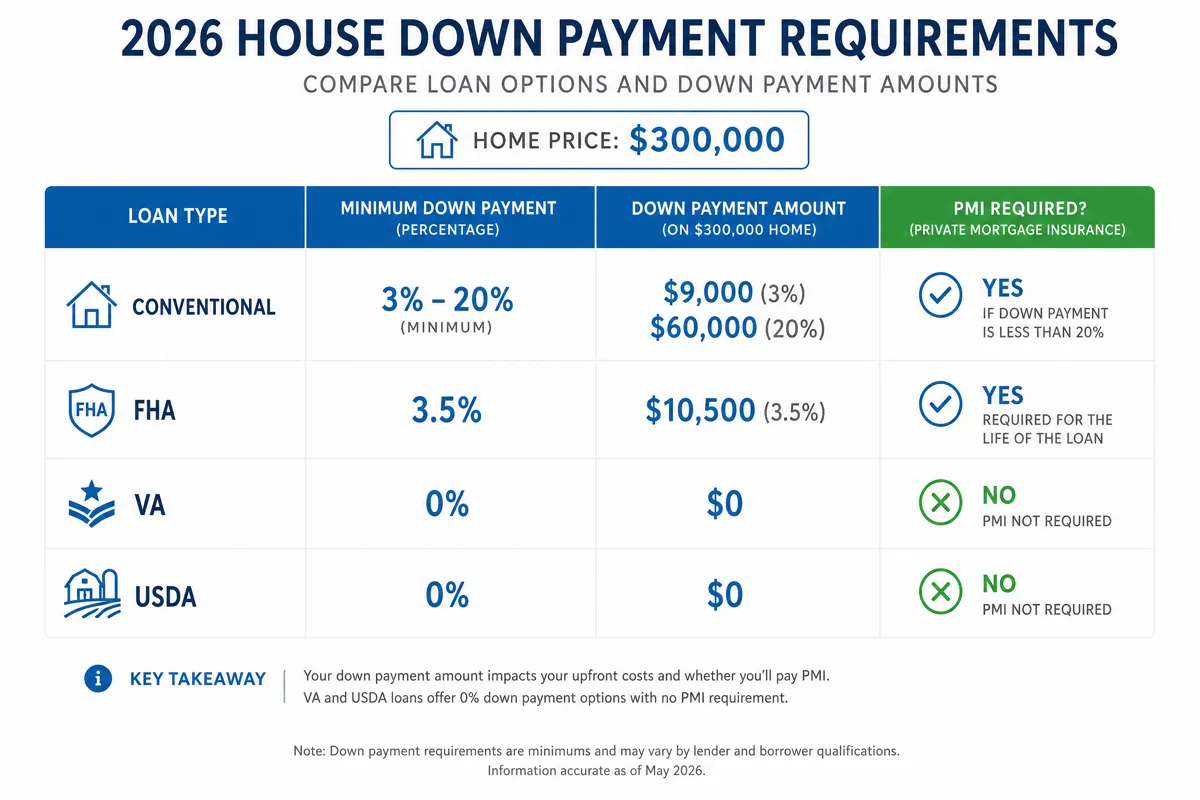
Down Payment Requirements by Loan Type in 2026
How much down payment you need for a house depends almost entirely on the type of mortgage you choose. Each loan program has different minimums, different mortgage insurance rules, and different trade-offs between upfront costs and monthly payments. Here is how the four major loan types compare on a $400,000 home purchase.
Conventional Loans: 3-20% Down
Conventional loans backed by Fannie Mae and Freddie Mac offer the widest range of down payment options. First-time buyers qualify for programs like HomeReady and Home Possible with just 3% down -- $12,000 on a $400,000 home. Repeat buyers typically need 5% ($20,000). The trade-off is private mortgage insurance (PMI), which adds $95-$300 per month depending on your credit score and loan amount. PMI automatically drops off when your loan balance reaches 78% of the original home value, or you can request removal at 80%. Putting down 20% ($80,000) eliminates PMI entirely, which is why this number persists as a benchmark -- but it is a guideline, not a rule.
FHA Loans: 3.5% Down
Federal Housing Administration loans require 3.5% down ($14,000 on $400,000) with a credit score of 580 or higher. Borrowers with scores between 500-579 must put down 10%. FHA loans are popular with first-time buyers because of the lower credit score requirements, but they come with a significant drawback: mortgage insurance premiums (MIP) include both an upfront fee of 1.75% of the loan amount ($6,755 on $385,000, typically rolled into the loan) and an annual premium of 0.55% ($2,118/year or $176/month). Unlike conventional PMI, FHA mortgage insurance does not automatically cancel -- on loans with less than 10% down, MIP stays for the life of the loan. You must refinance into a conventional loan to remove it.
VA Loans: 0% Down
Veterans Affairs loans are available to active military, veterans, and eligible surviving spouses. The standout feature is 0% down payment with no private mortgage insurance -- ever. There is a one-time VA funding fee of 1.25-3.3% of the loan amount (waived for veterans with service-connected disabilities), but this can be rolled into the loan. On a $400,000 home, a first-time VA buyer with no down payment pays a 2.15% funding fee of $8,600. VA loans also tend to offer lower interest rates than conventional mortgages, typically 0.25-0.50% below market rates.
USDA Loans: 0% Down
The U.S. Department of Agriculture offers 0% down payment loans for properties in eligible rural and suburban areas (which cover roughly 97% of U.S. land area and about 30% of the population). Income limits apply -- generally 115% of the area median income. USDA loans charge a 1% upfront guarantee fee ($4,000 on $400,000) and an annual fee of 0.35% ($1,400/year or $117/month). Both costs are lower than FHA mortgage insurance. The catch is the geographic restriction: check the Home Affordability Calculator to see what you can afford in USDA-eligible areas.
Down Payment Comparison: $400,000 Home
The table below shows exactly what each down payment percentage means in real dollars, including the monthly cost of mortgage insurance at each level:
| Down Payment % | Cash Needed | Loan Amount | Monthly P&I | Est. PMI/Month | Total Monthly |
|---|---|---|---|---|---|
| 3% (Conventional) | $12,000 | $388,000 | $2,452 | $258 | $2,710 |
| 3.5% (FHA) | $14,000 | $386,000 | $2,440 | $177 | $2,617 |
| 5% | $20,000 | $380,000 | $2,402 | $222 | $2,624 |
| 10% | $40,000 | $360,000 | $2,275 | $150 | $2,425 |
| 20% | $80,000 | $320,000 | $2,023 | $0 | $2,023 |
Assumes 6.5% interest rate, 30-year fixed mortgage. PMI estimates based on 700+ credit score. FHA MIP of 0.55% annual. Does not include property taxes or homeowners insurance. Use our Mortgage Calculator for a complete monthly payment estimate.
The difference between 3% and 20% down is $687 per month in total housing cost -- but also $68,000 in upfront cash. For many buyers, that $68,000 difference represents years of additional saving during which home prices may rise 3-5% annually, rent continues to increase, and the opportunity to build equity is deferred.
Case Study: Priya and David Choose Their Down Payment Strategy
Priya (30) and David (32) are a dual-income couple in Raleigh, NC, with a combined household income of $115,000. Priya is a data analyst earning $62,000 and David is a high school teacher earning $53,000. They have $45,000 in savings, no student debt, and $350 in monthly car payments. They are targeting homes in the $380,000- $420,000 range.
Their dilemma: put down 10% ($40,000) and keep $5,000 as an emergency cushion, or continue saving for another 18 months to reach 20% ($80,000). They ran both scenarios through the Down Payment Calculator:
| Scenario | Buy Now (10% Down) | Wait 18 Months (20% Down) |
|---|---|---|
| Home Price | $400,000 | $418,000* |
| Down Payment | $40,000 | $83,600 |
| Loan Amount | $360,000 | $334,400 |
| Monthly P&I | $2,275 | $2,114 |
| PMI/Month | $150 | $0 |
| Total Monthly | $2,425 | $2,114 |
| Rent Paid While Waiting | $0 | $27,000 |
*Assumes 3% annual home price appreciation over 18 months. Rent estimated at $1,500/month.
Priya and David chose to buy now with 10% down. Their reasoning: they would spend $27,000 in rent during the 18-month wait, the home would likely cost $18,000 more, and they would need $43,600 more in cash. The PMI of $150/month on their conventional loan would automatically cancel in about 5 years as they build equity through payments and appreciation. The total PMI cost over those 5 years is approximately $9,000 -- far less than the $27,000 in rent plus $18,000 in higher home prices they would have faced by waiting.
Step-by-Step: How to Save for Your Down Payment Faster
- Set your target amount. Use our Down Payment Calculator to compare different percentages. For most first-time buyers, 5-10% is the practical target. On a $400,000 home, that is $20,000- $40,000. Add $5,000-$10,000 for closing costs (typically 2-5% of the loan amount).
- Open a dedicated high-yield savings account. In September 2026, top HYSAs pay 4.25-4.75% APY. A separate account prevents you from dipping into down payment funds. On $20,000, a 4.5% HYSA earns $900 per year in interest alone.
- Automate monthly transfers. Calculate your monthly savings target: divide the remaining amount by your timeline in months. If you need $30,000 in 24 months, that is $1,250/month. Set up automatic transfers on payday to remove the decision from the equation.
- Explore down payment assistance. Over 2,500 DPA programs exist nationally. Many first-time buyers earning under $80,000-$100,000 qualify for $5,000-$25,000 in grants or forgivable loans. Your state housing finance agency website lists current programs.
- Consider your full financial picture. Do not drain your entire savings for the down payment. Keep at least 3 months of expenses ($6,000-$12,000) in an emergency fund separate from your down payment. Factor in $3,000-$10,000 for moving costs, immediate repairs, and furnishing.
- Run the rent-vs-buy math. Use our Home Affordability Calculator to determine the maximum home price you can afford today. If buying now with a smaller down payment costs less than renting plus saving for a larger down payment, the math favors buying sooner.
Calculate Your Down Payment
See exactly how much you need, compare PMI costs at different percentages, and find out how long it takes to save your target.
FAQ
What is the minimum down payment for a house?
The minimum depends on your loan type. Conventional loans allow as little as 3% down for first-time buyers and 5% for repeat buyers. FHA loans require 3.5% with a credit score of 580 or higher (10% below 580). VA and USDA loans offer 0% down payment options for eligible borrowers. On a $400,000 home, that means you could put down as little as $12,000 (conventional 3%), $14,000 (FHA 3.5%), or $0 (VA/USDA).
Is 20% down still necessary in 2026?
No. The 20% down payment is not a requirement -- it is a threshold that eliminates private mortgage insurance (PMI). In 2026, the median first-time buyer puts down approximately 8%, and many programs allow 3-5%. Putting down 20% saves you $100-$300 per month in PMI on a typical mortgage, but waiting years to save the full 20% means missing out on home price appreciation and paying rent instead of building equity. Run the numbers for your specific situation before assuming 20% is the right target.
How much is PMI if I put down less than 20%?
PMI typically costs 0.3% to 1.5% of the original loan amount per year, depending on your credit score, down payment percentage, and loan type. On a $380,000 loan (5% down on a $400,000 home), PMI ranges from $95 to $475 per month. Most borrowers with good credit pay 0.4-0.8%, which works out to $127-$253 per month. PMI automatically cancels when your loan balance reaches 78% of the original home value.
Can I use gift money for a down payment?
Yes, most loan programs accept gift funds for down payments. Conventional loans require a gift letter stating the money is not a loan. FHA loans allow 100% of the down payment to come from a gift from a family member, employer, or approved nonprofit. VA and USDA loans also accept gift funds. The key requirement is documentation: the gift donor must provide a signed letter, and lenders will verify the transfer with bank statements.
What are down payment assistance programs?
Down payment assistance (DPA) programs are government or nonprofit programs that provide grants, forgivable loans, or low-interest second mortgages to help buyers cover the down payment. Over 2,500 DPA programs exist across the U.S. in 2026. Most target first-time buyers earning below 80-120% of area median income. Common programs include state housing finance agency grants ($5,000-$25,000), employer-assisted housing programs, and community land trust partnerships. Check your state HFA website for current offerings.
Related Guides
How Much House Can I Afford? Complete Guide by Income Level
Learn exactly how much home you can afford based on your salary, debts, and down payment. Includes income-based tables, a real case study, and the formulas lenders actually use.
Rent vs Buy in 2026: How to Make the Right Decision
Should you rent or buy in 2026? Break-even analysis at 7% rates, hidden costs of buying, a real case study, and a step-by-step decision framework.
15-Year vs 30-Year Mortgage: Which Saves You More Money?
Compare 15-year vs 30-year mortgages with real numbers on a $350K loan. See monthly payments, total interest, break-even analysis, and who should choose each term.