How the Down Payment Calculator Works
The down payment is the single largest upfront cost in a home purchase, and choosing the right amount affects everything from your monthly mortgage payment to whether you pay private mortgage insurance (PMI). Our Down Payment Calculator lets you experiment with different percentages on any home price and instantly see the impact on your loan amount, monthly payment, PMI cost, and total interest over the life of the loan.
Enter your target home price, desired down payment percentage, current savings, and how much you can set aside each month. The calculator computes exactly how much cash you need, how long it takes to reach that goal, and provides a side-by-side comparison of five common down payment levels (3.5%, 5%, 10%, 15%, and 20%). Use it alongside our Mortgage Calculator to see how down payment size changes your monthly obligation and total borrowing cost.
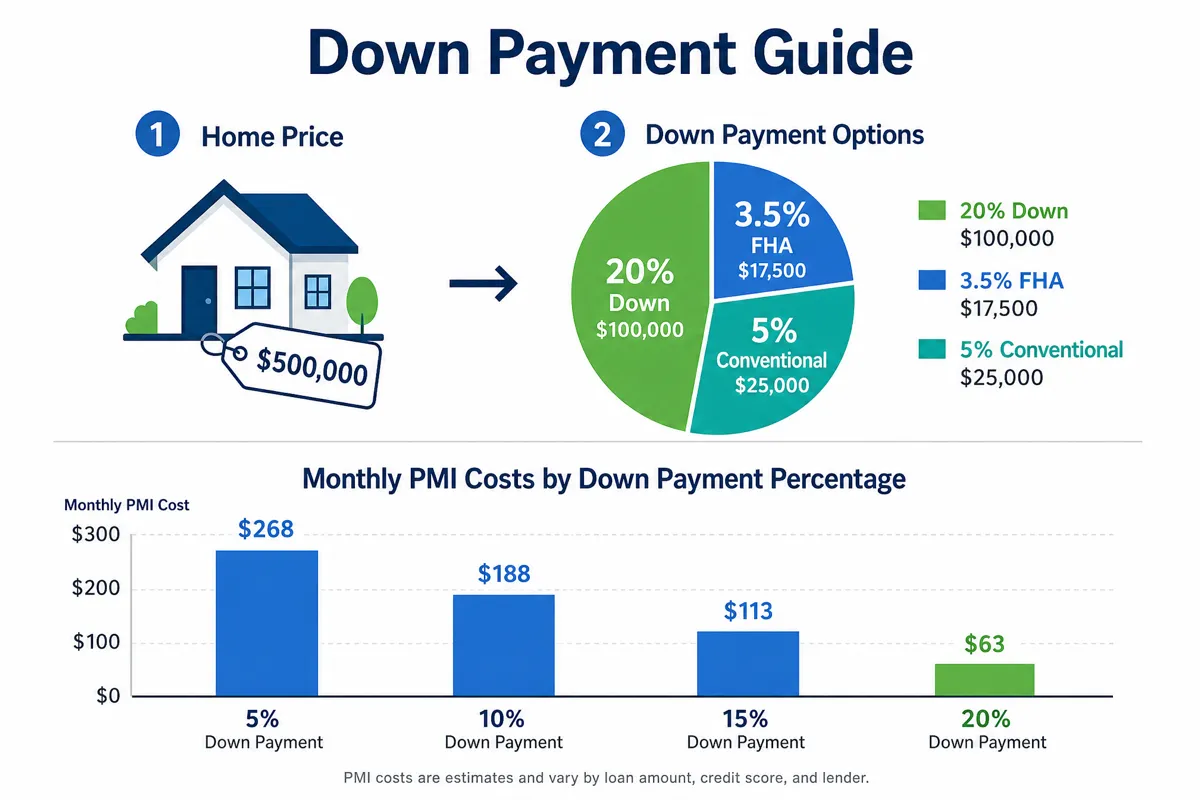
How Much Down Payment Do You Actually Need?
The conventional wisdom of "20% down" persists, but the reality is more nuanced. According to the National Association of Realtors, the median down payment for first-time buyers in 2025 was just 8%, while repeat buyers averaged 19%. Several loan programs allow significantly less:
- Conventional loans: As low as 3% down for first-time buyers through Fannie Mae HomeReady or Freddie Mac Home Possible programs, though PMI applies until you reach 20% equity.
- FHA loans: 3.5% minimum down payment with a credit score of 580 or higher. FHA mortgage insurance premiums (both upfront and annual) are required for the life of the loan unless you refinance.
- VA loans: 0% down for eligible military service members and veterans. No PMI required, though a funding fee applies (1.25% to 3.3% depending on service category and down payment).
- USDA loans: 0% down for eligible rural and suburban properties in designated areas, with household income limits.
The 20% threshold remains significant because it eliminates PMI on conventional loans. On a $350,000 home, PMI at 0.7% of the loan amount adds roughly $194/month when you put only 5% down versus zero PMI at 20% down -- that is $2,333/year in additional cost until you build sufficient equity. For a complete analysis of how much home you can afford at different income levels, see our How Much House Can I Afford guide.
Case Study: Rachel Saving for Her First Home in Atlanta
Rachel is a 29-year-old physical therapist earning $68,000/year in Atlanta, Georgia. She has $18,000 in savings and can contribute $1,200/month toward her down payment fund, which earns 4.5% APY in a high-yield savings account. She is targeting homes in the $320,000 range.
Scenario A: 20% down ($64,000). Rachel needs $46,000 more. At $1,200/month with 4.5% APY, the calculator shows she reaches her goal in approximately 35 months (just under 3 years). Her loan would be $256,000, with a monthly P&I of $1,661 at 6.75% and no PMI. Total interest over 30 years: $341,860.
Scenario B: 10% down ($32,000). Rachel needs only $14,000 more, which she accumulates in about 11 months. Her loan rises to $288,000, pushing the monthly P&I to $1,869, plus roughly $168/month in PMI. That PMI adds $2,016/year until she reaches 20% equity (approximately 7-8 years with normal appreciation and payment). Total interest over 30 years: $384,840.
Scenario C: 5% down ($16,000). Rachel already has enough saved today (plus a $2,000 buffer for closing costs). Her loan jumps to $304,000, monthly P&I hits $1,972, and PMI adds approximately $177/month. While she enters the market immediately, the larger loan means $47,000 more in total interest compared to the 20% down scenario.
Rachel decides on 10% down as a compromise: she enters the market within a year, avoids the highest PMI tier, and uses the additional time to improve her credit score for a better rate. She also uses our Home Affordability Calculator to confirm that $2,037/month (P&I plus PMI) stays within the 28% housing ratio on her income, and our Savings Goal Calculator to track her monthly progress.
Down Payment Comparison by Home Price
The table below shows the required down payment, loan amount, estimated monthly payment (P&I only at 6.75%, 30-year term), and PMI cost at five common down payment levels for three popular home prices.
| Home Price | Down % | Down Payment | Monthly P&I | Monthly PMI | Total Interest (30yr) |
|---|---|---|---|---|---|
| $250,000 | 5% | $12,500 | $1,540 | $139 | $316,900 |
| 10% | $25,000 | $1,459 | $131 | $300,240 | |
| 20% | $50,000 | $1,297 | $0 | $266,920 | |
| $400,000 | 5% | $20,000 | $2,464 | $222 | $507,040 |
| 10% | $40,000 | $2,334 | $210 | $480,240 | |
| 20% | $80,000 | $2,075 | $0 | $427,000 | |
| $600,000 | 5% | $30,000 | $3,696 | $333 | $760,560 |
| 10% | $60,000 | $3,501 | $315 | $720,360 | |
| 20% | $120,000 | $3,113 | $0 | $640,680 |
The pattern is clear: every 5% increase in down payment drops the monthly payment and eliminates years of PMI cost. However, the largest jump in savings comes at the 20% threshold where PMI disappears entirely. On a $400,000 home, the difference between 5% and 20% down is roughly $611/month ($389 less in P&I plus $222 saved on PMI).
Strategies to Save for a Down Payment Faster
- Automate transfers to a high-yield savings account. Set up a recurring transfer on payday so the money moves before you can spend it. Current HYSA rates of 4.0% to 5.0% APY mean your savings earn meaningful interest while you accumulate.
- Use a dedicated savings account. Keeping down payment funds separate from your checking account reduces the temptation to dip in. Some banks let you create named sub-accounts specifically for goals.
- Redirect windfalls. Tax refunds, work bonuses, and cash gifts can accelerate your timeline dramatically. A single $5,000 tax refund can cut 4-5 months off a $1,000/month savings plan.
- Explore down payment assistance programs. Over 2,000 programs exist nationwide, offering grants, forgivable loans, or matched savings for first-time buyers. Check your state housing finance agency for eligibility.
- Consider a CD ladder strategy. If your timeline is 2-3 years, splitting savings across multiple CDs with staggered maturity dates can earn higher rates than a standard savings account. See our High-Yield Savings vs CD guide for details on this approach.
FAQ
Is a 20% down payment always the best choice?
Not necessarily. While 20% down eliminates PMI and gives you the lowest monthly payment, waiting years to save 20% means potentially missing home appreciation and continuing to pay rent. If putting 10% down lets you buy 2 years sooner and home values rise 4% annually, you capture roughly $28,000 in appreciation on a $350,000 home that would otherwise be lost. The right down payment balances monthly affordability, PMI cost, and opportunity cost.
What is PMI and how do I get rid of it?
Private mortgage insurance (PMI) protects the lender if you default on a loan with less than 20% equity. On conventional loans, you can request PMI removal once your loan-to-value ratio reaches 80% (through payments, appreciation, or both). Lenders must automatically cancel PMI when the ratio hits 78% based on the original amortization schedule. FHA loans require mortgage insurance for the life of the loan if you put less than 10% down.
Should I use retirement funds for a down payment?
First-time buyers can withdraw up to $10,000 from a traditional IRA penalty-free (taxes still apply) or pull Roth IRA contributions at any time without tax or penalty. However, this permanently reduces your retirement savings and the decades of compound growth those funds would have generated. Most financial planners recommend exhausting other savings strategies first and only tapping retirement accounts as a last resort.
How much should I budget for closing costs on top of the down payment?
Closing costs typically run 2% to 5% of the home purchase price. On a $350,000 home, budget $7,000 to $17,500 for items like origination fees, appraisal, title insurance, escrow deposits, and prepaid property taxes. Some closing costs are negotiable, and sellers occasionally contribute toward them as part of the purchase agreement.