Guides / Savings Strategy
High-Yield Savings Account vs CD: Which Is Better in 2026?
You have $30,000 sitting in a traditional savings account earning 0.01% APY — roughly $3 per year. Two FDIC-insured alternatives dominate in 2026: high-yield savings accounts paying 4.5-5.0% APY and certificates of deposit locking in 4.8-5.2% APY. The rate gap looks small, but the trade-off between flexibility and guaranteed yield changes everything depending on your timeline. This guide compares real August 2026 rates, runs the numbers on $30,000, and shows you exactly when each account type wins.
Last updated: August 2026
TL;DR - Quick Answer
- HYSA wins for flexibility: 4.5-5.0% APY, unlimited deposits, penalty-free withdrawals, variable rate rises with the Fed
- CD wins for rate-locking: 4.8-5.2% APY on 12-month terms, fixed rate guaranteed for the full term, ideal when you know your withdrawal date
- The $30,000 gap: A 12-month CD at 5.05% earns $1,515/year vs $1,425 in a 4.75% HYSA — a $90 difference that may not justify losing access to your money
- Best hybrid: HYSA for emergency funds and short-term goals; CD or CD ladder for fixed-date savings of $15,000+ over 12-18 months
Use our Savings Goal Calculator and CD Calculator to model your exact scenario.
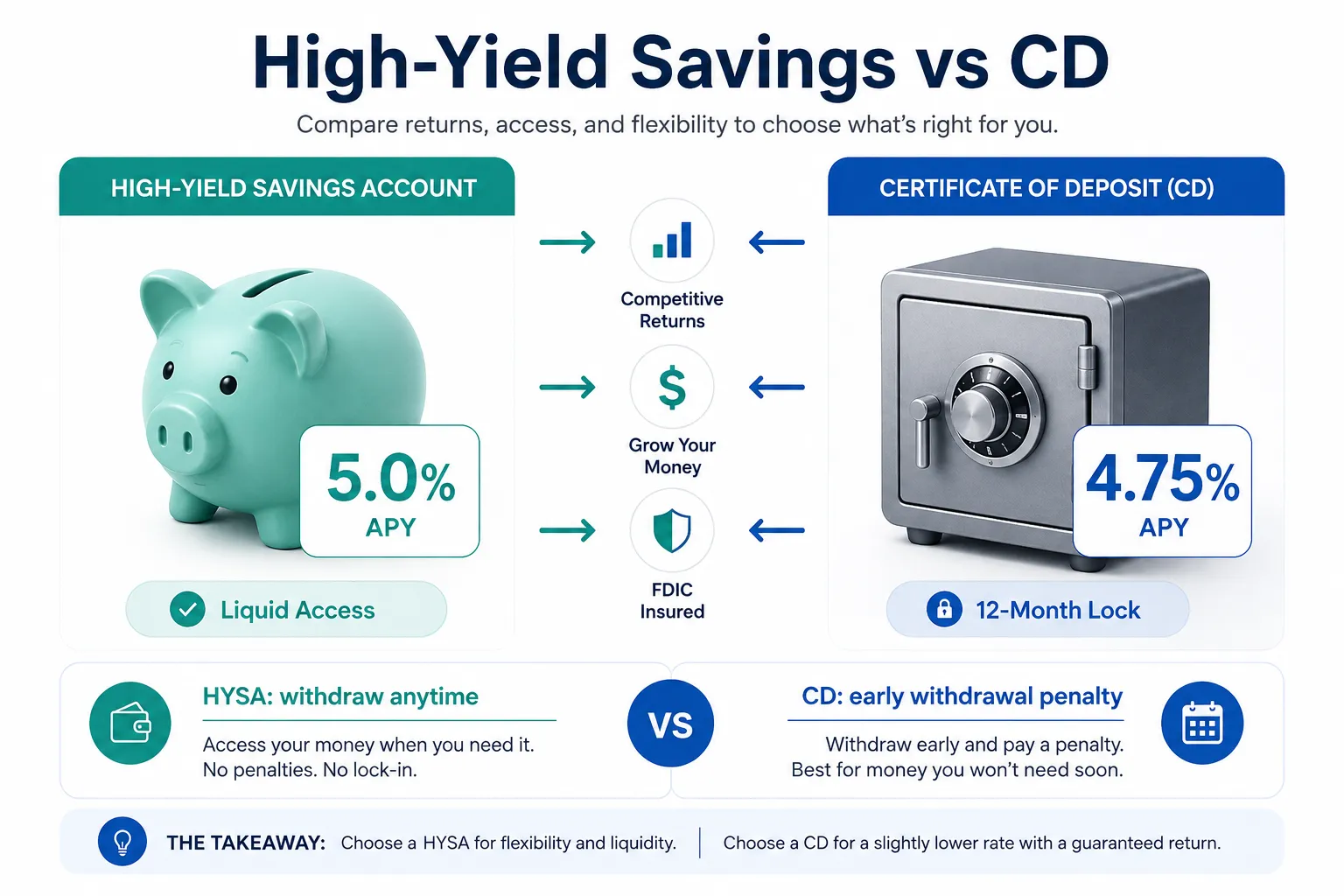
Current Rates: HYSA vs CD Terms (August 2026)
Top online banks currently offer competitive rates across both account types. CD rates typically run 0.25-0.55 percentage points higher than HYSAs at the same bank, reflecting the trade-off of locking your money for a fixed term. These ranges reflect rates from Ally Bank, Marcus by Goldman Sachs, Capital One 360, and Discover as of August 2026.
| Account Type | Term | APY Range | Interest on $30,000 (1 Year) | Access |
|---|---|---|---|---|
| High-yield savings (HYSA) | No term | 4.50-5.00% | $1,350-$1,500 | Anytime, no penalty |
| 3-month CD | 3 months | 4.60-4.85% | $345-$364 (3 mo.) | Locked; 3-mo. penalty |
| 6-month CD | 6 months | 4.75-4.95% | $712-$743 (6 mo.) | Locked; 3-mo. penalty |
| 12-month CD | 12 months | 4.85-5.20% | $1,455-$1,560 | Locked; 3-6 mo. penalty |
| 18-month CD | 18 months | 4.90-5.15% | $2,205-$2,318 (18 mo.) | Locked; 6-mo. penalty |
*APY ranges from top online banks as of August 2026. Interest calculated on $30,000 using stated APY for the full term shown. HYSA rates are variable and can change at any time. CD rates are fixed at opening.
How High-Yield Savings Accounts and CDs Work
Both accounts are FDIC insured up to $250,000 per depositor, per bank. Both earn compound interest. The fundamental difference is whether you trade flexibility for a guaranteed rate — and that trade-off drives every decision in this comparison.
High-Yield Savings Account (HYSA)
A HYSA functions like a regular savings account but pays dramatically higher interest. Online banks like Ally (4.50% APY), Marcus (4.65% APY), and Capital One 360 (4.75% APY) offer rates 450-500x higher than traditional brick-and-mortar savings accounts at 0.01% APY.
Key Features
- Variable rate — rises and falls with Fed policy
- Unlimited deposits at any time
- Withdrawals with no penalty (some limit to 6/month)
- Same-day or next-day transfers to checking
- No minimum term or maturity date
- FDIC insured up to $250,000 per bank
Rate Behavior
- Rate can increase if the Fed raises rates
- Rate can decrease if the Fed cuts rates
- Banks adjust independently — shop around quarterly
- No guarantee your 4.75% APY stays at 4.75% for 12 months
- Historical range: 0.50% (2021) to 5.30% (2023)
Certificate of Deposit (CD)
A CD is a time deposit: you commit a lump sum for a fixed term (3 months to 5 years) and receive a guaranteed APY for the entire period. You cannot add money after opening, and withdrawing before maturity triggers an early withdrawal penalty — typically 3-6 months of accrued interest.
Key Features
- Fixed rate locked for the full term
- One-time deposit at opening (no additions)
- Early withdrawal penalty: 3-6 months of interest
- Maturity date is predetermined (e.g., August 2027)
- Auto-renewal option at maturity (check new rate)
- FDIC insured up to $250,000 per bank
Rate Behavior
- Rate locked regardless of Fed cuts or hikes
- Longer terms typically pay higher APY (up to 18-24 mo.)
- 5-year CDs currently pay 4.25-4.50% (inverted yield curve)
- No-penalty CDs available at 0.10-0.25% lower APY
- At maturity: withdraw, renew, or roll into new term
The Core Trade-Off
A HYSA pays you for keeping your options open. A CD pays you for making a commitment. The 0.25-0.55 percentage point rate premium on CDs is the bank's compensation for knowing exactly how long they hold your money — and your compensation for giving up access.
When a High-Yield Savings Account Wins
A HYSA is the right default for most savers in 2026. The rate difference versus CDs is small enough that flexibility often matters more than the extra 0.30-0.50 percentage points.
1. Emergency fund storage
Emergency funds must be accessible within 24-48 hours. A $24,000 emergency fund in a 12-month CD at 5.05% APY earns $1,212/year — but breaking it early for a $6,000 car repair costs a 6-month interest penalty of approximately $606, wiping out half a year of gains. The same $24,000 in a 4.75% HYSA earns $1,140/year with zero penalty for withdrawal. The $72 annual difference is negligible compared to the $606 penalty risk.
2. Saving for a goal under 2 years with ongoing deposits
CDs accept one deposit at opening. If you are saving $1,500/month toward a $20,000 vacation fund over 13 months, a HYSA lets you deposit incrementally and earn interest on every dollar from day one. A CD requires you to wait until you have the full amount — meaning $1,500/month sits in checking at 0.01% APY for months before you can lock it in. On $1,500/month over 13 months, the lost interest from delayed CD funding costs $180-$240 compared to depositing into a HYSA immediately.
3. You expect rates to rise
If the Federal Reserve is pausing cuts or signaling future hikes, a HYSA lets you benefit automatically. HYSA rates climbed from 0.50% to 5.30% between 2021 and 2023 as the Fed raised rates. Locking $30,000 in a 12-month CD at 5.05% today means missing out if HYSA rates climb to 5.50% in six months. That 0.45 percentage point difference on $30,000 equals $135 in annual interest you would forfeit by being locked in.
4. Uncertain withdrawal timeline
Saving for a house down payment but not sure if you will buy in 12 or 24 months? A HYSA keeps your options open. A 12-month CD forces a decision: withdraw at maturity and reinvest, or pay a penalty to access funds early. Uncertainty about timing is the single strongest argument for HYSA over CD — the flexibility premium costs $90/year on $30,000, which is cheap insurance against a $757 early withdrawal penalty.
When a Certificate of Deposit Wins
CDs reward savers who know exactly when they need their money and can commit a lump sum without touching it. The rate premium is modest but guaranteed — and that guarantee matters most when rates are expected to fall.
1. Saving for a known future date
Wedding in exactly 14 months? Property tax due in 12 months? A CD matched to your withdrawal date locks in today's rate with zero ongoing management. A $15,000 12-month CD at 5.05% APY matures to $15,757.50 — you know the exact amount on day one. A HYSA at 4.75% might drop to 4.25% if the Fed cuts rates in month 6, reducing your return to $1,425 instead of the projected $1,515. The CD eliminates that uncertainty.
2. You expect rates to fall
When the Fed signals rate cuts, HYSA rates follow within weeks. Banks cut HYSA rates faster than they raise CD rates because HYSAs have no lock-in. If you believe rates will drop 0.50-0.75 percentage points over the next 12 months, locking a 5.05% 12-month CD today protects your yield. A HYSA starting at 4.75% that falls to 4.00% by month 6 earns approximately $1,313 over the year — $202 less than the CD's guaranteed $1,515 on $30,000.
3. You have a lump sum ready now
Inherited $50,000? Sold a car for $18,000? Received a bonus? A CD maximizes yield on money you will not add to later. There is no advantage to a HYSA's unlimited deposit feature if the full amount is already saved. A $50,000 18-month CD at 5.00% APY earns $3,750 over the term — $375 more than the same amount in a 4.75% HYSA ($3,375). When the deposit is complete and the timeline is fixed, the CD's rate premium is free money.
4. Discipline and lock-in advantage
Some savers spend money they can access too easily. A CD creates a psychological and financial barrier: the early withdrawal penalty makes impulsive spending costly. If you saved $20,000 for a house down payment but dipped into your HYSA twice for vacations ($3,200 total), the CD's lock-in would have preserved the full balance. The $90/year rate premium on $30,000 is a small price for forced discipline on goal-oriented savings.
$30,000 Over 12 Months: HYSA vs 12-Month CD
Here is the head-to-head comparison most savers want to see. Both accounts hold the same $30,000 for exactly 12 months with no additional deposits or withdrawals.
| Metric | HYSA at 4.75% APY | 12-Month CD at 5.05% APY |
|---|---|---|
| Starting balance | $30,000 | $30,000 |
| Rate type | Variable (can change) | Fixed (locked 12 months) |
| Interest earned (12 months) | $1,425 | $1,515 |
| Ending balance | $31,425 | $31,515 |
| Additional deposits allowed | Yes, unlimited | No |
| Early withdrawal penalty | None | ~$757 (6 months interest) |
| CD advantage | — | +$90/year |
*Interest calculated on $30,000 at stated APY for 12 months. Assumes HYSA rate remains constant at 4.75% — actual HYSA earnings may vary if rates change. Early withdrawal penalty assumes 6-month interest forfeiture on the CD.
Is $90 Worth It?
The CD earns $90 more — $7.50 per month — in exchange for locking $30,000 with no access for 12 months. If you need even $5,000 before maturity, the 6-month early withdrawal penalty ($757) wipes out 8.4 years of that $90 premium. The CD only makes financial sense if you are confident you will not touch the money early. For most savers, the HYSA's flexibility is worth far more than $7.50/month.
Case Study: Tom, 40, Saving $50K House Down Payment in 18 Months
His Situation
- Age: 40, software engineer in Denver
- Gross salary: $125,000/year ($7,400/month take-home)
- Goal: $50,000 house down payment
- Timeline: 18 months (February 2028 purchase target)
- Current savings: $32,000 already saved
- Monthly contribution: $1,000/month ($18,000 over 18 months)
- Total at goal date: $50,000 ($32,000 + $18,000)
His Optimal Split Strategy
- $12,000 in Ally HYSA at 4.50% APY (ongoing $1,000/month deposits + buffer)
- $32,000 in Marcus 18-month CD at 5.00% APY (lump sum locked until February 2028)
- $6,000 in Ally 6-month CD at 4.90% APY (maturing August 2027, then rolled to HYSA)
Why This Split Works
Tom already has $32,000 saved — a lump sum ideal for an 18-month CD matched to his purchase date. Locking it at 5.00% APY guarantees $2,400 in interest regardless of rate cuts. His ongoing $1,000/month contributions go into a HYSA because CDs do not accept additional deposits. The $12,000 HYSA balance grows by $1,000/month and provides a buffer if the home purchase timeline shifts by 3-6 months.
The $6,000 6-month CD is a bridge: it earns 4.90% APY on money Tom saved before finalizing his strategy. When it matures in February 2027, he moves the $6,147 ($6,000 + $147 interest) into the HYSA to continue receiving deposits alongside his monthly $1,000 contributions.
18-Month Interest Comparison
All in HYSA (4.50%)
~$3,510
Split strategy
~$3,890
Extra vs all-HYSA
+$380
Tom's split earns approximately $380 more over 18 months than keeping everything in a HYSA — while maintaining $12,000+ in penalty-free access at any point. The $32,000 CD generates $2,400 in guaranteed interest. The HYSA portion earns roughly $890 on average balances. The 6-month CD adds $147. If Tom's closing date slips to month 20, he can cover the gap from his HYSA without touching the CD or paying a penalty.
What Tom Avoided
Putting all $50,000 in a single 18-month CD would have been impossible — he only had $32,000 at the start and adds $1,000/month. Keeping everything in a HYSA would have cost $380 in foregone interest over 18 months. Locking all $32,000 in a CD with zero HYSA buffer would mean paying a $800+ early withdrawal penalty if his closing date moved up by 2 months. The split captures 97% of the CD rate advantage while preserving flexibility on 24% of his total savings.
CD Ladder vs HYSA for Different Goals
A CD ladder splits your savings across multiple CDs with staggered maturity dates, combining CD rate premiums with periodic liquidity. Here is how ladders compare to a pure HYSA strategy for common savings goals.
| Goal | Amount | Timeline | Best Choice | Why |
|---|---|---|---|---|
| Emergency fund | $15,000-$25,000 | Permanent | HYSA | Instant access required; no CD penalty risk |
| Vacation fund | $5,000-$8,000 | 6-12 months | HYSA | Still adding deposits; CD rate premium too small on low balance |
| House down payment | $30,000-$60,000 | 12-24 months | Split or CD ladder | Lock lump sum in CD; HYSA for ongoing deposits and timeline buffer |
| Car purchase | $20,000-$35,000 | 12-18 months | 12-18 month CD | Fixed date, lump sum ready, 5.00-5.05% APY rate lock |
| Tax payment reserve | $8,000-$15,000 | 6-12 months | 6-12 month CD | Exact due date known; no need for ongoing deposits |
| General savings | $10,000+ | No fixed date | HYSA | Uncertain timeline; flexibility worth more than 0.30% APY premium |
Sample 4-Rung CD Ladder on $40,000
For savers with $40,000 and a 12-18 month horizon who want higher rates than a HYSA but more liquidity than a single long-term CD:
| Rung | Amount | Term | APY | Year-1 Interest | Matures |
|---|---|---|---|---|---|
| Rung 1 | $10,000 | 3 months | 4.75% | $119 | November 2026 |
| Rung 2 | $10,000 | 6 months | 4.90% | $245 | February 2027 |
| Rung 3 | $10,000 | 12 months | 5.05% | $505 | August 2027 |
| Rung 4 | $10,000 | 18 months | 5.00% | $500 | February 2028 |
Total year-1 interest: $1,369 on $40,000 — a blended rate of 3.42% in year 1 (ramps up as longer rungs accrue full-year interest). Full 18-month blended rate: approximately 4.91% APY. Compare to $40,000 in a HYSA at 4.75% APY earning $1,900/year. The ladder earns $64 more in year 1 while providing access to $10,000 every 3 months without penalty. Use our CD Calculator to model different ladder configurations.
Decision Framework
Under $10,000 or under 12 months: HYSA, no question. $10,000-$25,000 with a fixed date: single CD matched to your timeline. $25,000+ with a fixed date and lump sum ready: CD or split (HYSA for deposits, CD for existing balance). $25,000+ with uncertain timeline: HYSA, or CD ladder if you will not need more than 25% of the balance at any one time.
Run Your Savings Numbers
Every savings goal has different math. Use our free calculators to compare HYSA and CD returns, plan monthly contributions, and see how compound interest grows your balance over time.
Frequently Asked Questions
Is a high-yield savings account or CD better in 2026?
Neither is universally better — it depends on your timeline and liquidity needs. A HYSA wins when you need flexible access, are still adding deposits, or expect rates to rise (4.5-5.0% APY as of August 2026). A CD wins when you have a fixed withdrawal date, want to lock in today's rate before expected Fed cuts, and do not need the money early (4.8-5.2% APY on 12-month terms). On $30,000 over 12 months, a 5.05% CD earns $90 more than a 4.75% HYSA — but the HYSA lets you withdraw without penalty.
Can you lose money in a high-yield savings account or CD?
No — both are FDIC insured up to $250,000 per depositor, per bank, so your principal is protected. The risk is opportunity cost, not loss of principal. If you lock $30,000 in a 12-month CD at 5.05% APY and rates rise to 5.5%, you miss out on $135 in extra annual interest. If you keep money in a HYSA and rates fall from 4.75% to 4.0%, you lose $225 in annual interest on $30,000. Early CD withdrawal penalties (typically 3-6 months of interest) can reduce your earnings but do not eat into principal unless you withdraw very early.
What is the penalty for breaking a CD early?
Most banks charge 3-6 months of interest as an early withdrawal penalty. On a $30,000 12-month CD at 5.05% APY, a 6-month penalty costs approximately $757.50 in forfeited interest. On a $10,000 6-month CD at 4.90% APY with a 3-month penalty, you forfeit about $122.50. Some no-penalty CDs exist (Ally, Marcus) but typically pay 0.10-0.25% less than standard CDs. Always check the specific penalty terms before opening — penalties vary by bank and term length.
Should I put my emergency fund in a CD or high-yield savings account?
Keep your emergency fund in a HYSA, not a single long-term CD. Emergency funds require same-day or next-day access for job loss, medical bills, and car repairs — events that do not wait for a CD maturity date. A HYSA at 4.5-5.0% APY gives you FDIC protection, unlimited deposits, and penalty-free withdrawals. If you want slightly higher rates on a portion of your fund, use a CD ladder for 33-50% of the balance while keeping the rest liquid in a HYSA. See our emergency fund guide for a full breakdown.
What is a CD ladder and when does it beat a HYSA?
A CD ladder splits your savings across multiple CDs with staggered maturity dates — for example, $10,000 each in 3-month, 6-month, 12-month, and 18-month CDs. One CD matures every quarter, giving you periodic liquidity while locking in higher rates than a HYSA. A 4-rung ladder on $40,000 earns a blended 4.91% APY versus 4.75% in a HYSA — about $64 extra per year. CD ladders beat a HYSA when you have $15,000+, a predictable savings timeline of 12-24 months, and do not need instant access to the full balance. For goals under 12 months or amounts under $10,000, a HYSA is simpler and nearly as competitive.
Related Guides
Where to Keep Your Emergency Fund for the Best Interest Rate
Compare HYSAs, money market accounts, CDs, and more for your emergency fund. Real 2026 APY rates, a case study, and the CD ladder strategy explained.
How to Save $50,000 in 3 Years: A Realistic Plan
A step-by-step plan to save $50,000 in 3 years on an average salary. Includes monthly targets, budget breakdowns, a real case study, and strategies that actually work.