Guides / Savings Strategy
Where to Keep Your Emergency Fund for the Best Interest Rate
You built a $24,000 emergency fund. Congratulations — 68% of Americans cannot cover a $1,000 surprise expense. But where you keep that money matters as much as how much you saved. The difference between a traditional checking account and a high-yield savings account on $25,000 is $1,250 per year in free money. This guide breaks down every option, compares real 2026 rates, and shows you exactly where to park your cash for maximum safety and interest.
Last updated: August 2026
TL;DR - Quick Answer
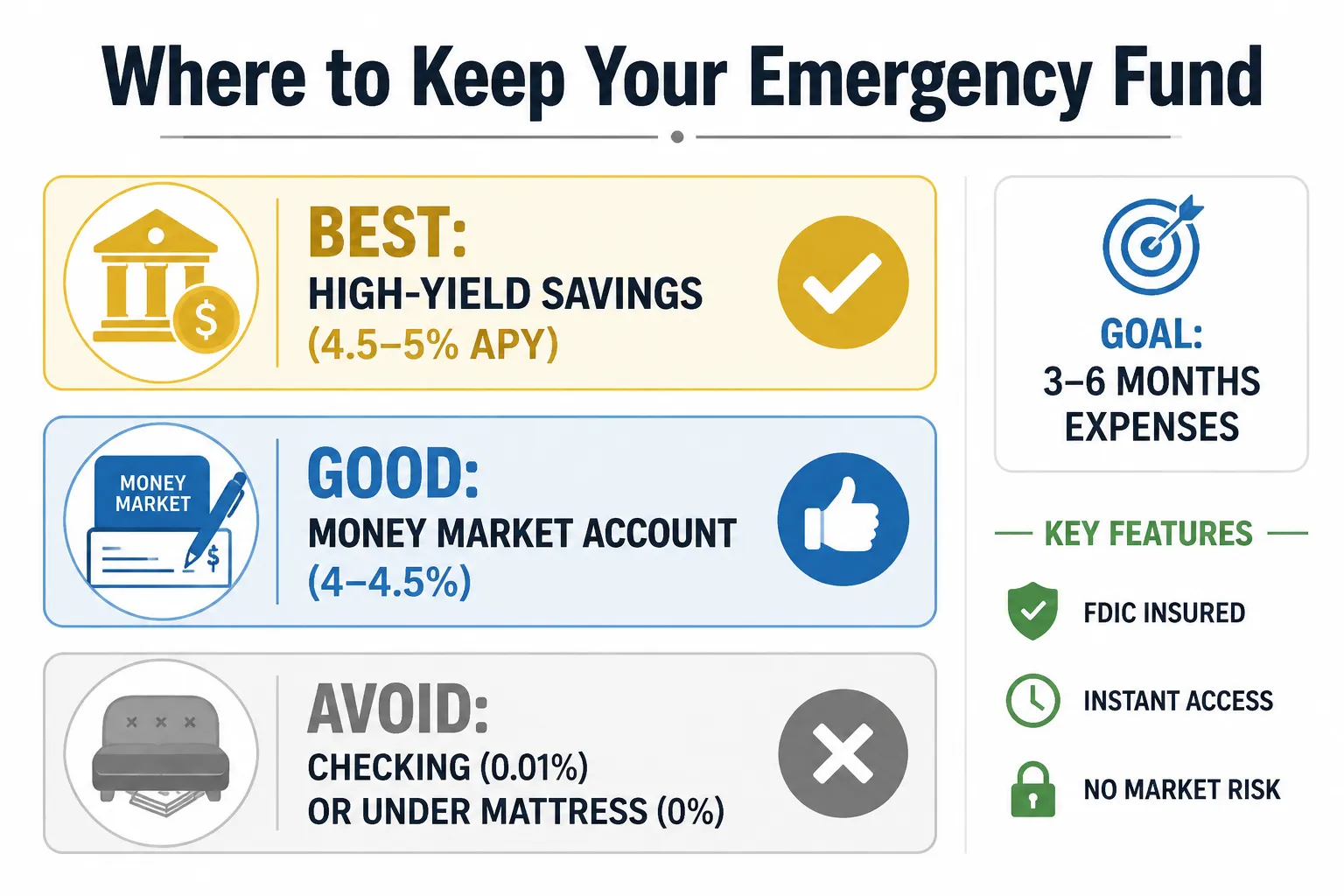
Best option: High-yield savings account at 4.5-5.0% APY. Keep 3-6 months of expenses liquid and FDIC insured.
- Target size: 3-6 months of essential expenses ($12,000-$24,000 for most households spending $4,000/month)
- Top accounts: Online HYSAs from Ally Bank, Marcus by Goldman Sachs, and Capital One 360 (4.5-5.0% APY as of August 2026)
- Avoid: Traditional checking (0.01% APY), stocks, and single long-term CDs without a ladder strategy
- Annual gain: Moving $25,000 from checking to a 5.0% HYSA earns an extra $1,247.50 per year
Use our Emergency Fund Calculator to determine your target amount.
Why Where You Keep Your Emergency Fund Matters
Most people leave their emergency fund in the same checking account where their paycheck lands. That account probably earns 0.01% APY — the national average at the four largest U.S. banks in 2026. On a $25,000 balance, that generates $2.50 in annual interest. You essentially earn nothing while inflation erodes your purchasing power at roughly 2.8% per year ($700 in real value lost annually on $25,000).
Move that same $25,000 to a high-yield savings account paying 5.0% APY and the math changes dramatically. You earn $1,250 per year in interest — a $1,247.50 annual difference compared to checking. Over five years, that compounds to roughly $6,900 in extra interest, enough to cover 1.7 months of expenses for someone spending $4,000 per month on essentials.
The account type also determines access speed and safety. Your emergency fund exists for job loss, medical bills, and car repairs — events that require cash within 24-48 hours, not weeks. A brokerage account might earn 8-10% historically, but it can drop 20-30% in a recession exactly when you need the money. The right account balances three priorities: competitive interest (4.5%+ APY), instant liquidity (same-day or next-day transfers), and full principal protection (FDIC insurance up to $250,000 per depositor, per bank).
| Account Type | APY on $25,000 | Annual Interest | 5-Year Total Interest |
|---|---|---|---|
| Traditional checking | 0.01% | $2.50 | $12.50 |
| High-yield savings | 5.0% | $1,250 | $6,901 |
*5-year total assumes constant 5.0% APY with monthly compounding and no withdrawals. Actual rates fluctuate with Federal Reserve policy.
Emergency Fund Account Comparison: Every Option Ranked
Here is how every common account type stacks up for emergency fund purposes. Rates reflect August 2026 market conditions from top providers across each category.
| Account Type | APY | Liquidity | FDIC Insured | Best For |
|---|---|---|---|---|
| Traditional checking | 0.01% | Instant | Yes | Daily spending buffer ($500-1,000 max) |
| High-yield savings (HYSA) | 4.5-5.0% | Same/next day | Yes | Primary emergency fund (best default) |
| Money market account | 4.3-4.8% | Same day (check/debit) | Yes | Those wanting check-writing access |
| Certificates of deposit (CDs) | 4.8-5.2% | Locked (penalty to withdraw) | Yes | CD ladder strategy only |
| Treasury bills (T-bills) | 4.6-5.0% | 1-3 business days | No (U.S. gov backed) | Tax-advantaged savers in high brackets |
| Series I savings bonds | 3.5-4.5% (variable) | 12-month lock, 3-mo penalty if <5 yrs | No (U.S. gov backed) | Inflation hedge, not primary emergency fund |
| Brokerage (stocks/ETFs) | 8-10% avg (variable) | 1-3 business days | No (SIPC up to $500K) | Long-term investing, not emergencies |
*APY ranges based on top-tier providers as of August 2026. I-bond rates adjust every 6 months. Brokerage returns are historical averages, not guaranteed.
Top 3 Options: Detailed Pros and Cons
1. High-Yield Savings Account (HYSA)
The HYSA is the gold standard for emergency funds in 2026. Online banks like Ally (4.50% APY), Marcus by Goldman Sachs (4.65% APY), and Capital One 360 (4.75% APY) offer rates 450-500x higher than traditional checking accounts, with no minimum balance requirements and no monthly fees on most accounts.
Pros
- 4.5-5.0% APY on $24,000 = $1,080-$1,200/year in interest
- FDIC insured up to $250,000 per bank
- Transfers to checking in 1-2 business days (some instant)
- No market risk — principal never drops
- No early withdrawal penalties
- Can open in 10 minutes online
Cons
- Rates can drop when the Fed cuts rates (was 5.3% in 2023)
- No check-writing on most HYSAs
- Some accounts limit to 6 withdrawals/month (soft limit)
- Separate from your primary bank — one extra login
- Not ideal for balances over $250,000 (FDIC limit per bank)
Verdict: Best for 80-90% of your emergency fund. Put $18,000-$22,000 of a $24,000 fund here.
2. Money Market Account
Money market accounts (MMAs) function like savings accounts but typically include check-writing and debit card access. Vanguard Federal Money Market Fund (VMFXX) and Fidelity Government Money Market (SPAXX) offer 4.3-4.8% APY. Bank MMAs from Discover and Synchrony pay similar rates with FDIC insurance.
Pros
- Check and debit access for emergencies
- 4.3-4.8% APY — nearly matches HYSA rates
- FDIC insured at bank MMAs
- Same-day access via debit card at ATMs
- Often pairs well with existing brokerage accounts
Cons
- Minimum balance requirements ($1,000-$2,500 at some banks)
- Debit card access makes it easier to spend impulsively
- Fund-based MMAs are not FDIC insured (but very safe)
- Slightly lower rates than top HYSAs (0.1-0.3% difference)
- Monthly fee if balance drops below minimum ($10-15/month)
Verdict: Good alternative if you want check access without sacrificing much yield. On $24,000, the 0.2% rate difference vs. a HYSA costs about $48/year.
3. CD Ladder Strategy
A CD ladder splits your emergency fund across multiple certificates of deposit with staggered maturity dates. Instead of locking $24,000 in a single 12-month CD at 5.0% APY (and paying a 6-month interest penalty to access it early), you divide the money into 3-month, 6-month, and 12-month rungs. Each quarter, a CD matures and you can reinvest or withdraw without penalty.
Pros
- 4.8-5.2% APY — highest FDIC-insured cash rates available
- Rate locked for the CD term regardless of Fed cuts
- Quarterly liquidity with a 4-rung ladder
- Disciplined structure prevents impulsive spending
- Works well for funds above $15,000
Cons
- Early withdrawal penalty: 3-6 months of interest
- More complex to manage than a single HYSA
- Not suitable for the first $5,000-$8,000 (keep that liquid)
- Requires reinvestment action every 3-6 months
- Opportunity cost if rates rise after you lock in
Verdict: Best as a supplement to a HYSA, not a replacement. Use for the portion of your fund you are confident you will not need for 90+ days.
Case Study: Amanda, 34, Nurse, $78K in Phoenix
Her Situation
- Age: 34, registered nurse at Banner Health
- Gross salary: $78,000/year ($6,500/month)
- Take-home after taxes/benefits: $4,850/month
- Monthly essentials: $4,000 (rent $1,650, car $420, food $550, insurance $380, utilities $180, minimum debt $820)
- Target emergency fund: 6 months = $24,000
- Current savings: $24,000 (goal reached after 18 months of saving $1,333/month)
- Previously kept entire fund in Wells Fargo checking at 0.01% APY
Her New Structure
- $4,000 in Wells Fargo checking (1 month buffer + daily spending)
- $14,000 in Ally Bank HYSA at 4.50% APY (3.5 months of expenses, instant transfer)
- $6,000 in CD ladder across Ally (2 rungs: $3,000 in 6-month CD at 4.90% APY, $3,000 in 12-month CD at 5.05% APY)
Annual Interest Comparison
Old setup (all checking)
$2.40/year
New setup (split accounts)
$928/year
Annual gain
+$925.60
Amanda's restructure took 45 minutes total — 15 minutes to open the Ally HYSA, 15 minutes to initiate the $20,000 transfer from Wells Fargo, and 15 minutes to set up the 2-rung CD ladder. Her $14,000 HYSA earns $630/year. Her $6,000 in CDs earns $298/year (blended 4.98% APY). The $4,000 in checking earns $0.40/year — but gives her instant access for a flat tire or urgent copay without touching the higher-yield accounts.
When her 6-month CD matured in February 2026, she rolled the $3,073 ($3,000 principal + $73 interest) into a new 12-month CD at 5.05% APY. She kept the matured funds in her HYSA for 2 weeks while comparing rates, then locked in the new CD. This rolling strategy ensures she always has either a CD maturing or $14,000+ available in her HYSA within 24 hours.
The CD Ladder Strategy Explained With Numbers
A CD ladder works by dividing your emergency fund into equal portions across CDs with different maturity dates. Here is a 4-rung ladder for $16,000 of Amanda's fund (keeping $8,000 in HYSA for instant access):
| Rung | Amount | Term | APY | Maturity Value | Matures |
|---|---|---|---|---|---|
| Rung 1 | $4,000 | 3 months | 4.75% | $4,047 | November 2026 |
| Rung 2 | $4,000 | 6 months | 4.90% | $4,098 | February 2027 |
| Rung 3 | $4,000 | 9 months | 4.95% | $4,149 | May 2027 |
| Rung 4 | $4,000 | 12 months | 5.05% | $4,202 | August 2027 |
Total interest earned across all 4 rungs in the first year: $496 on $16,000 — a blended rate of 4.91% APY. Compare that to leaving $16,000 in checking at 0.01% APY, which earns $1.60. The ladder generates $494.40 more per year while providing access to $4,000 every 3 months without early withdrawal penalties.
When Rung 1 matures in November 2026, Amanda has three choices: withdraw the $4,047 if she needs it, roll it into a new 12-month CD at the current rate, or move it to her HYSA. Most months she reinvests into a new 12-month CD, creating a self-perpetuating ladder where one CD matures every quarter. Use our CD Calculator to model different ladder configurations and see exact maturity values.
CD Ladder Rule of Thumb
Never put more than 50-67% of your emergency fund in CDs. Keep the remaining 33-50% ($8,000-$12,000 of a $24,000 fund) in a HYSA for same-day access. If you need $6,000 for an emergency root canal and your next CD does not mature for 8 weeks, the HYSA covers you without penalty.
3 Common Emergency Fund Mistakes
1. Keeping too much in checking
The average American keeps $5,300 in checking — often including their entire emergency fund. At 0.01% APY, $24,000 in checking earns $2.40 per year. That same $24,000 in a 4.50% HYSA earns $1,080 per year. The $1,077.60 you leave on the table annually equals 27 days of groceries for a household spending $550/month on food. Keep $500-1,000 in checking for immediate needs and move the rest today. The transfer takes 5 minutes and the interest starts accruing immediately.
2. Investing your emergency fund in stocks
Stocks average 8-10% returns long-term, so investing a $24,000 emergency fund seems smart — until you need the money during a downturn. In 2022, the S&P 500 dropped 18.1%. A $24,000 portfolio would have fallen to $19,656 — a $4,344 shortfall when covering 6 months of $4,000/month expenses. Job losses and market crashes correlate: companies lay off workers during recessions, exactly when your portfolio is down 15-25%. Emergency funds must prioritize stability over growth. A 5.0% HYSA guarantees your $24,000 stays $24,000.
3. Not having an emergency fund at all
56% of Americans cannot cover a $1,000 emergency with savings, according to recent Bankrate surveys. Without a fund, a $2,400 transmission repair goes on a credit card at 22% APR — costing $528 in interest over 12 months if you pay $220/month. A $4,800 medical bill becomes a payment plan at 18% APR. The math is unforgiving: a single $3,000 surprise expense on credit at 22% APR costs $370 in interest over one year. Building even a $1,000 starter fund in a HYSA (requiring just $167/month for 6 months) breaks the cycle of debt for most unexpected costs.
Calculate Your Emergency Fund Target
Before choosing where to keep your money, know how much you need. Our free calculators help you set the right target and plan how long it takes to get there.
Frequently Asked Questions
Where is the best place to keep an emergency fund in 2026?
A high-yield savings account (HYSA) is the best default for most people. Top online banks currently offer 4.5-5.0% APY with FDIC insurance up to $250,000 per depositor, per bank. You get same-day or next-day access to your money without market risk. Keep 3-6 months of expenses in a HYSA and avoid keeping more than $500-1,000 in a traditional checking account earning 0.01% APY.
Should I keep my emergency fund in a checking account?
No — not beyond a small buffer for immediate needs. A traditional checking account at a big bank pays roughly 0.01% APY. On a $25,000 balance, that earns $2.50 per year. The same $25,000 in a 5.0% APY HYSA earns $1,250 per year — a $1,247.50 difference. Keep $500-1,000 in checking for same-day transactions and park the rest in a HYSA.
Can I use a CD for my emergency fund?
Only with a CD ladder strategy, not a single long-term CD. A 12-month CD might pay 4.8-5.2% APY, but early withdrawal penalties typically cost 3-6 months of interest. A 3-rung ladder — splitting funds across 3-month, 6-month, and 12-month CDs — gives you quarterly liquidity while locking in higher rates than checking. Keep at least 1 month of expenses ($3,000-5,000 for most households) in a HYSA for instant access.
Is it safe to invest my emergency fund in stocks or ETFs?
No. Emergency funds must be liquid and stable. The S&P 500 dropped 34% in 33 days during March 2020. If you lost your job during that crash, you would be forced to sell investments at a loss to cover rent and groceries. A $24,000 emergency fund invested in stocks could have dropped to $15,840 — leaving you $8,160 short when you needed the money most. Keep emergency money in FDIC-insured cash accounts.
How much should I keep in my emergency fund?
Most financial planners recommend 3-6 months of essential expenses — not gross income. If your monthly essentials (housing, food, insurance, minimum debt payments, utilities) total $4,000, target $12,000-$24,000. Single-income households and freelancers should aim for 6 months ($24,000 on $4,000/month expenses). Dual-income households with stable jobs can often target 3 months ($12,000). Use our Emergency Fund Calculator to find your exact number.
Related Guides
High-Yield Savings Account vs CD: Which Is Better in 2026?
Compare high-yield savings accounts vs CDs with August 2026 rates. See when each wins, a $30,000 comparison, and the optimal split strategy.
The 50/30/20 Budget Rule Explained with Real Examples
Learn the 50/30/20 budget rule with real examples at $50K, $75K, and $100K income. Includes a case study, category breakdowns, and when the rule doesn't work.