Your debt-to-income ratio is the single most important number most borrowers have never calculated. Before a lender approves your mortgage, they divide your total monthly debt payments by your gross monthly income to determine whether you can realistically handle another obligation. A DTI of 35% means $35 of every $100 you earn is already committed to debt — and lenders have hard thresholds for how high that number can go before they decline your application. In 2026, with the median home price at $420,000 and average 30-year mortgage rates near 6.5%, understanding and optimizing your DTI is more critical than ever.
Quick Answer
Your debt-to-income ratio equals total monthly debt payments divided by gross monthly income. Most conventional lenders want a front-end DTI (housing only) at or below 28% and a back-end DTI (all debt) at or below 36%. FHA loans allow up to 43%, sometimes 50% with compensating factors.
What Is Debt-to-Income Ratio and How Is It Calculated?
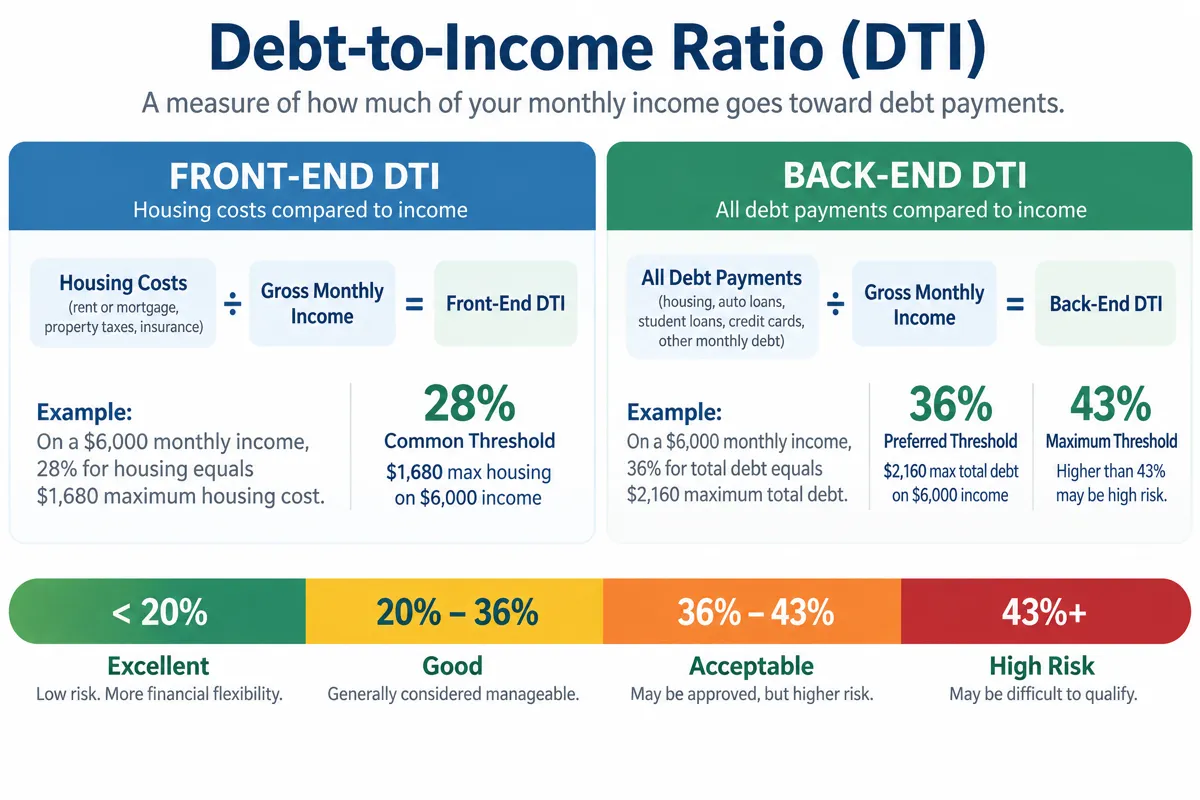
Debt-to-income ratio (DTI) measures the percentage of your gross monthly income that goes toward paying recurring debts. Lenders use it as a primary gauge of your ability to manage new monthly payments. The formula is simple: DTI = (Total Monthly Debt Payments / Gross Monthly Income) x 100. If you earn $8,000/month before taxes and pay $2,400 in total debts, your back-end DTI is 30%.
Lenders evaluate two distinct versions of DTI. The front-end ratio (also called the housing ratio) includes only housing-related costs: mortgage principal and interest, property taxes, homeowners insurance, and HOA dues. Conventional lenders typically want this at or below 28%. The back-end ratio includes housing costs plus all other recurring obligations: car payments, student loans, credit card minimums, personal loans, child support, and alimony. The standard threshold for conventional loans is 36%, though some lenders extend this to 43% or even 45% with strong compensating factors.
The critical detail most borrowers miss: lenders use gross income (before taxes and deductions), not net take-home pay. A person earning $72,000 annually has a gross monthly income of $6,000, even if their paycheck after taxes, retirement contributions, and insurance premiums is only $4,200. This distinction means your DTI may be lower than you think if you have been mentally calculating with net pay. Use our Debt-to-Income Ratio Calculator to see your exact front-end and back-end ratios instantly.
What Counts as Debt (and What Does Not)
Not every monthly expense counts toward DTI. Lenders include fixed monthly obligations that appear on your credit report, plus housing costs. Here is the full breakdown:
| Included in DTI | NOT Included in DTI |
|---|---|
| Mortgage / Rent payment | Groceries and food |
| Property taxes and insurance | Utility bills (electric, gas, water) |
| Car loan payments | Streaming subscriptions |
| Student loan payments | Cell phone bills |
| Credit card minimum payments | Gasoline and transportation |
| Personal loan payments | Health / auto / life insurance |
| Child support / Alimony | Gym memberships |
| Co-signed loan obligations | Daycare / tuition expenses |
Two common traps: credit card minimums are counted at the minimum payment due on your statement, not the full balance or the amount you actually pay. If your minimum is $35 but you pay $500/month, lenders count $35. Second, deferred student loans still count — most lenders impute 0.5% to 1% of the outstanding balance as a monthly obligation, even during deferment or forbearance. A $45,000 student loan balance in deferment adds $225 to $450/month to your DTI calculation.
DTI Thresholds by Loan Program
Different mortgage programs set different DTI limits. The table below shows the standard guidelines lenders follow in 2026:
| Loan Program | Front-End Max | Back-End Max | Exceptions |
|---|---|---|---|
| Conventional | 28% | 36% | Up to 45% with 740+ credit, 20%+ down payment |
| FHA | 31% | 43% | Up to 50% with 680+ credit, 3+ months reserves |
| VA | No limit | 41% | Residual income test used; no hard front-end cap |
| USDA | 29% | 41% | Eligible rural properties; income limits apply |
| Qualified Mortgage (QM) | N/A | 43% | Federal Dodd-Frank limit; exceeding loses QM safe harbor |
These thresholds are guidelines, not absolute ceilings. Lenders can make exceptions when you have compensating factors: large cash reserves (6+ months of payments), excellent credit above 740, a substantial down payment (20%+), or stable employment history of 5+ years. However, staying within these ranges ensures you qualify for the most competitive rates and widest range of products. Check your Mortgage Calculator to model payments at different price points that keep you within your DTI limits.
Case Study: Adriana and Kevin Apply for Their First Home
Adriana, a 31-year-old registered nurse in Charlotte, NC, earns $5,500/month gross. Her fiance Kevin, a high school teacher, earns $4,000/month. Their combined gross monthly income is $9,500. They want to buy a home priced at $375,000 with 10% down ($37,500), financing $337,500 at 6.5% interest over 30 years.
Their estimated monthly housing payment (PITI): $2,133 for principal and interest, $312 for property taxes, $125 for homeowners insurance, and $95 for PMI (since they are putting less than 20% down). Total housing cost: $2,665/month.
Their existing monthly debts:
| Debt | Monthly Payment | Balance |
|---|---|---|
| Adriana's car payment | $385 | $14,200 |
| Kevin's student loans | $290 | $28,000 |
| Credit card minimums (combined) | $175 | $6,800 |
| Total non-housing debt | $850 |
Front-end DTI: $2,665 / $9,500 = 28.1%— barely above the 28% conventional threshold but within FHA's 31% limit.
Back-end DTI: ($2,665 + $850) / $9,500 = $3,515 / $9,500 = 37.0% — above the conventional 36% limit but under the FHA 43% ceiling.
With a conventional loan, Adriana and Kevin are over the standard 36% back-end threshold. Their lender offers approval at 37% DTI because both have credit scores above 720 and they have $18,000 in savings beyond the down payment (4.8 months of reserves). But their rate includes a 0.25% risk-based pricing adjustment compared to a borrower at 32% DTI, costing them an extra $17,100 over 30 years.
If they pay off the $6,800 credit card balance before applying — eliminating $175/month — their back-end DTI drops to 35.2%, qualifying them for the standard rate tier and saving that $17,100. The $6,800 payoff generates a 2.5x returnin avoided interest. This is why reducing small debts before a mortgage application can have an outsized financial impact. Use our Home Affordability Calculator to see exactly how debt reduction changes your maximum qualifying home price.
Maximum Debt Capacity by Income Level
The following table shows how much monthly debt you can carry at each DTI threshold for different gross income levels. These numbers represent total capacity — subtract your existing non-housing debts to find your available housing budget:
| Gross Monthly Income | Max Housing at 28% | Max Total Debt at 36% | Max Total Debt at 43% | Max Total Debt at 50% |
|---|---|---|---|---|
| $4,000 | $1,120 | $1,440 | $1,720 | $2,000 |
| $6,000 | $1,680 | $2,160 | $2,580 | $3,000 |
| $8,000 | $2,240 | $2,880 | $3,440 | $4,000 |
| $10,000 | $2,800 | $3,600 | $4,300 | $5,000 |
| $12,500 | $3,500 | $4,500 | $5,375 | $6,250 |
| $15,000 | $4,200 | $5,400 | $6,450 | $7,500 |
The gap between 36% and 43% widens at higher incomes. At $10,000/month, that 7-percentage-point spread represents $700/month in additional debt capacity — enough to cover a car payment and student loans. However, stretching to 43% leaves far less cushion for emergencies, lifestyle expenses, and retirement savings. Financial advisors generally recommend keeping back-end DTI below 35% for long-term financial health, even if lenders will approve higher. See how your budget breaks down with our 50/30/20 Budget Calculator to understand whether stretching your DTI leaves enough for savings and discretionary spending.
6 Strategies to Lower Your DTI Before a Mortgage Application
1. Pay off high-minimum debts first. Target debts with the largest monthly payments relative to their balance. Paying off a $3,500 credit card with a $150/month minimum has the same DTI impact as earning $417 more per month (at 36% threshold). A $400/month car payment with 8 months remaining can be eliminated for $3,200, freeing significant DTI capacity. Prioritize by monthly payment size, not by interest rate or balance, when your immediate goal is mortgage qualification.
2. Increase your documented income. Overtime, bonuses, commissions, and side income count if you can demonstrate 2 years of consistent earning history. A documented side income of $600/month increases your gross income from $6,000 to $6,600, dropping a 38% DTI to 34.5%. Ask your employer about overtime opportunities 12 to 24 months before you plan to apply. For freelance income, ensure it appears on your last two tax returns.
3. Avoid new debt in the 6-12 months before applying. Every new loan or credit card balance adds to your monthly obligations. Do not finance furniture, a new car, or make large purchases on credit. Even a $5,000 personal loan at $150/month can push you from 35% to 37.5% DTI on a $6,000 income.
4. Consolidate debts to lower monthly payments. Refinancing a car loan from a 4-year term to a 6-year term reduces the monthly payment, though it increases total interest. If the priority is qualifying for a mortgage, the reduced monthly payment may be worth the trade-off. A $20,000 auto loan at 6.5% drops from $475/month (4-year) to $337/month (6-year), freeing $138/month in DTI.
5. Add a co-borrower.A spouse or partner's income increases the denominator in the DTI formula. A couple earning $4,500 and $5,500 individually has DTI calculated on $10,000 combined, giving them substantially more borrowing power than either person alone. However, the co-borrower's debts are also included, so this strategy works best when the co-borrower has minimal existing obligations.
6. Request a credit card minimum payment reduction. Some credit card issuers will lower your minimum payment if you have a strong payment history. Reducing a minimum from $200 to $125 on a $6,000 balance saves $75/month in DTI — a small change that can be the difference between approval and denial. This does not affect your balance or interest rate.
DTI vs. Credit Score: How Lenders Weigh Each Factor
Both DTI and credit score are critical, but they measure fundamentally different things. Your credit score is backward-looking — it reflects how reliably you have repaid debts in the past based on payment history, utilization, length of credit history, and credit mix. Your DTI is forward-looking — it measures how much of your current income is committed to debt, indicating your capacity to take on more.
You can have a 780 credit score and be denied a mortgage if your DTI is 55%. Conversely, a borrower with a 680 credit score and 25% DTI may qualify more easily than someone with 750 credit and 44% DTI. In practice, lenders use both together in a matrix: strong credit can compensate for slightly elevated DTI (up to 3-5 percentage points above standard thresholds), and low DTI can partially offset a lower credit score.
The most competitive mortgage terms go to borrowers with both a credit score above 740 and a back-end DTI below 36%. This combination qualifies you for the best rates, lowest PMI premiums, and widest selection of loan products. Use our Mortgage Calculator to model the rate you are likely to receive at different DTI levels and see the total cost difference over your loan term.
Common DTI Calculation Mistakes to Avoid
- Using net income instead of gross — Lenders always calculate with pre-tax income. Using take-home pay inflates your apparent DTI. An $85,000 annual salary is $7,083/month gross, not the $5,200 that may hit your bank account after taxes, 401(k), and insurance.
- Forgetting co-signed loans— If you co-signed a family member's car loan or student loan, that payment appears on your credit report and counts toward your DTI, even if the other person makes every payment. The only way to remove it is to refinance the loan in the other person's name alone.
- Ignoring deferred student loans — Many borrowers assume deferred loans do not count. Most lenders impute 0.5% to 1% of the loan balance as a monthly payment. A $50,000 deferred student loan adds $250 to $500/month to your DTI.
- Counting non-debt expenses — Utilities, groceries, subscriptions, gas, and childcare are not debts. Only fixed monthly obligations that appear on your credit report (plus proposed housing costs) count toward DTI.
- Using the wrong credit card number — Lenders use the minimum payment due from your credit report, not your full balance or what you actually pay. Check your credit report to see the reported minimum.
Check Your Debt-to-Income Ratio
Use our free calculator to see your front-end and back-end DTI, lender qualification thresholds, and how much room you have to borrow.
Open Debt-to-Income CalculatorFrequently Asked Questions
What is a good debt-to-income ratio for a mortgage?
A back-end debt-to-income ratio of 36% or lower is considered good by most conventional mortgage lenders, meaning no more than 36% of your gross monthly income goes toward total debt payments. A front-end DTI of 28% or less for housing costs alone is the standard guideline. Below 20% back-end DTI is excellent and gives you the best rates and most loan options. FHA loans may accept up to 43% back-end DTI, and in some cases up to 50% with strong compensating factors like a high credit score or large cash reserves.
What debts are included in the DTI calculation?
Lenders include all recurring monthly obligations that appear on your credit report plus housing costs. This covers mortgage or rent payments, property taxes, homeowners insurance, car loan payments, student loan payments, credit card minimum payments, personal loans, child support, alimony, and co-signed loan obligations. Utilities, groceries, streaming subscriptions, gas, and insurance premiums other than homeowners are not included. For credit cards, lenders use the minimum payment due, not your full balance or the amount you actually pay each month.
How do I calculate my debt-to-income ratio?
Divide your total monthly debt payments by your gross monthly income (before taxes) and multiply by 100 to get a percentage. For example, if you earn $7,000 per month gross and pay $2,100 in total monthly debts including housing, your DTI is $2,100 divided by $7,000 times 100, which equals 30%. Lenders calculate two versions: front-end DTI uses only housing costs, and back-end DTI uses all debt payments. Always use pre-tax income, not take-home pay.
Can I get a mortgage with a 45% debt-to-income ratio?
It is difficult with conventional loans, which typically cap back-end DTI at 36% to 45% depending on compensating factors. FHA loans allow up to 43% as a standard guideline and may stretch to 50% if you have significant cash reserves, a credit score above 680, or a substantial down payment. Some non-QM lenders offer products for higher DTI borrowers at higher interest rates. A 45% DTI leaves minimal financial cushion, so most financial advisors recommend reducing debt before applying.
Does my DTI affect my interest rate?
Yes, indirectly. While DTI is primarily a qualification metric rather than a direct pricing factor, a higher DTI signals greater risk to lenders. Borrowers with DTI ratios above 36% may face risk-based pricing adjustments that add 0.25% to 0.75% to their interest rate compared to borrowers with DTI below 30%. Additionally, a higher DTI limits your loan options to programs with less competitive rates. Reducing your DTI from 42% to 34% could save you $30,000 to $50,000 in interest over a 30-year mortgage.