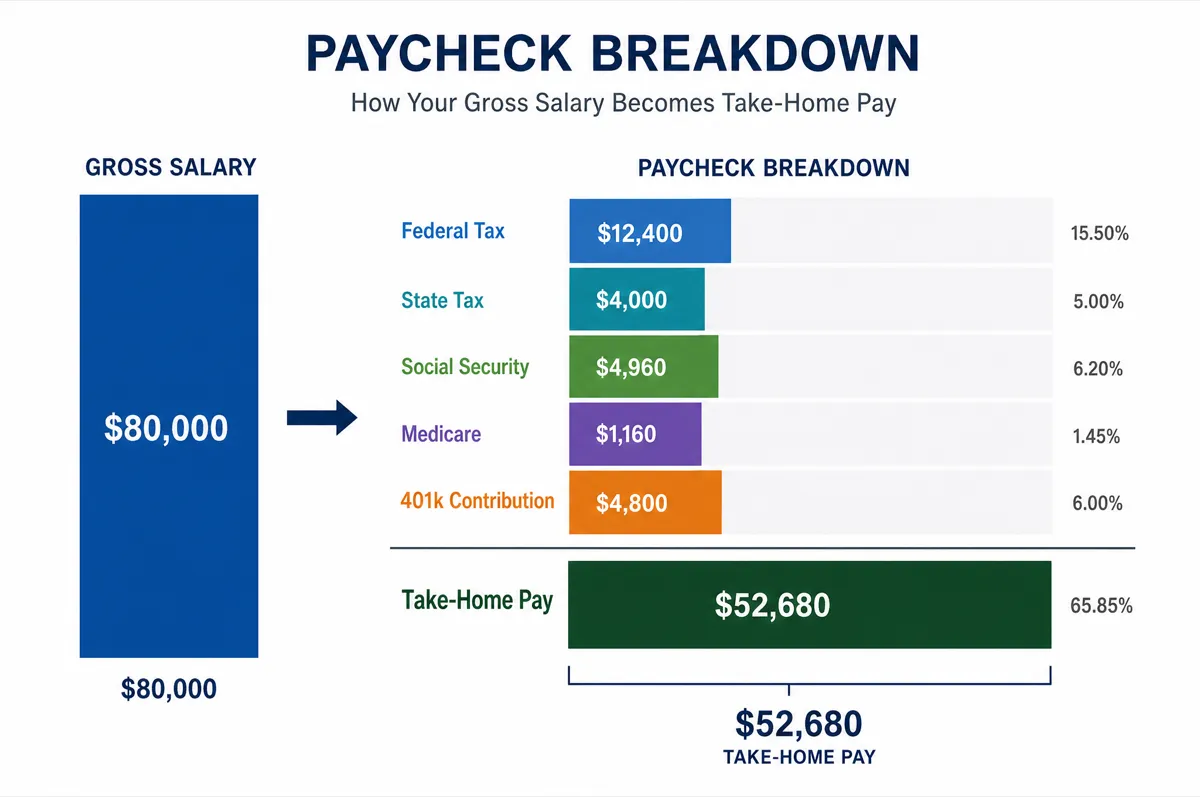
How Your Paycheck Is Calculated
Every pay period, your employer withholds a series of deductions from your gross pay before depositing the remainder into your bank account. Understanding each deduction helps you forecast your actual spending power and make better decisions about retirement contributions, tax withholding adjustments, and overall budgeting. The gap between what you earn on paper and what hits your checking account can be surprising, especially for first-time salaried employees or those switching from freelance to W-2 employment.
The major components of paycheck withholding fall into three categories: federal income tax (progressive, based on filing status and income), FICA taxes (Social Security at 6.2% up to the wage base of $168,600, plus Medicare at 1.45% with no cap), and state/local income taxes that vary widely by jurisdiction. On top of these mandatory withholdings, voluntary pre-tax deductions like 401(k) contributions, health insurance premiums, and HSA contributions further reduce your taxable income.
Key Concepts Behind Paycheck Withholding
Federal income tax withholding uses the W-4 form you submitted when starting your job. The IRS progressive bracket system means your first $11,600 (single filer, 2026) is taxed at only 10%, then the next $35,550 at 12%, and so on up through the 37% bracket. Your employer approximates your annual tax liability and divides it evenly across pay periods, so your per-paycheck withholding stays consistent even though the brackets are annual.
FICA taxes fund Social Security and Medicare. Unlike income tax, these are flat-rate taxes with no deductions or brackets reducing them (below the wage base). The 6.2% Social Security tax stops once you earn $168,600 in a calendar year — if you earn more than this, your later paychecks will see a bump in take-home pay because Social Security withholding stops. Medicare has no cap and adds a 0.9% surtax on earnings above $200,000 for single filers. Your employer matches your FICA contributions dollar-for-dollar, but that match does not appear on your pay stub.
Pre-tax deductions like traditional 401(k) contributions reduce your taxable income dollar for dollar. Contributing 6% of a $75,000 salary ($4,500 per year) lowers your federal taxable income to $70,500, saving you roughly $990 in federal taxes at the 22% bracket. This is why financial planners often describe 401(k) contributions as costing less than the headline amount — a $4,500 contribution might only reduce your take-home pay by about $3,500 because of the tax savings. Use our Income Tax Calculator to see exactly how different income levels map to tax brackets.
Case Study: Marcus, Software Developer in Texas
Marcus earns $95,000 per year as a mid-level developer in Austin, Texas. He is paid bi-weekly (26 paychecks per year) and files as single. Texas has no state income tax, but he contributes 8% to his 401(k). Here is how his paycheck breaks down:
- Gross pay per paycheck: $3,653.85
- 401(k) contribution (8%): -$292.31
- Federal income tax: -$432.19 (based on $72,400 taxable after standard deduction and 401(k))
- Social Security (6.2%): -$226.54
- Medicare (1.45%): -$52.98
- State tax: $0.00 (Texas has no income tax)
- Take-home pay: $2,649.83
Marcus takes home 72.5% of his gross pay. His effective overall tax rate is 19.5%, and his retirement savings grow tax-deferred at $7,600 per year. If he moved to California (top marginal rate of 9.3%), his take-home would drop by roughly $200 per paycheck. He uses the 50/30/20 Budget Calculator to allocate his $5,300 monthly take-home between needs, wants, and savings.
How Pay Frequency Affects Your Finances
| Pay Frequency | Paychecks/Year | Gross Per Check ($75K) | Best For |
|---|---|---|---|
| Weekly | 52 | $1,442 | Hourly workers, tight cash flow management |
| Bi-weekly | 26 | $2,885 | Most common for salaried employees |
| Semi-monthly | 24 | $3,125 | Aligns with monthly bill cycles |
| Monthly | 12 | $6,250 | Executives, some government positions |
Bi-weekly pay creates two “bonus” months per year where you receive three paychecks instead of two. These months are powerful savings opportunities — if your budget is built around two paychecks per month, that third check can go directly to your savings goal or debt payoff without affecting your normal spending.
State Tax Impact: A Comparison
| State | Income Tax Rate (approx.) | Annual Tax on $75K | Monthly Take-Home Difference vs. No-Tax State |
|---|---|---|---|
| Texas / Florida / Washington | 0% | $0 | Baseline |
| Colorado | 4.4% | $3,300 | -$275/mo |
| Illinois | 4.95% | $3,713 | -$309/mo |
| New York | ~6.5% | $4,875 | -$406/mo |
| California | ~8% | $6,000 | -$500/mo |
State income tax significantly impacts take-home pay, but should not be the sole factor in relocation decisions. No-tax states often have higher property taxes or sales taxes that offset the income tax savings. The true comparison requires looking at your total tax burden including property, sales, and local taxes specific to your spending patterns.
Strategies to Maximize Your Take-Home Pay
- Optimize W-4 withholding: If you consistently receive large tax refunds ($1,000+), you are over-withholding. Adjust your W-4 to keep more money in each paycheck rather than giving the IRS an interest-free loan.
- Use pre-tax benefits strategically: Max out your HSA ($4,150 individual / $8,300 family in 2026) if eligible — it reduces taxable income, grows tax-free, and withdrawals for medical expenses are never taxed.
- Consider Roth vs. Traditional 401(k): Roth contributions do not reduce your current paycheck taxes, but they grow tax-free. If you expect to be in a higher bracket in retirement, Roth may win long-term despite the lower current take-home. Read our 401(k) vs Roth IRA guide for a detailed comparison.
- Leverage FSA or DCFSA: Flexible Spending Accounts for healthcare ($3,200) or dependent care ($5,000) reduce taxable income and cover predictable expenses with pre-tax dollars.
- Watch the Social Security wage base: High earners ($168,600+) see a take-home pay increase in later months when Social Security withholding stops for the year. Plan for this windfall rather than letting lifestyle creep absorb it.
Frequently Asked Questions
Why is my take-home pay so much lower than my salary?
Federal income tax, Social Security (6.2%), Medicare (1.45%), state taxes, and pre-tax deductions like 401(k) and health insurance all reduce your gross pay. For a typical single filer earning $75,000 with a 5% state tax and 6% 401(k) contribution, total deductions consume roughly 30-35% of gross pay, leaving about $48,000-$52,000 in actual take-home.
Does my 401(k) contribution actually cost me the full amount?
No. Pre-tax 401(k) contributions reduce your taxable income, so the net cost to your paycheck is less than the contribution amount. If you are in the 22% federal bracket plus 5% state tax, every $100 contributed only reduces your take-home by about $73. You get $100 invested for $73 of reduced spending money.
How do I calculate my paycheck if I am paid hourly?
Multiply your hourly rate by hours worked in the pay period to get gross pay. Then apply the same withholding calculations: federal and state income tax based on annualized income, Social Security at 6.2%, and Medicare at 1.45%. Overtime hours (over 40/week) are paid at 1.5x your regular rate and taxed at your marginal rate.
What happens to my paycheck when I get a raise?
Only the portion of your raise that pushes you into a new bracket is taxed at the higher rate. A $5,000 raise does not move your entire salary into a higher bracket — it only increases your marginal tax by the bracket rate applied to those additional dollars. Your effective tax rate rises gradually, not suddenly. Use our Income Tax Calculator to model your specific before-and-after scenario.
Should I adjust my withholding if I have a side income?
Yes. If you have freelance or gig income, your employer withholding is calculated only on your W-2 salary. You will owe additional taxes on 1099 income at filing time. Either increase W-4 withholding at your primary job or make quarterly estimated payments (Form 1040-ES) to avoid underpayment penalties.