Guides / Auto Finance
How Much Car Can I Afford? The Complete 2026 Guide by Salary
The average new car transaction price hit $48,528 in Q2 2026, while the average auto loan payment climbed to $738/month over 68 months. Nearly 17% of new car buyers now commit more than 15% of their gross income to vehicle payments alone — a level that financial advisors call "car poor." This guide uses the 20/4/10 rule and real 2026 loan rates to show you exactly how much car you can afford at every income level, from $40,000 to $150,000, without wrecking your budget.
Last updated: August 2026
TL;DR - Quick Answer
- The 20/4/10 rule: Put 20% down, finance for 4 years max, keep total car costs (payment + insurance + gas) under 10% of gross monthly income
- $50K salary: Afford $17,500-$25,000 car ($290-$420/month total costs)
- $75K salary: Afford $26,000-$37,500 car ($435-$625/month total costs)
- $100K salary: Afford $35,000-$50,000 car ($580-$833/month total costs)
- Hidden costs add 30-40%: Insurance ($150-$220/month), gas ($120-$180/month), and maintenance ($75-$125/month) are on top of the loan payment
Use our Auto Loan Calculator and Budget Calculator to model your exact scenario.
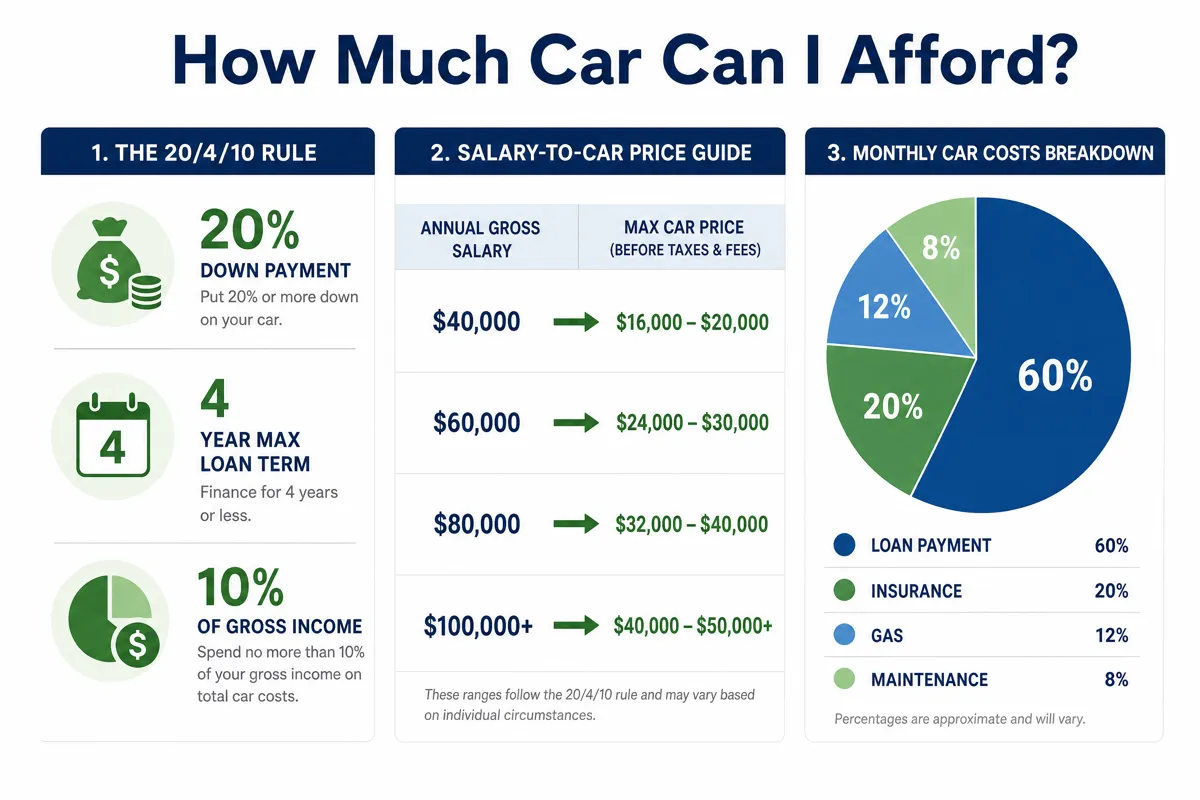
The 20/4/10 Rule: How Much Car You Can Actually Afford
Financial advisors developed the 20/4/10 rule as a guardrail against the auto industry's push toward longer loan terms and lower down payments. Dealerships will approve you for far more than you should spend — lenders routinely approve borrowers for payments consuming 15-20% of gross income. The 20/4/10 rule draws the line at a sustainable level.
20% Down Payment
A 20% down payment immediately solves two problems: it reduces your loan balance (and therefore monthly payment and total interest), and it protects you from being "underwater" — owing more than the car is worth. New cars lose 10-15% of value the moment you drive off the lot and 20-30% within the first two years. On a $30,000 car, 20% down ($6,000) means you borrow $24,000. If the car is worth $25,500 after you leave the dealership (15% immediate depreciation), your loan balance is $24,000 — you still have equity. With 0% down, you owe $30,000 on a car worth $25,500, and you are $4,500 underwater from day one.
4-Year (48-Month) Maximum Loan Term
The average auto loan term has stretched to 68 months in 2026, with 72- and 84-month loans increasingly common. Longer terms lower monthly payments but dramatically increase total interest and keep you underwater longer. On a $24,000 loan at 6.5% APR: a 48-month term costs $569/month with $3,328 total interest; a 72-month term costs $406/month but with $5,230 total interest — $1,902 more paid to the bank. Worse, at month 36 of a 72-month loan you still owe $12,840 on a car worth approximately $12,000, making it nearly impossible to trade in without rolling negative equity into your next loan.
10% of Gross Monthly Income for Total Car Costs
This is the most commonly violated boundary and the most important. Total car costs include the monthly loan payment, insurance premium, fuel, and routine maintenance. On a $70,000 salary ($5,833/month gross), the 10% ceiling is $583/month. If your loan payment is $480/month, you have just $103 left for insurance, gas, and maintenance — meaning you probably cannot afford that payment. Insurance alone averages $175/month for full coverage in 2026. The 10% rule forces you to account for the real cost of ownership, not just the loan payment.
How Much Car Can I Afford by Salary? (2026 Rates)
The following table applies the 20/4/10 rule at current August 2026 auto loan rates (5.5-6.8% APR for new, 7.5-9.0% for used) to show maximum car price by annual salary. All numbers assume a 20% down payment, 48-month loan at 6.5% APR, and average insurance/fuel costs.
| Annual Salary | 10% Monthly Budget | Max Loan Payment | Max Car Price | Down Payment (20%) |
|---|---|---|---|---|
| $40,000 | $333 | $133 | $7,000 | $1,400 |
| $50,000 | $417 | $217 | $11,400 | $2,280 |
| $60,000 | $500 | $300 | $15,800 | $3,160 |
| $70,000 | $583 | $383 | $20,200 | $4,040 |
| $80,000 | $667 | $467 | $24,600 | $4,920 |
| $90,000 | $750 | $550 | $29,000 | $5,800 |
| $100,000 | $833 | $633 | $33,400 | $6,680 |
| $120,000 | $1,000 | $800 | $42,200 | $8,440 |
| $150,000 | $1,250 | $1,050 | $55,400 | $11,080 |
*Max loan payment = 10% monthly budget minus $200 estimated insurance/gas/maintenance. Max car price = max loan amount (from 48-month payment at 6.5% APR) / 0.80 to account for 20% down. Actual numbers vary by credit score, location, and vehicle type.
Important Caveat
At $40,000 income, the 20/4/10 rule limits you to roughly $7,000 — a car you will likely buy with cash rather than finance. This is by design: the rule acknowledges that at lower income levels, a car payment competes directly with rent, groceries, and emergency savings. If you earn under $50,000, prioritize reliable used vehicles in the $5,000-$12,000 range and avoid financing more than 36 months.
Total Cost of Ownership: The Numbers Dealerships Never Show You
Your monthly payment is just 55-65% of what a car actually costs each month. The rest — insurance, fuel, depreciation, and maintenance — adds $350-$600/month depending on the vehicle. Here is a breakdown for three popular 2026 vehicles.
| Monthly Cost | Honda Civic ($28,500) | Toyota RAV4 ($35,000) | Ford F-150 ($48,000) |
|---|---|---|---|
| Loan payment (20% down, 48 mo., 6.5%) | $541 | $665 | $912 |
| Insurance (full coverage) | $155 | $185 | $220 |
| Fuel (12,000 mi/year) | $120 | $140 | $195 |
| Maintenance & repairs | $75 | $90 | $125 |
| Depreciation (year 1-4 avg) | $225 | $280 | $390 |
| Total monthly cost | $1,116 | $1,360 | $1,842 |
| Salary needed (10% rule) | $133,900 | $163,200 | $221,000 |
| Salary needed (payment + insurance + gas only) | $97,900 | $118,800 | $159,200 |
*Fuel cost assumes $3.50/gallon national average (August 2026). Insurance based on 30-year-old driver with clean record and 750+ credit score. Depreciation is the average annual value loss over the first 4 years of ownership.
The Depreciation Tax
Depreciation is the largest cost of car ownership and the one most buyers ignore because it is invisible — there is no monthly bill. A $48,000 truck loses $4,680 in value during year one alone. Over four years of ownership, depreciation on new vehicles averages 40-50% of the purchase price. Buying a 2-3 year old vehicle lets the first owner absorb that hit: a $48,000 F-150 purchased at $32,000 with 25,000 miles saves you approximately $16,000 in depreciation without significantly changing reliability or maintenance costs.
Case Study: Rachel, 31, Buying Her First Car on a $68,000 Salary
Her Situation
- Age: 31, UX designer in Portland, OR
- Gross salary: $68,000/year ($5,667/month gross)
- Take-home pay: $4,350/month after tax
- Credit score: 720 (qualifies for 6.5% APR)
- Savings available for down payment: $7,000
- Current rent: $1,600/month
- Existing debt: $280/month student loan payment
- Needs: reliable commuter, 25-mile round trip, 5 days/week
Her 20/4/10 Budget
- 10% monthly budget: $567/month ($5,667 x 10%)
- Insurance estimate: $165/month (full coverage, Portland rates, clean record)
- Fuel estimate: $95/month (25 mi/day x 22 days, 32 MPG, $3.80/gal Oregon avg)
- Maintenance: $65/month average
- Available for loan payment: $242/month ($567 - $165 - $95 - $65)
- Max loan at $242/mo, 48 months, 6.5%: $10,200
- Down payment: $5,100 (20% of car price)
- Max car price: $12,750 ($10,200 / 0.80)
What Rachel Actually Did
The strict 20/4/10 math pointed to a $12,750 max car price. But Rachel had $7,000 saved — more than the 20% minimum ($2,550) — so she could put a larger down payment to afford a slightly better vehicle. She allocated $6,000 as down payment (keeping $1,000 as a car repair emergency fund) and searched for certified pre-owned vehicles.
She found a 2024 Honda Civic EX with 22,000 miles, certified pre-owned, priced at $22,500. With $6,000 down (27% of price), her loan was $16,500 at 7.2% APR (used car rate for 720 credit score). Over 48 months, her payment was $397/month.
Rachel's Monthly Breakdown
Loan payment
$397
Insurance
$155
Fuel
$85
Total monthly
$637
Rachel's total monthly car costs came to $637 — 11.2% of her gross monthly income, slightly above the 10% guideline. She accepted this because: (1) her student loan payments end in 14 months, freeing $280/month; (2) the CPO Civic has a remaining 3-year/36,000-mile warranty, reducing maintenance risk; (3) the 27% down payment meant she had $6,000 in equity from day one, protecting against negative equity.
The Alternative She Avoided
The dealership approved Rachel for a $35,000 new RAV4 with $2,000 down and 72-month financing at 6.9% APR. That monthly payment alone would have been $567/month — her entire 10% car budget before insurance and fuel. Total monthly costs would have been $807 (14.2% of gross income), and she would have been $4,200 underwater by month 12. The CPO Civic costs her $170/month less, builds equity faster, and she will own it free and clear in 4 years with 70,000 miles — well within a Civic's 200,000+ mile reliability window.
New vs Used: The Real Cost Difference in 2026
New cars offer the latest features, full warranty, and better loan rates. Used cars cost less upfront and avoid the steepest depreciation. Here is the math on the same vehicle — a Toyota Camry — bought new versus 2 years old.
| Metric | 2026 Camry (New) | 2024 Camry (Used, 28K mi) |
|---|---|---|
| Purchase price | $30,500 | $22,800 |
| Down payment (20%) | $6,100 | $4,560 |
| Loan amount | $24,400 | $18,240 |
| Interest rate (48 months) | 6.2% APR | 7.8% APR |
| Monthly payment | $575 | $444 |
| Total interest paid | $3,200 | $3,072 |
| Total out-of-pocket (4 years) | $33,700 | $25,872 |
| Value at year 4 (6 yrs old / 4 yrs old) | $14,600 | $13,200 |
| True cost of ownership (4 years) | $19,100 | $12,672 |
| Savings (used vs new) | — | $6,428 |
*New car APR based on national average for 700+ credit score (August 2026). Used car APR typically 1.3-2.0% higher. Residual values from Kelley Blue Book projections. True cost = total payments + down payment - residual value.
Step-by-Step: How to Calculate Your Car Budget
Calculate your 10% monthly car budget
Take your gross annual salary, divide by 12, multiply by 0.10. Example: $72,000 / 12 = $6,000/month gross x 0.10 = $600/month total car budget.
Subtract estimated insurance, fuel, and maintenance
Get an insurance quote online (Progressive, Geico, State Farm) before shopping for cars. Budget $100-$180 for fuel depending on commute and $65-$100 for maintenance. $600 - $170 insurance - $130 fuel - $75 maintenance = $225 available for loan payment.
Calculate your maximum loan amount
Use the Auto Loan Calculator to find the loan amount that produces your target monthly payment at current rates. At $225/month, 48 months, 6.5% APR, your max loan is approximately $9,480.
Add your down payment to find max purchase price
Max car price = max loan / 0.80 (to build in the 20% down). $9,480 / 0.80 = $11,850 max car price. Your 20% down payment is $2,370, and you finance the remaining $9,480.
Shop within your budget (not the dealer's approval)
Get pre-approved through your bank or credit union before visiting dealerships. Pre-approval locks your rate, prevents dealer markup on financing, and gives you a non-negotiable price ceiling. When a salesperson says "we can get you approved for $35,000," you already know your real number is $11,850.
48 vs 60 vs 72 Months: How Loan Term Affects Total Cost
Stretching a loan term lowers monthly payments but dramatically increases what you pay in total. Here is the same $24,000 loan at 6.5% APR across three common terms.
| Metric | 48 Months | 60 Months | 72 Months |
|---|---|---|---|
| Monthly payment | $569 | $470 | $406 |
| Total interest | $3,328 | $4,183 | $5,230 |
| Total paid | $27,328 | $28,183 | $29,230 |
| Car value at payoff | ~$16,200 | ~$13,400 | ~$10,800 |
| Months underwater | 0 | ~14 | ~30 |
| Extra cost vs 48 months | $0 (baseline) | +$855 | +$1,902 |
*Loan amount: $24,000 at 6.5% APR. Car values assume 15% year-1 depreciation, then 12% annually thereafter on a $30,000 new purchase. "Underwater" = loan balance exceeds car value.
Calculate Your Car Budget
Every situation is different. Use our free calculators to find the exact car price, monthly payment, and total cost that fits your salary, down payment, and loan terms.
Frequently Asked Questions
How much car can I afford on a $50,000 salary?
On a $50,000 salary, you can afford a car priced between $17,500 and $25,000 using the 20/4/10 rule. With a 20% down payment ($3,500-$5,000), a 48-month loan at 6.5% APR, and total monthly car costs (payment + insurance + gas) under $417 (10% of $4,167 gross monthly income), a $20,000-$22,000 vehicle is the sweet spot. This keeps your monthly payment around $290-$320, leaving room for $100-$130 in insurance and fuel. Going above $25,000 typically pushes total monthly costs past the 10% threshold, risking financial strain on other budget categories.
What is the 20/4/10 rule for buying a car?
The 20/4/10 rule is a car-buying guideline that sets three boundaries: put at least 20% down, finance for no more than 4 years (48 months), and keep total monthly transportation costs (loan payment + insurance + gas + maintenance) under 10% of your gross monthly income. On a $70,000 salary ($5,833/month gross), that means total car costs should stay below $583/month. The rule prevents buyers from becoming 'car poor' — spending so much on a vehicle that savings, retirement contributions, and lifestyle spending suffer. It was popularized by financial advisors as a response to the trend toward 72-84 month auto loans that keep borrowers underwater on their vehicles for years.
Is it better to buy new or used to maximize affordability?
Used cars (2-3 years old) typically offer the best value because new cars lose 20-30% of their value in the first two years. A 2024 Toyota Camry that stickered at $30,000 sells for $21,000-$23,000 in 2026 with 25,000-35,000 miles — saving $7,000-$9,000 while still having 60-75% of its factory warranty remaining. However, used car loan rates average 7.5-9.0% APR versus 5.5-6.8% for new cars in August 2026. On a $22,000 loan over 48 months, the 2% rate difference costs $940 in extra interest — far less than the $7,000+ depreciation savings. For most buyers on a budget, a certified pre-owned vehicle 2-3 years old with under 40,000 miles provides the best balance of price, reliability, and financing terms.
How much should I put down on a car to get the best monthly payment?
Aim for 20% down to avoid being underwater on your loan and to qualify for the best interest rates. On a $28,000 car, 20% down is $5,600, leaving a $22,400 loan. At 6.5% APR over 48 months, that payment is $532/month. With only 10% down ($2,800), the $25,200 loan payment jumps to $598/month — $66 more per month and $3,168 in extra interest over the loan term. Putting 0% down on the same car means a $28,000 loan at a likely higher rate (7.0-7.5% APR with no equity), costing $670/month and $4,160 more in total interest. The 20% threshold also typically qualifies you for rates 0.5-1.0% lower because lenders see less risk when you have equity from day one.
Should I buy or lease a car in 2026?
Buy if you drive over 12,000 miles per year, plan to keep the car 5+ years, or want to build equity. Lease if you want a new car every 3 years, drive under 10,000-12,000 miles annually, and prefer lower monthly payments. A $35,000 sedan leased for 36 months at $389/month costs $14,004 in payments plus a $3,500 down payment — $17,504 total with no asset at the end. Buying the same car with 20% down ($7,000) at 6.5% APR over 48 months costs $661/month ($31,728 total payments), but you own a car worth approximately $18,000-$20,000 at payoff. Over 6 years, two 3-year leases cost $35,008 and you own nothing; buying once costs $38,728 but you have a $12,000-$14,000 asset. For most people who keep cars 5+ years, buying is $10,000-$15,000 cheaper long-term.
Related Guides
The 50/30/20 Budget Rule Explained with Real Examples
Learn the 50/30/20 budget rule with real examples at $50K, $75K, and $100K income. Includes a case study, category breakdowns, and when the rule doesn't work.
How to Save $50,000 in 3 Years: A Realistic Plan
A step-by-step plan to save $50,000 in 3 years on an average salary. Includes monthly targets, budget breakdowns, a real case study, and strategies that actually work.
How Much House Can I Afford? Complete Guide by Income Level
Learn exactly how much home you can afford based on your salary, debts, and down payment. Includes income-based tables, a real case study, and the formulas lenders actually use.