How Amortization Works
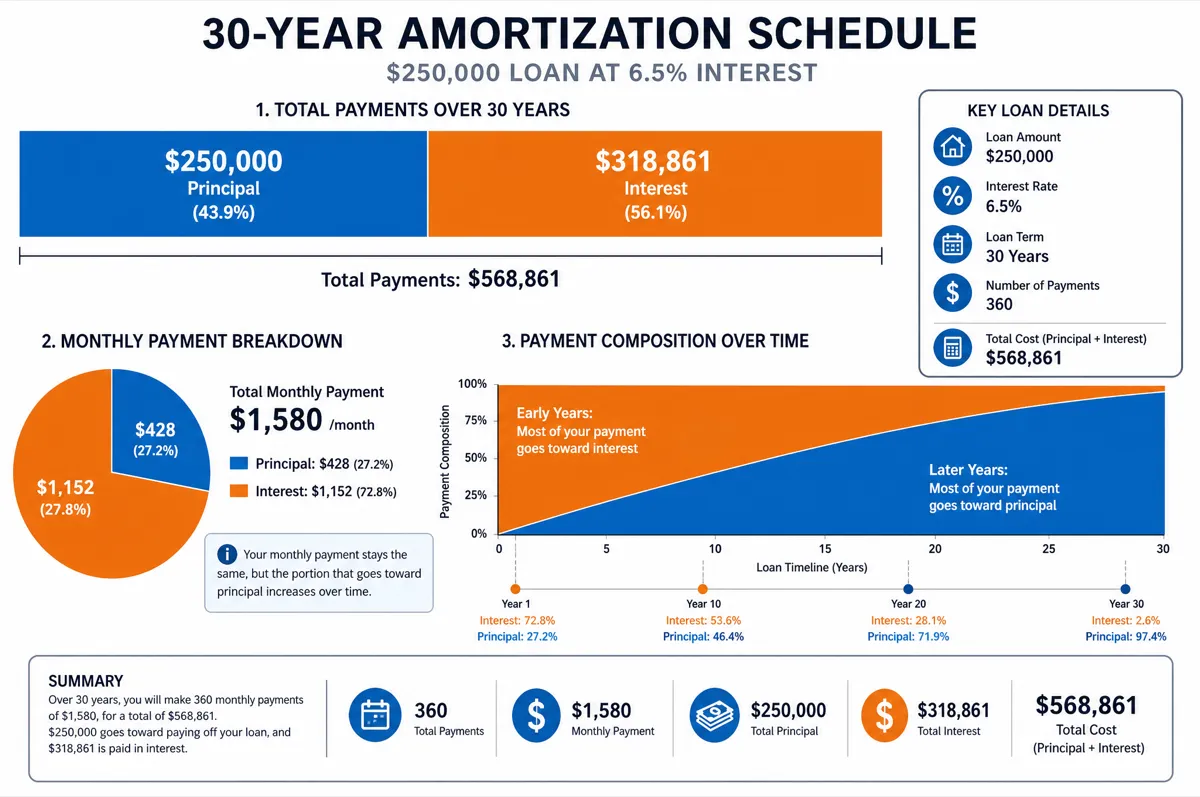
Amortization is the process of spreading a loan into a series of fixed payments over time. Each payment covers two components: interest charged on the outstanding balance and a portion that reduces the principal. Because interest is calculated on the remaining balance, early payments are heavily weighted toward interest while later payments apply mostly to principal. On a $250,000 mortgage at 6.5% over 30 years, your first monthly payment of $1,580.17 allocates $1,354.17 to interest and only $226.00 to principal. By month 180 (halfway through), the split is roughly 50/50. In the final year, nearly the entire payment reduces your balance.
Understanding this front-loaded interest structure is essential for making informed decisions about refinancing, extra payments, and loan term selection. Use our Mortgage Calculator to see how different rates and terms affect your monthly payment before generating the full amortization schedule here.
The Amortization Formula
The standard amortization formula calculates the fixed monthly payment (M) from three inputs: the loan principal (P), the monthly interest rate (r = annual rate / 12), and the total number of payments (n = years x 12):
M = P x [r(1 + r)^n] / [(1 + r)^n - 1]
For a $250,000 loan at 6.5% APR over 30 years: r = 0.065/12 = 0.005417, n = 360. Plugging in: M = $250,000 x [0.005417 x (1.005417)^360] / [(1.005417)^360 - 1] = $1,580.17 per month. The total paid over the life of the loan is $1,580.17 x 360 = $568,861, meaning you pay $318,861 in interest alone, more than the original loan amount.
Case Study: David and Lisa Compare Loan Strategies
David and Lisa are purchasing a $350,000 home in Austin, TX, with a $70,000 down payment, leaving a $280,000 mortgage. They have been approved for 6.75% APR and are deciding between a 30-year and a 15-year term. They also want to understand the impact of making an extra $200 per month in principal payments on the 30-year option.
| Scenario | Monthly Payment | Total Interest | Payoff Time |
|---|---|---|---|
| 30-year standard | $1,816 | $373,702 | 30 years |
| 30-year + $200 extra/mo | $2,016 | $270,418 | 23 years 4 months |
| 15-year fixed | $2,478 | $166,038 | 15 years |
The 15-year option saves $207,664 in interest compared to the standard 30-year mortgage, but the $662 higher monthly payment ($2,478 vs. $1,816) strains their $5,800 monthly take-home budget. The compromise option of a 30-year mortgage with $200/month extra payments reduces interest by $103,284 and shortens the loan by nearly 7 years, while keeping mandatory payments manageable if one spouse loses income. David and Lisa chose the 30-year with extra payments because it offered flexibility: they can stop extra payments during tight months without risk of default.
30-Year vs. 15-Year vs. 20-Year: Amortization Compared
The loan term determines how quickly equity builds and how much total interest you pay. Shorter terms mean higher monthly payments but dramatically less interest over the life of the loan. Here is a side-by-side comparison for a $300,000 loan at 6.5%.
| Metric | 30-Year | 20-Year | 15-Year |
|---|---|---|---|
| Monthly payment | $1,896 | $2,239 | $2,613 |
| Total interest | $382,633 | $237,360 | $170,340 |
| Total cost | $682,633 | $537,360 | $470,340 |
| Interest as % of loan | 127.5% | 79.1% | 56.8% |
| Equity at year 5 | $19,632 | $39,816 | $55,680 |
The 30-year loan costs $212,293 more in interest than the 15-year option. However, the $717 monthly savings ($2,613 - $1,896) invested in an S&P 500 index fund averaging 10% annually would grow to approximately $480,000 over 30 years. This is why the pay-off-early vs. invest decision depends on your expected investment returns relative to your mortgage rate.
The Power of Extra Payments
Even small additional principal payments produce outsized savings because they reduce the balance that accrues interest for every remaining month. On a $250,000 loan at 6.5% over 30 years, here is what different extra payment amounts achieve:
| Extra/Month | Interest Saved | Months Saved | New Payoff |
|---|---|---|---|
| $0 (baseline) | -- | -- | 30 years |
| $100 | $62,718 | 62 | 24 years 10 months |
| $250 | $117,210 | 115 | 20 years 5 months |
| $500 | $170,392 | 163 | 16 years 5 months |
| $1,000 | $222,818 | 218 | 11 years 10 months |
The first $100 extra provides the best return per dollar: $627 saved for every $1 of monthly extra payment, cutting more than 5 years off the loan. Diminishing returns set in at higher amounts, but even $250/month extra eliminates nearly a decade of payments. Consider biweekly payments as an effortless strategy: paying half your monthly amount every two weeks results in 26 half-payments (13 full payments) per year instead of 12, effectively making one extra payment annually.
Reading Your Amortization Schedule
An amortization table shows every payment over the life of your loan, broken into principal, interest, and remaining balance columns. The key patterns to watch for:
The crossover point. This is the month where your principal payment first exceeds your interest payment. On a 30-year mortgage at 6.5%, the crossover happens around month 208 (year 17). Any payment before the crossover is majority interest. Refinancing before the crossover restarts the interest-heavy cycle, which is why refinancing a 30-year mortgage after 15 years often costs more than it saves unless the rate drop is substantial.
Equity milestones. Track when you reach 20% equity to eliminate PMI (private mortgage insurance) on conventional loans. On a $300,000 home with $15,000 down (5%), you need to reach $60,000 in equity. At 6.5% on a 30-year loan, this takes approximately 9.5 years with standard payments, but just 5.5 years with $300/month extra. Use our Auto Loan Calculator to generate amortization schedules for car loans and compare the interest impact of shorter terms.
When to Refinance Based on Your Amortization Schedule
Your amortization schedule reveals whether refinancing makes financial sense. The general rule is that refinancing saves money if the new rate is at least 0.75-1% lower than your current rate and you plan to stay in the home long enough to recoup closing costs (typically 2-5% of the loan amount). However, where you stand in the amortization schedule matters more than most people realize.
If you are in years 1-10 of a 30-year mortgage, you are paying mostly interest. Refinancing to a lower rate dramatically reduces total interest because the principal reductions in the new schedule are larger from the start. If you are in years 15-25, you have already paid the bulk of the interest. Refinancing resets the amortization clock, and the new schedule front-loads interest again on your remaining balance, often negating the rate savings. Compare both scenarios with our Loan Comparison Calculator before committing to a refinance.
Tips for Using Amortization to Your Advantage
Make one extra payment per year. If your monthly payment is $1,580, putting an additional $1,580 toward principal once a year (perhaps from a tax refund or bonus) can cut 4-5 years off a 30-year mortgage and save over $50,000 in interest. Specify that the extra payment applies to principal, not as a prepayment of the next month.
Round up your payment. Rounding from $1,580 to $1,600 adds just $20/month extra but saves approximately $13,000 in interest and eliminates 14 months of payments on a $250,000 loan at 6.5%. This approach works because every dollar of extra principal reduces the interest charged on every subsequent payment.
Recast instead of refinancing. Some lenders allow recasting: after making a large lump-sum principal payment, they recalculate your monthly payment based on the reduced balance while keeping the same rate and term. This avoids the $3,000-$8,000 in closing costs associated with refinancing. Use our 15-year vs. 30-year mortgage guide to understand how term length affects the amortization dynamics.
Frequently Asked Questions
What is the difference between an amortization schedule and a loan statement?
An amortization schedule is a projected table showing every payment for the full life of the loan, assuming you make all payments on time and make no extra payments. A loan statement shows actual payments made, including any missed payments, late fees, extra payments, or escrow adjustments. The amortization schedule is your roadmap; the loan statement shows where you actually are. If you have made extra payments, your actual balance will be lower than what the original amortization schedule projected.
Does an amortization schedule work for adjustable-rate mortgages (ARMs)?
A standard amortization schedule assumes a fixed interest rate. For ARMs, the schedule is accurate only through the initial fixed-rate period (typically 5, 7, or 10 years). After the rate adjusts, the monthly payment and principal/interest split change. You can use this calculator to model different rate scenarios by generating separate schedules: one at the initial rate for the fixed period, and another at the expected adjusted rate for the remaining term.
Why do I pay more interest than principal in the first years?
Interest is calculated on the outstanding balance each month. At the start of a $250,000 loan at 6.5%, you owe interest on the full $250,000, which is $1,354/month. Since the total payment is $1,580, only $226 goes to principal. As the balance drops, less interest accrues each month, freeing up more of each payment for principal reduction. This is mathematically inherent to how fixed-payment amortization works and is not a lender trick, though it does mean early principal paydowns have the largest impact on total interest savings.
Can I use an amortization schedule for student loans or car loans?
Yes. The amortization formula works identically for any fixed-rate, fixed-term installment loan, including mortgages, auto loans, personal loans, and student loans. Enter the loan amount, interest rate, and term in years. The only difference is the typical term length: 3-7 years for auto loans, 10-25 years for student loans, and 15-30 years for mortgages. Shorter-term loans have a less dramatic interest front-loading effect because the balance decreases faster.
How do biweekly payments affect the amortization schedule?
Biweekly payments split your monthly payment in half and pay it every two weeks. Since there are 52 weeks in a year, you make 26 half-payments (equivalent to 13 full monthly payments) instead of 12. That extra payment goes entirely to principal. On a $250,000 loan at 6.5% for 30 years, biweekly payments reduce the payoff time to approximately 25 years and save about $62,000 in interest. The effect is essentially identical to making one extra monthly payment per year but is easier to budget for most people.