How to Convert Hourly Pay to Annual Salary
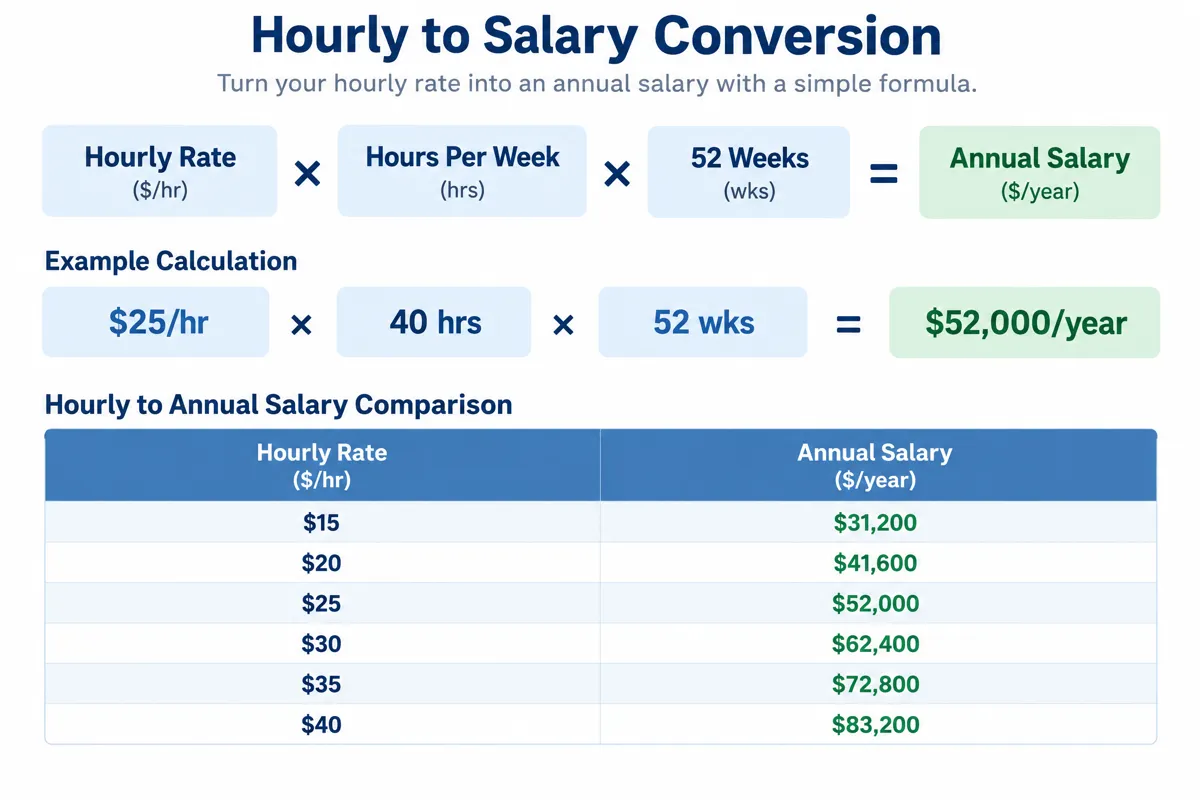
The standard formula for converting an hourly wage to an annual salary is straightforward: Annual Salary = Hourly Rate x Hours Per Week x 52 Weeks. At $25/hour working 40 hours per week for 52 weeks, the calculation is $25 x 40 x 52 = $52,000 per year. However, this baseline number does not account for paid time off, overtime, benefits, or taxes — factors that can shift your real earning power by $5,000 to $15,000 in either direction.
This calculator goes beyond the simple formula. Enter your hourly rate, weekly hours, PTO weeks, and overtime to see your gross and net income at every pay frequency: annual, monthly, biweekly, weekly, and daily. The tax estimate section shows approximate take-home pay after federal, state, and FICA taxes. You can also compare your rate against the full reference table of common hourly wages and their salary equivalents.
Why the Simple Formula Can Be Misleading
The $25/hour = $52,000 calculation assumes you work every week of the year. In practice, most full-time employees receive 2 to 4 weeks of paid time off (vacation, sick days, and holidays). If you receive 3 weeks of PTO, you are actually working 49 weeks but being paid for 52 — which means your effective hourly rate is higher than your nominal rate. At $25/hour with 3 weeks PTO, your effective rate for hours actually worked is $25 x 52 / 49 = $26.53/hour.
Conversely, if you are a contractor or part-time worker with no paid time off, you only earn money for the weeks you work. Taking 2 weeks unpaid vacation reduces your annual income from $52,000 to $50,000 — a $2,000 difference that matters when budgeting. The calculator above accounts for this by separating total weeks from PTO weeks. Compare how different PTO policies affect your earnings using our Salary to Hourly Calculator to see the reverse conversion.
Overtime and Its Impact on Annual Earnings
Under the Fair Labor Standards Act (FLSA), non-exempt hourly workers must receive at least 1.5x their regular rate for hours worked beyond 40 per week. Some employers pay double time (2x) for holidays or hours exceeding 12 in a single day. The financial impact is significant: a $25/hour worker who averages just 5 hours of overtime per week at 1.5x earns an additional $9,375/year ($25 x 1.5 x 5 x 50 weeks worked), bringing total gross pay from $52,000 to $61,375.
Some industries routinely offer overtime opportunities. Nurses working three 12-hour shifts plus one 8-hour shift log 44 hours — 4 hours of overtime per week at $35/hour adds $10,920 annually. Construction workers averaging 50 hours/week at $22/hour earn $11,440 in overtime alone. Use the overtime section above to model exactly how extra hours translate to annual income, and see how that additional income fits into a 50/30/20 Budget for effective financial planning.
Case Study: Dana Evaluates a Job Offer
Dana, a 26-year-old administrative assistant in Phoenix, currently earns $20/hour working 40 hours/week with no overtime and 2 weeks of PTO. Her gross annual salary: $20 x 40 x 52 = $41,600. After federal taxes (12% bracket), Arizona state tax (2.5%), and FICA (7.65%), her take-home is approximately $32,382 — or $2,699/month.
Dana receives a job offer from a logistics company at $23/hour with the same 40-hour schedule, 2 weeks PTO, but with an average of 5 hours/week overtime at 1.5x during peak shipping season (roughly 40 weeks/year). Her new compensation:
| Component | Current Job ($20/hr) | New Offer ($23/hr) |
|---|---|---|
| Base annual (40 hrs x 52 wks) | $41,600 | $47,840 |
| Overtime (5 hrs/wk x 40 wks at 1.5x) | $0 | $6,900 |
| Gross annual | $41,600 | $54,740 |
| Estimated taxes (22.15%) | $9,214 | $12,125 |
| Net annual take-home | $32,386 | $42,615 |
| Net monthly | $2,699 | $3,551 |
The new position pays $13,140 more gross and $10,229 more net annually — a 31.6% increase in gross pay. Even accounting for 5 extra hours per week during peak season, Dana's effective hourly rate on the new job is $24.33 when overtime weeks are included. The $852/month increase in take-home pay would allow her to accelerate savings toward a down payment, which she can model with a Savings Goal Calculator to see exactly when she reaches her target.
Hourly to Salary Reference: Common Rates
The following table converts common hourly wages to annual salaries based on a standard 40-hour workweek, 52 weeks per year. Use it as a quick reference when evaluating job offers or comparing compensation:
| Hourly Rate | Weekly | Monthly | Annual Salary | Typical Roles |
|---|---|---|---|---|
| $10.00 | $400 | $1,733 | $20,800 | Entry-level retail, food service |
| $15.00 | $600 | $2,600 | $31,200 | Warehouse, customer service |
| $20.00 | $800 | $3,467 | $41,600 | Administrative, skilled trades entry |
| $25.00 | $1,000 | $4,333 | $52,000 | Technician, paralegal, bookkeeper |
| $30.00 | $1,200 | $5,200 | $62,400 | Electrician, dental hygienist |
| $35.00 | $1,400 | $6,067 | $72,800 | Registered nurse, IT support |
| $40.00 | $1,600 | $6,933 | $83,200 | Project coordinator, analyst |
| $50.00 | $2,000 | $8,667 | $104,000 | Senior engineer, consultant |
These figures represent gross pay before taxes. Actual take-home pay depends on your tax bracket, state taxes, and deductions. Workers in no-income-tax states like Texas, Florida, and Washington keep $3,000 to $6,000 more annually than those in high-tax states like California or New York. Use our Paycheck Calculator to estimate your exact take-home pay after all deductions.
Hidden Factors That Affect Your True Hourly Value
When comparing hourly jobs, the posted rate is only part of the picture. Consider these additional factors that affect your real compensation:
- Benefits value: Employer-provided health insurance is worth $6,000 to $18,000/year for individuals and families. A $22/hour job with full health coverage may be worth more than a $25/hour job without it. Add the annual premium value to your salary before comparing.
- Retirement match: A 401(k) match of 4% on a $52,000 salary adds $2,080 in free money annually. Over 30 years at 7% returns, that match alone grows to roughly $196,000 — an often-overlooked component of hourly compensation.
- Commute costs: An extra 30 minutes of commute each way costs approximately $3,000 to $5,000/year in gas, vehicle wear, and opportunity cost. A $23/hour job 10 minutes from home may net more than a $26/hour job with a 45-minute commute.
- Schedule consistency: Unpredictable scheduling with variable hours makes budgeting difficult. A guaranteed 40-hour schedule at $22/hour provides more financial stability than a $25/hour position that fluctuates between 25 and 45 hours weekly.
Tips for Negotiating a Higher Hourly Rate
1. Know your market rate. Research the hourly range for your role in your metro area using the Bureau of Labor Statistics Occupational Employment and Wage Statistics. Targeting the 60th to 75th percentile gives you a strong but realistic negotiating position.
2. Quantify your value in dollars. If you saved your previous employer $15,000 annually through process improvements, that number justifies a $2 to $3/hour premium. Prepare specific examples with dollar amounts.
3. Negotiate total compensation. If the employer cannot budge on hourly rate, negotiate for additional PTO (each week is worth your hourly rate x 40), a signing bonus, earlier review dates for raises, or tuition reimbursement. One extra week of PTO at $25/hour is worth $1,000 in paid time off. See how different rates translate to annual income in our Income Tax Calculator to understand the after-tax impact of each dollar increase.
Frequently Asked Questions
How do you convert hourly to salary?
Multiply your hourly rate by the number of hours you work per week, then multiply by 52 (the number of weeks in a year). For example, $20/hour x 40 hours x 52 weeks = $41,600 annual salary. If you receive paid time off, the formula stays the same because you are paid for all 52 weeks. If you do not receive PTO, multiply by only the weeks you actually work.
Is $25 an hour a good salary?
At $25/hour working full-time (40 hours/week, 52 weeks), you earn $52,000/year gross. The median household income in the United States is approximately $80,610 (2024 Census data), so $52,000 is below median for a household but above the individual median of roughly $45,000. Whether it is sufficient depends heavily on your location — $52,000 goes much further in Memphis, TN (cost of living index 84) than in San Francisco, CA (cost of living index 180). After taxes, a single filer at $52,000 takes home roughly $40,500.
How many working hours are in a year?
A standard full-time work year is 2,080 hours (40 hours/week x 52 weeks). If you subtract typical PTO — 10 holidays and 10 vacation days (4 weeks total) — the actual working hours drop to 1,920. Government and union positions often use 1,920 or 1,950 hours for salary equivalency calculations. The 2,080 figure is the standard used by the Bureau of Labor Statistics and most employers for converting between hourly and annual pay.
How does overtime affect my annual salary?
Under FLSA rules, overtime pays at least 1.5x your regular rate for hours over 40 per week. A $20/hour worker averaging 5 hours of overtime weekly at 1.5x earns $7,500 in overtime annually ($30/hour x 5 hours x 50 weeks), boosting total pay from $41,600 to $49,100. Some states like California require daily overtime after 8 hours, even if the weekly total is under 40.
Should I take the higher hourly rate or the salaried position?
Compare total compensation, not just the top-line numbers. A $28/hour position ($58,240 annual at 40 hours) with health insurance worth $7,200/year and a 4% 401(k) match ($2,330) has total compensation of $67,770. A salaried position at $62,000 without benefits has a lower total package despite a higher base. Also consider overtime eligibility — hourly workers earn extra for hours over 40, while many salaried roles are overtime-exempt.