Quick Answer
Dividend investing means buying stocks that pay you regular cash distributions from company profits. Starting with $5,000 in dividend growth stocks yielding 3%, reinvesting all dividends, and adding $200/month, you could build a portfolio generating over $8,000 per year in passive dividend income within 20 years.
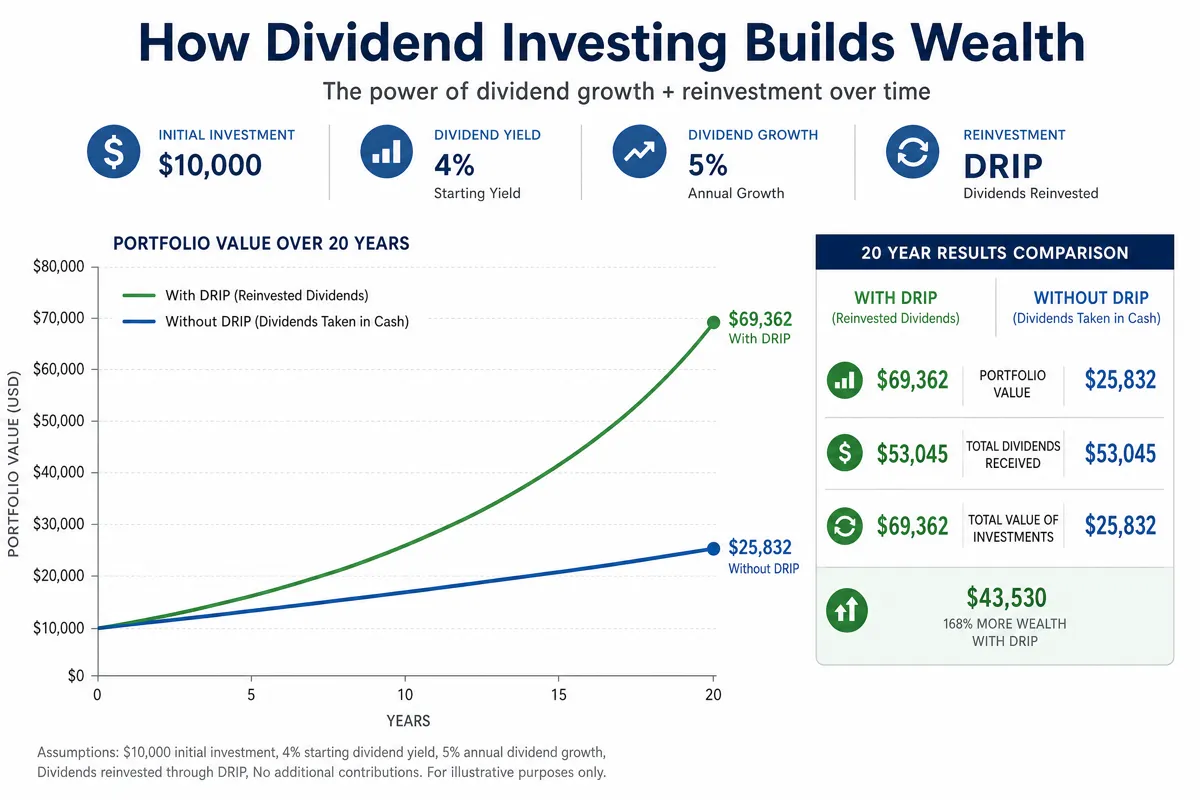
What Is Dividend Investing and Why It Works
Dividend investing is a strategy where you buy shares in companies that distribute a portion of their profits to shareholders as regular cash payments. Unlike growth investing, where returns come exclusively from share price appreciation, dividend investing provides two income streams: the dividends themselves and potential capital gains on the stock price. This dual-return mechanism is what makes dividend investing one of the most reliable long-term wealth-building strategies available to individual investors.
When you own 100 shares of a company paying $2.00 per share annually, you receive $200 in cash dividends each year — regardless of whether the stock price goes up or down. If you reinvest those dividends through a Dividend Reinvestment Plan (DRIP), you automatically purchase additional shares, which then generate their own dividends. This compounding cycle is what transforms modest initial investments into substantial income streams over time. The Compound Interest Calculator demonstrates exactly how this snowball effect works with real numbers.
Historically, dividends have accounted for roughly 40% of the S&P 500's total return since 1930. During the decade from 2000 to 2009, when the S&P 500 delivered a total price return near zero, dividend-paying stocks provided positive returns through their cash distributions alone. This resilience during flat or declining markets is a core advantage of the dividend investing approach.
Key Concepts Every Dividend Investor Must Know
Dividend Yield
Dividend yield is the annual dividend payment divided by the current share price. A stock trading at $100 that pays $3.50 per year has a 3.5% yield. This metric lets you compare the income potential of different stocks and decide where to allocate capital. The average S&P 500 dividend yield in 2026 is approximately 1.4%, while dedicated dividend stocks typically yield 2.5% to 5.0%. Yields above 6% often indicate elevated risk — the company may be paying out more than it can sustain, or the stock price has dropped sharply (inflating the yield mathematically).
Dividend Growth Rate
This measures how quickly a company increases its dividend year over year. A company paying $1.00/share this year and $1.08 next year has an 8% dividend growth rate. Over decades, dividend growth is arguably more important than starting yield. A stock with a 2.5% yield and 10% annual growth will pay more in dividends after year 8 than a stock with a 5% yield and 0% growth — and the gap widens every year after that. Use the Dividend Calculator to model how dividend growth compounds over any time horizon.
Payout Ratio
The payout ratio is the percentage of earnings a company distributes as dividends. A company earning $5.00 per share and paying $2.50 has a 50% payout ratio. Lower ratios (under 60%) generally indicate safer dividends because the company retains enough earnings to grow the business and maintain payments during temporary downturns. REITs are an exception — they typically pay 75-95% of earnings due to tax structure requirements.
Dividend Aristocrats and Kings
Dividend Aristocrats are S&P 500 companies that have increased their dividends for at least 25 consecutive years. Dividend Kings have 50+ years of consecutive increases. These are the gold standard for dividend reliability. Names like Johnson & Johnson (62 years), Coca-Cola (62 years), Procter & Gamble (68 years), and 3M (66 years) have raised dividends through recessions, pandemics, and financial crises. Owning a diversified basket of Aristocrats is one of the simplest and most effective dividend strategies.
Case Study: Priya Builds a Dividend Portfolio from Scratch
Priya, a 29-year-old data analyst in Charlotte, North Carolina, earning $78,000 per year, decided to start dividend investing in January 2024. She had $8,000 in savings earmarked for investing and could commit $400/month from her paycheck. Her goal: build a portfolio generating $24,000/year in dividends by age 55 to supplement her retirement income.
Priya allocated her $8,000 initial investment across a diversified dividend portfolio:
- SCHD (Schwab U.S. Dividend Equity ETF): $3,200 (40%) — Yield: 3.5%, 5-year dividend growth: 12%
- Johnson & Johnson (JNJ): $1,600 (20%) — Yield: 3.0%, 10-year dividend growth: 6%
- Realty Income (O): $1,200 (15%) — Yield: 5.2%, monthly dividend payer
- Texas Instruments (TXN): $1,200 (15%) — Yield: 2.8%, 5-year dividend growth: 13%
- Vanguard High Dividend Yield ETF (VYM): $800 (10%) — Yield: 3.1%, broad diversification
With a blended portfolio yield of 3.5% and weighted average dividend growth of 8%, Priya enabled DRIP on all positions and set up automatic $400/month contributions. Here is what her portfolio trajectory looks like:
| Year | Portfolio Value | Annual Dividends | Monthly Income | Yield on Cost |
|---|---|---|---|---|
| Year 1 | $13,400 | $420 | $35 | 3.5% |
| Year 5 | $42,800 | $1,820 | $152 | 5.1% |
| Year 10 | $108,500 | $5,420 | $452 | 8.1% |
| Year 15 | $224,000 | $12,900 | $1,075 | 13.6% |
| Year 20 | $428,000 | $26,500 | $2,208 | 22.4% |
| Year 26 (age 55) | $782,000 | $51,200 | $4,267 | 37.8% |
By age 55, Priya's portfolio projects to generate over $51,000 in annual dividends — more than double her original $24,000 goal. The key drivers: consistent $400/month contributions, DRIP reinvestment, and selecting stocks with strong dividend growth rates. Her total out-of-pocket investment over 26 years would be approximately $132,800 ($8,000 + $400 x 312 months), yet the portfolio could be worth over $780,000 producing $4,267 per month in passive income.
Dividend Investing Strategies Compared
| Strategy | Starting Yield | Dividend Growth | Best For | Risk Level |
|---|---|---|---|---|
| Dividend Growth | 1.5-3.0% | 8-15%/year | Long-term wealth building (15+ years) | Low-Medium |
| High Yield | 4.0-7.0% | 2-5%/year | Immediate income needs | Medium-High |
| Dividend Aristocrats | 2.0-3.5% | 6-10%/year | Reliability and consistency | Low |
| REIT Focused | 4.0-6.5% | 3-6%/year | Real estate exposure + high income | Medium |
| Dividend ETF | 2.5-4.0% | 5-8%/year | Beginners and hands-off investors | Low |
Step-by-Step Guide: Start Dividend Investing Today
Step 1: Open a brokerage account. Choose a no-fee brokerage that supports DRIP and fractional shares. Fidelity, Charles Schwab, and Vanguard are the top three for dividend investors. Open both a taxable brokerage account and a Roth IRA — hold higher-yield stocks (REITs, high-yield payers) in the Roth to shelter dividends from taxes.
Step 2: Set your monthly investment budget. Determine how much you can invest each month after covering expenses and emergency fund contributions. Even $100/month builds meaningful dividend income over time. Use a Investment Return Calculator to project what your monthly contributions could grow to over 10, 20, or 30 years.
Step 3: Build a diversified portfolio. Start with 2-3 dividend ETFs (SCHD, VYM, or DGRO) for broad exposure. As your portfolio grows past $10,000, begin adding individual Dividend Aristocrats in sectors you understand. Target 15-20 holdings across at least 7 sectors for adequate diversification.
Step 4: Enable DRIP on every position. Automatic dividend reinvestment is the single most important action for long-term wealth building. It eliminates the temptation to spend dividends and ensures compounding works at maximum efficiency.
Step 5: Monitor quarterly and rebalance annually. Check dividend announcements each quarter. Watch for payout ratios creeping above 75% or earnings declining for two consecutive quarters — these are warning signs. Once per year, rebalance positions that have drifted more than 5% from your target allocation.
Run Your Own Numbers
Use our free calculator to see how much dividend income your portfolio could generate.
Open Dividend CalculatorFrequently Asked Questions
How much money do I need to start dividend investing?
You can start with as little as $100 using fractional shares available through most modern brokerages like Fidelity, Schwab, and Robinhood. However, starting with $1,000 to $5,000 provides a more meaningful income base. With $5,000 invested at a 3% yield, you earn $150/year in dividends — enough to see the compounding effect within a few years.
What is the difference between dividend yield and dividend growth?
Dividend yield is the annual dividend divided by the current share price. A $50 stock paying $2/year has a 4% yield. Dividend growth is the rate at which a company increases its dividend annually. A company raising its dividend from $2.00 to $2.10 has 5% growth. For long-term investors, growth often matters more because it compounds — a 2.5% yield growing at 10% per year surpasses a static 5% yield within 8 years. See the power of compounding with our guide to compound interest with real-life examples.
Are dividend stocks safe investments?
Dividend-paying stocks — especially Dividend Aristocrats with 25+ years of consecutive increases — are generally lower-risk than non-dividend stocks. However, no stock is completely safe. Companies can cut dividends during severe downturns. Diversifying across 15-20 stocks in different sectors significantly reduces individual company risk. REITs, utilities, and consumer staples tend to have the most stable dividends.
Should I invest in individual dividend stocks or dividend ETFs?
For beginners, dividend ETFs like VYM, SCHD, or NOBL provide instant diversification with expense ratios under 0.10%. Individual stocks offer higher control and potentially higher yields but require more research. A balanced approach uses ETFs as a 60-70% core with select Aristocrats for the remaining 30-40%.
How are dividends taxed?
Qualified dividends (from U.S. stocks held 60+ days) are taxed at long-term capital gains rates: 0% for taxable income under $47,025, 15% for income up to $518,900, and 20% above that. Non-qualified dividends (including most REIT distributions) are taxed at your ordinary income rate. Holding dividend stocks in a Roth IRA eliminates all dividend taxation entirely.