If you earn income as a freelancer, consultant, gig worker, or independent contractor, you owe self employment tax on top of regular federal income tax. Unlike W-2 employees who split Social Security and Medicare taxes with their employer, self-employed workers pay the full 15.3% themselves. On $80,000 in net profit, that means roughly $11,304 in SE tax before you even calculate income tax. Understanding how this tax is calculated, when it is due, and what you can deduct is essential for every 1099 worker who wants to avoid surprise tax bills and IRS penalties.
Quick Answer
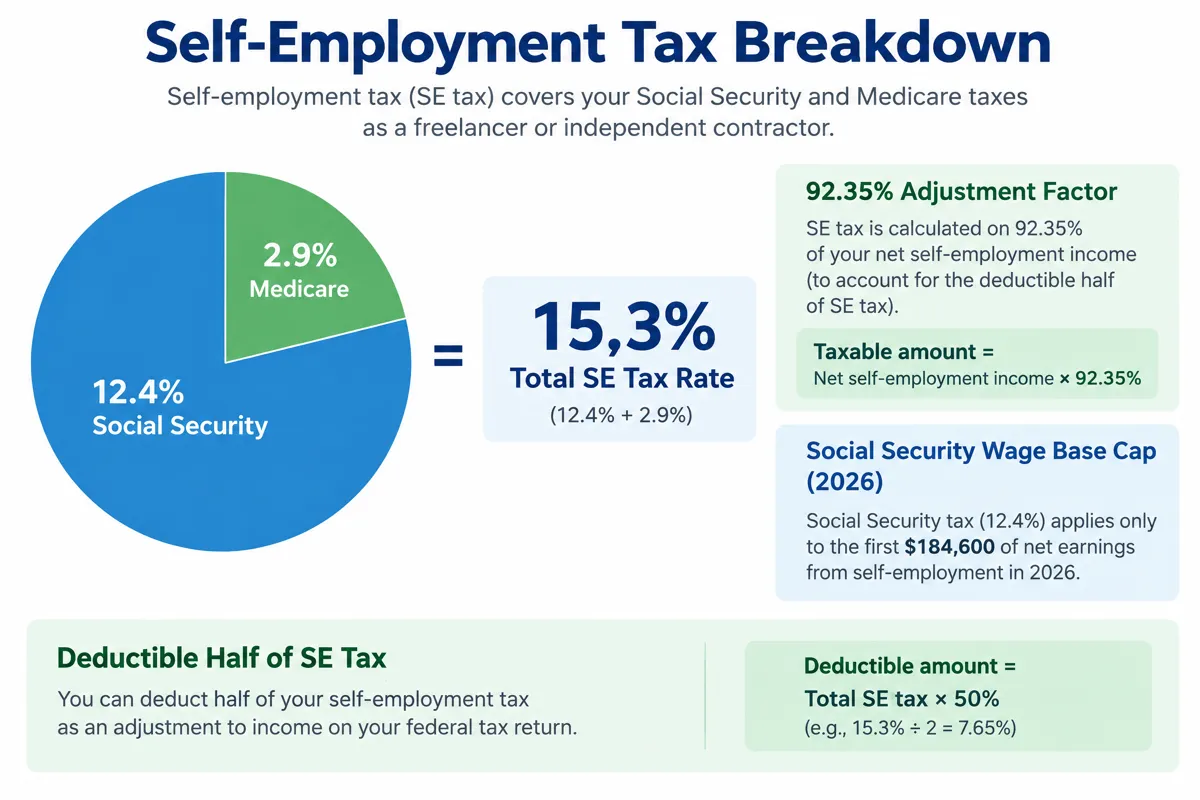
Self-employment tax is 15.3% of your net business profit (12.4% Social Security + 2.9% Medicare), applied to 92.35% of your Schedule C net income. You can deduct half of the SE tax on your income tax return, and you must make quarterly estimated payments if you expect to owe $1,000 or more in total federal tax.
How Self-Employment Tax Works in 2026
When you work for an employer, you pay 7.65% in FICA taxes (6.2% Social Security + 1.45% Medicare) and your employer matches that amount. Self-employed workers must pay both halves, which is why the self employment tax rate totals 15.3%. This tax is separate from your federal income tax and is calculated on Schedule SE when you file your return.
The IRS does not apply the 15.3% rate to your entire net profit. Instead, it multiplies your Schedule C net income by 92.35% to arrive at "net earnings from self-employment." This adjustment accounts for the fact that W-2 employees do not pay FICA on the employer's half. If your net profit is $100,000, your net earnings subject to SE tax are $92,350 ($100,000 × 0.9235). Your SE tax: $92,350 × 15.3% = $14,130.
The 15.3% breaks into two components with different rules. The Social Security portion (12.4%) applies only to net earnings up to the wage base of $168,600 in 2026. Earnings above that threshold are exempt from the Social Security tax but still subject to Medicare. The Medicare portion (2.9%) has no income cap. High earners with combined wages and self-employment income above $200,000 (single) or $250,000 (married filing jointly) also owe an additional 0.9% Medicare surtax.
One important relief: you can deduct half of your self-employment tax as an above-the-line deduction on Form 1040. On $14,130 in SE tax, you deduct $7,065, which reduces your adjusted gross income and lowers your income tax bill. This deduction does not reduce your SE tax itself — it only affects income tax.
Because no employer withholds taxes from your 1099 payments, the IRS expects you to make quarterly estimated tax payments if you expect to owe $1,000 or more in total federal tax for the year. The four due dates for 2026 are April 15, June 16, September 15, and January 15, 2027. Each payment should cover roughly one-quarter of your expected annual SE tax plus income tax. Missing deadlines triggers underpayment penalties. Use our Self-Employment Tax Calculator to estimate your total liability and quarterly amounts before the next deadline.
Case Study: Marcus, a Freelance Web Developer in Denver
Marcus is a 34-year-old freelance web developer in Denver. He left a $95,000 W-2 job in 2024 and now runs his own LLC, billing clients directly. In 2026, his Schedule C shows $125,000 in gross receipts from 14 client projects. After subtracting business expenses — $6,200 for software subscriptions, $4,800 for a home office deduction, $3,500 for a new laptop and monitor, $8,400 in health insurance premiums, $4,600 for professional development and conferences, and $2,500 in travel — his net self-employment income is $95,000.
Marcus calculates his SE tax using the standard formula. Net earnings from self-employment: $95,000 × 92.35% = $87,732.50. Self-employment tax: $87,732.50 × 15.3% = $13,423. Because his net earnings are well below the $168,600 Social Security wage base, the full 12.4% Social Security rate applies to all $87,732.50, plus 2.9% Medicare on the same amount.
Marcus deducts half of his SE tax — $6,712 — on Form 1040, reducing his adjusted gross income to $88,288. After the $15,750 standard deduction (single filer), his taxable income is $73,538. Using 2026 federal brackets, his income tax is approximately $11,094. Combined federal tax burden: $13,423 (SE tax) + $11,094 (income tax) = $24,517.
Marcus makes quarterly estimated payments of $6,129 ($24,517 ÷ 4) on April 15, June 16, September 15, and January 15. His effective total tax rate on $95,000 net profit is 25.8%($24,517 ÷ $95,000). Colorado adds a flat 4.4% state income tax on his taxable income, roughly $3,236 more. After all taxes, Marcus keeps about $67,247 — which is why he tracks every deductible expense and contributes $22,500 to a Solo 401(k) to reduce next year's bill.
Compare this to his old W-2 job: on $95,000 salary, his employer paid half his FICA ($7,259), and his share was $7,259. As a freelancer on the same net income, Marcus pays nearly double the FICA portion — the defining cost of self-employment. Planning for that difference with a 50/30/20 Budget Calculator helps Marcus set aside 25% to 30% of every client payment for taxes before spending on personal expenses.
Self-Employment Tax at Different Income Levels
The table below shows estimated self-employment tax for six net profit levels in 2026, assuming all income comes from self-employment with no W-2 wages. Calculations use the 92.35% net earnings adjustment and the 15.3% combined rate, with the Social Security cap applied at $168,600 for the highest tier.
| Net Profit | Net Earnings (92.35%) | SE Tax (15.3%) | Deductible Half | Effective SE Rate |
|---|---|---|---|---|
| $40,000 | $36,940 | $5,652 | $2,826 | 14.1% |
| $60,000 | $55,410 | $8,478 | $4,239 | 14.1% |
| $80,000 | $73,880 | $11,304 | $5,652 | 14.1% |
| $100,000 | $92,350 | $14,130 | $7,065 | 14.1% |
| $120,000 | $110,820 | $16,955 | $8,478 | 14.1% |
| $200,000+ | $184,700 | $26,263 | $13,132 | 13.1% |
Notice the effective SE rate drops above the Social Security wage base. At $200,000 net profit, only $168,600 of net earnings ($184,700 total) is subject to the 12.4% Social Security rate. The remaining $16,100 in net earnings pays only the 2.9% Medicare tax, plus the 0.9% surtax if total income exceeds $200,000. Income tax is calculated separately on top of these amounts — use the Income Tax Calculator to see your combined federal liability at any income level.
5 Steps to Reduce Your Self-Employment Tax
1. Maximize legitimate business deductions. Every dollar you deduct on Schedule C reduces your net profit and therefore your SE tax. Track home office expenses, mileage ($0.70 per mile in 2026), software, equipment, professional memberships, and client meals (50% deductible). A freelancer who increases deductions from $15,000 to $25,000 on $100,000 gross income saves $1,413 in SE tax ($10,000 × 92.35% × 15.3%).
2. Contribute to a Solo 401(k) or SEP-IRA. Retirement contributions reduce net self-employment income before SE tax is calculated. A Solo 401(k) allows up to $23,500 in employee deferrals plus 25% of net self-employment income as employer contributions (capped at $70,000 total for 2026). Marcus contributing $22,500 lowers his net profit from $95,000 to $72,500, saving approximately $3,178 in SE tax. See our 401(k) vs Roth IRA guide for help choosing the right retirement account structure.
3. Deduct health insurance premiums.Self-employed workers who are not eligible for employer-sponsored coverage can deduct health, dental, and qualified long-term care premiums above the line on Form 1040. Marcus deducts $8,400 in premiums on Schedule C, which reduces both SE tax and income tax. This deduction is unavailable if you could enroll in a spouse's employer plan.
4. Consider S-Corp election at higher income levels. Once net profit consistently exceeds $60,000 to $80,000, forming an S-Corp and paying yourself a reasonable W-2 salary while taking remaining profit as distributions can significantly reduce SE tax. Only the salary portion is subject to FICA; distributions are not. A consultant earning $150,000 net who pays herself a $70,000 salary and takes $80,000 in distributions saves roughly $11,304 in SE tax on the distribution portion. S-Corp compliance costs ($2,000 to $4,000 annually for payroll and filing) must be weighed against the savings.
5. Claim the Qualified Business Income (QBI) deduction. Most self-employed taxpayers can deduct up to 20% of qualified business income on Form 8995, subject to income limits ($191,950 for single filers in 2026). On $95,000 net profit, the QBI deduction could reduce taxable income by $19,000, saving approximately $3,800 in income tax. The QBI deduction does not reduce SE tax directly, but it lowers overall tax burden. Maintain meticulous records — bank statements, invoices, mileage logs, and receipt archives — to substantiate every deduction if the IRS questions your return.
Calculate Your Self-Employment Tax
Use our free calculator to estimate your SE tax, quarterly payments, and deductible half.
Open Self-Employment Tax CalculatorFrequently Asked Questions
What is the self-employment tax rate for 2026?
The combined self-employment tax rate for 2026 is 15.3%, split into 12.4% for Social Security and 2.9% for Medicare. Social Security tax applies only to the first $168,600 of net earnings from self-employment. Medicare tax applies to all net earnings with no cap. An additional 0.9% Medicare surtax applies when combined wages and self-employment income exceed $200,000 for single filers or $250,000 for married filing jointly. The IRS taxes 92.35% of your net Schedule C profit, not the full amount.
Do I have to pay self-employment tax on side income?
Yes, if your net self-employment earnings exceed $400 in a tax year, you must file Schedule SE and pay self-employment tax on that income. Side income from freelancing, consulting, gig work, or 1099-NEC forms counts even if you also have a W-2 job. If you earn $8,000 from weekend photography on top of a $70,000 salary, you owe SE tax on the $8,000 net profit. Your W-2 employer already withholds Social Security and Medicare on your salary, but the side income requires separate SE tax payments.
How do I lower my self-employment tax?
You cannot eliminate self-employment tax entirely on legitimate business income, but several strategies reduce the taxable base. Maximize business deductions on Schedule C to lower net profit. Contribute to a Solo 401(k) or SEP-IRA, which reduce net self-employment income. Deduct health insurance premiums above the line if you are not eligible for employer coverage. Consider S-Corp election once net profit consistently exceeds $60,000 to pay yourself a reasonable W-2 salary and take remaining profit as distributions exempt from SE tax. Claim the Qualified Business Income deduction for up to 20% of qualified business income.
When are quarterly estimated tax payments due?
Quarterly estimated tax payments for 2026 are due April 15, June 16, September 15, and January 15, 2027. Each payment should cover at least 25% of your expected annual federal tax liability, including both self-employment tax and income tax. If you expect to owe $24,000 total for the year, each quarterly payment should be roughly $6,000. Missing a deadline triggers an underpayment penalty calculated on the shortfall, currently around 7% annual interest. Use Form 1040-ES vouchers or pay electronically at IRS.gov.
What is the difference between self-employment tax and income tax?
Self-employment tax funds Social Security and Medicare programs and is calculated at a flat 15.3% on net self-employment earnings (after the 92.35% adjustment). Income tax is a separate federal obligation calculated on your total taxable income using progressive brackets from 10% to 37%. A freelancer earning $95,000 net might owe $13,423 in SE tax plus approximately $11,094 in federal income tax. SE tax is reported on Schedule SE; income tax is calculated on Form 1040. Both amounts are combined when determining quarterly estimated payments.