What Is Self-Employment Tax?
Self-employment tax is the Social Security and Medicare tax that freelancers, independent contractors, sole proprietors, and gig workers pay on their net business earnings. When you work for an employer, your employer pays half of the Social Security and Medicare taxes (FICA) and withholds the other half from your paycheck. When you are self-employed, you pay both halves -- the employee share and the employer share -- which totals 15.3% of your net self-employment earnings.
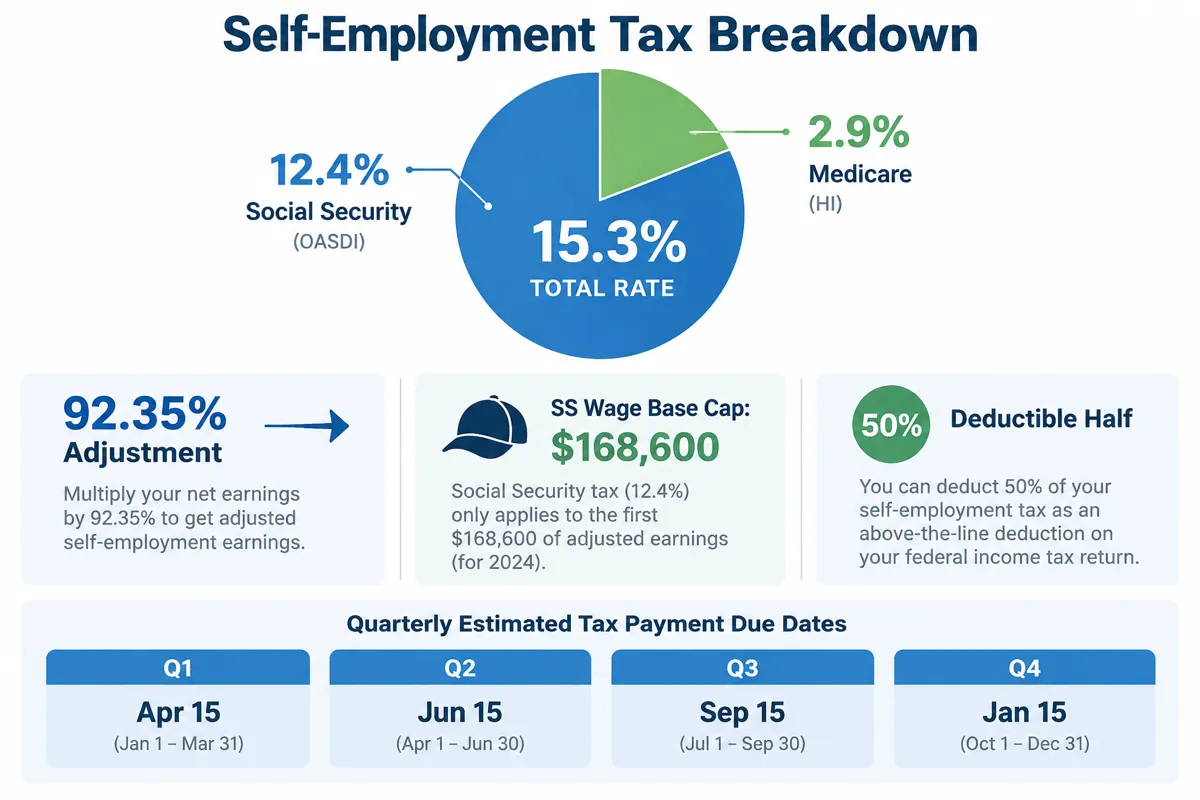
The 15.3% rate breaks down into two components: 12.4% for Social Security (officially Old-Age, Survivors, and Disability Insurance) and 2.9% for Medicare (Hospital Insurance). The Social Security portion applies only up to the 2026 wage base of $168,600, meaning earnings above that cap are exempt from the 12.4% tax. The Medicare portion has no cap -- it applies to every dollar of SE earnings. High earners also face an additional 0.9% Medicare surtax on earnings above $200,000 for single filers or $250,000 for married filing jointly. Use the calculator above to see your exact breakdown, or check your combined tax picture with our Income Tax Calculator.
How Self-Employment Tax Is Calculated
The calculation follows a specific sequence required by the IRS. First, determine your net self-employment earnings by subtracting all allowable business expenses from your gross income. This includes home office deductions, supplies, software subscriptions, professional development, vehicle expenses, health insurance premiums, and any other ordinary and necessary business costs.
Second, multiply your net earnings by 92.35% (the factor 0.9235). This adjustment simulates the employer-equivalent deduction that W-2 workers receive. The logic: if you earned $100,000, the IRS considers $92,350 to be the earnings base for computing SE tax. Without this adjustment, self-employed workers would pay tax on the employer-share portion of FICA, which W-2 employees never do.
Third, apply the 12.4% Social Security rate to the lesser of your adjusted earnings or the remaining wage base (after subtracting any W-2 wages already subject to Social Security). Then apply the 2.9% Medicare rate to your full adjusted earnings. Finally, add the 0.9% Additional Medicare Tax if applicable. The sum of these three components is your total self-employment tax.
Key Concepts Every Freelancer Should Know
The 92.35% adjustment: The IRS multiplies net SE earnings by 0.9235 before computing tax. This reduces your taxable base by 7.65%, effectively giving you the same treatment as a W-2 employee whose employer pays half of FICA. On $100,000 in net earnings, this adjustment saves you about $1,175 in SE tax.
The deductible half: After calculating your total SE tax, you can deduct exactly half of it (the employer-equivalent portion) as an above-the-line deduction on your Form 1040. This deduction reduces your adjusted gross income (AGI), which in turn lowers your income tax. For example, if your SE tax is $14,130, you deduct $7,065 from your AGI before computing income tax. This deduction is available even if you do not itemize.
The Social Security wage base cap: The 12.4% Social Security tax applies only up to $168,600 in combined wages and SE earnings for 2026. Once your total earnings from all sources hit this ceiling, additional income is only subject to the 2.9% Medicare tax (plus the 0.9% surtax if applicable). If you have a W-2 job earning $100,000 and freelance income of $90,000, only $68,600 of your SE earnings ($168,600 - $100,000) is subject to Social Security tax.
Quarterly estimated payments: Unlike W-2 employees whose taxes are withheld each pay period, self-employed individuals must make estimated tax payments four times per year. The IRS expects you to pay as you earn -- waiting until April 15 to pay the full amount triggers underpayment penalties. Plan your cash flow using our 50/30/20 Budget Calculator to ensure you set aside enough each month.
Case Study: Priya, a Freelance UX Designer
Priya is a 29-year-old UX designer in Austin, Texas, who left her $95,000 salary job in January 2026 to freelance full-time. In her first year, she earns $130,000 in gross revenue from three long-term clients. Her deductible business expenses total $18,000, broken down as: $6,000 for a home office (rent allocation, utilities, internet), $4,500 for software and design tools (Figma, Adobe Creative Suite, prototyping tools), $3,000 for professional development (conferences, online courses), $2,500 for health insurance premiums, and $2,000 for business travel and miscellaneous supplies. This leaves her with net self-employment earnings of $112,000.
Applying the 92.35% adjustment: $112,000 x 0.9235 = $103,432 in taxable SE earnings. Social Security tax: $103,432 x 12.4% = $12,826 (all under the $168,600 wage base). Medicare tax: $103,432 x 2.9% = $3,000. Total SE tax: $15,826. Her effective SE tax rate is $15,826 / $112,000 = 14.1%.
Priya can deduct half of her SE tax ($7,913) as an above-the-line deduction, reducing her AGI from $112,000 to $104,087 before computing income tax. Her quarterly estimated SE tax payment is $15,826 / 4 = $3,957. Since she also owes income tax, her total quarterly payment (SE tax + estimated income tax) will be higher.
Compare this to her old W-2 job: at a $95,000 salary, her employer paid 7.65% ($7,268) of FICA and withheld 7.65% ($7,268) from her paycheck. She only saw the employee half on her pay stub. As a freelancer earning $112,000, she pays $15,826 in SE tax -- more than double the $7,268 employee FICA she used to pay, but she also earns $17,000 more. Understanding this trade-off is critical. Use our Paycheck Calculator to compare your W-2 take-home pay against your freelance earnings after SE tax.
Self-Employment Tax vs W-2 Employee FICA: Side-by-Side Comparison
| Factor | W-2 Employee | Self-Employed (1099) |
|---|---|---|
| Social Security Rate | 6.2% (employee) + 6.2% (employer) | 12.4% (both halves) |
| Medicare Rate | 1.45% (employee) + 1.45% (employer) | 2.9% (both halves) |
| Total Rate | 7.65% visible + 7.65% employer | 15.3% (before 92.35% adjustment) |
| 92.35% Adjustment | Not applicable | Applied to reduce taxable base |
| Employer-Half Deduction | Employer pays directly (not deductible to you) | Deduct 50% of SE tax on Form 1040 |
| Withholding | Automatic per paycheck | Quarterly estimated payments (Form 1040-ES) |
| On $100K Net Earnings | $7,650 (employee share only) | $14,130 (full SE tax) |
The table above makes one thing clear: self-employed workers pay roughly double the visible FICA tax of W-2 employees. However, the true economic cost is similar because W-2 employees indirectly bear the employer share through lower wages. Economists generally agree that the employer portion of FICA reduces the total compensation employers are willing to offer. The difference is visibility -- freelancers see the full 15.3% on their tax return, while employees only see 7.65% on their pay stubs.
Strategies to Reduce Self-Employment Tax
- Maximize business deductions. Every legitimate business expense reduces your net SE income and therefore your SE tax. Track all deductible costs meticulously: home office, vehicle mileage (67 cents per mile in 2026), equipment, software, professional services, business insurance, and continuing education. A $5,000 increase in deductions saves approximately $707 in SE tax.
- Consider an S-Corporation election. Once your net SE income exceeds approximately $60,000 to $80,000, electing S-Corp status through Form 2553 can save significant SE tax. As an S-Corp, you pay yourself a "reasonable salary" (subject to FICA) and take remaining profits as distributions (not subject to SE tax). On $120,000 in net income with a $70,000 salary, you save SE tax on $50,000 of distributions -- approximately $7,065 per year.
- Contribute to a Solo 401(k) or SEP-IRA. While retirement contributions do not directly reduce SE tax (they are calculated on net earnings before contributions), they reduce your income tax. A Solo 401(k) allows up to $23,500 in employee contributions plus 25% of net SE earnings as employer contributions in 2026. Read our 401(k) vs Roth IRA guide to choose the best retirement vehicle for your situation.
- Deduct health insurance premiums. Self-employed individuals can deduct 100% of health, dental, and long-term care insurance premiums for themselves and their family as an above-the-line deduction. This does not reduce SE tax directly, but it lowers your AGI and income tax.
- Time income and expenses strategically. If you are near the Social Security wage base ($168,600), deferring income to next year or accelerating expenses into this year can shift earnings below the cap, reducing the 12.4% SS portion. Similarly, bunching expenses into high-income years maximizes their tax benefit.
SE Tax at Different Income Levels
| Net SE Income | SE Tax | Effective Rate | Deductible Half | Quarterly Payment |
|---|---|---|---|---|
| $40,000 | $5,652 | 14.1% | $2,826 | $1,413 |
| $75,000 | $10,597 | 14.1% | $5,299 | $2,649 |
| $100,000 | $14,130 | 14.1% | $7,065 | $3,532 |
| $150,000 | $21,194 | 14.1% | $10,597 | $5,299 |
| $200,000 | $27,651 | 13.8% | $13,629 | $6,913 |
The effective SE tax rate stays close to 14.1% for most income levels because the 92.35% adjustment brings the effective rate down from 15.3%. At very high incomes above the $168,600 Social Security wage base, the rate drops because you stop paying the 12.4% SS portion on earnings above the cap. However, the 0.9% Additional Medicare Tax kicks in above $200,000, partially offsetting that reduction. Understanding these thresholds helps you plan for the right amount in quarterly payments and avoid underpayment penalties.
Common Self-Employment Tax Mistakes
Forgetting quarterly payments: The most expensive mistake is not making estimated payments. The IRS charges both interest and a penalty on underpayments. Set up automatic transfers on the 1st of each quarter month to a dedicated tax savings account, then pay the IRS by the 15th.
Not separating business and personal expenses: Mixing accounts makes it nearly impossible to track deductible expenses accurately. Open a separate business checking account and credit card. This single step typically increases deductions by 15% to 20% because you stop missing legitimate write-offs buried in personal spending.
Ignoring the deductible half: Many freelancers correctly compute their SE tax but forget to claim the above-the-line deduction for half of it. This deduction reduces your AGI and your income tax. On $14,130 of SE tax, the $7,065 deduction at a 22% marginal rate saves $1,554 in income tax.
Missing the S-Corp election window: If S-Corp status makes sense for your income level, you must file Form 2553 by March 15 for it to apply to the current tax year (or within 75 days of forming the LLC). Late elections are sometimes accepted with reasonable cause, but it is far easier to plan ahead. Track your financial trajectory with our 50/30/20 Budget Rule guide to determine when your income justifies the S-Corp conversion.
FAQ
What is self-employment tax? Self-employment tax is the combined Social Security (12.4%) and Medicare (2.9%) tax that self-employed individuals pay on their net business earnings. The total rate is 15.3% before the 92.35% earnings adjustment. It is reported on Schedule SE and paid with your annual tax return and quarterly estimated payments.
How is self-employment tax calculated? Multiply net self-employment income by 92.35% to get taxable SE earnings. Apply 12.4% for Social Security (capped at the $168,600 wage base) and 2.9% for Medicare (no cap). Add 0.9% Additional Medicare Tax on combined earnings above $200,000 (single) or $250,000 (married filing jointly). The total is your SE tax.
Can I deduct self-employment tax? Yes, you can deduct the employer-equivalent half of your SE tax as an above-the-line deduction on Form 1040, Line 15. This reduces your adjusted gross income and lowers your income tax. You claim this deduction regardless of whether you itemize.
Do I need to make quarterly estimated tax payments? Yes, if you expect to owe $1,000 or more in combined income and self-employment tax. Quarterly due dates are April 15, June 15, September 15, and January 15. Pay at least 100% of last year's tax liability (110% if AGI exceeds $150,000) to avoid underpayment penalties.
What qualifies as self-employment income? Net earnings from a sole proprietorship, freelance or contract work reported on 1099-NEC, gig economy earnings (rideshare, delivery, etc.), partnership distributions, and any trade or business you operate for profit. W-2 wages, rental income (unless you are a real estate professional), and passive investment income do not count as SE income.