Guides / Debt Strategy
Student Loan Repayment: 7 Strategies to Pay Off Debt Faster in 2026
The average student loan borrower graduates with $37,850 in debt and spends 10 years on the standard repayment plan, paying over $12,000 in interest. This guide breaks down seven specific strategies with real numbers on a $40,000 balance so you can find the approach that matches your income, career path, and financial goals.
Last updated: August 2026
TL;DR - Quick Answer
- Standard plan baseline: $40,000 at 5.5% costs $434/month for 10 years with $12,040 in total interest
- Fastest payoff: Accelerated payments of $800/month clear the balance in 4 years 8 months, saving $5,687 in interest
- Lowest total cost: Refinancing to 4.0% over 7 years at $547/month costs $5,936 total interest, saving $6,104
- Lowest monthly payment: Income-driven repayment at $217/month (based on $45,000 income) with forgiveness after 20-25 years
- Free money: Employer repayment assistance provides up to $5,250/year tax-free, cutting 3.5 years off the standard plan
Use our Student Loan Calculator and Debt Payoff Calculator to model your exact loan portfolio.
The Student Loan Landscape in 2026
Total outstanding student loan debt in the U.S. stands at approximately $1.77 trillion across 43.5 million borrowers. The average monthly payment on the standard 10-year plan is $393, but actual payments vary enormously based on loan type, interest rate, and repayment plan selection. Federal student loan interest rates for 2025-2026 range from 5.50% for undergraduate Direct Loans to 7.05% for Direct PLUS Loans, while private loan rates vary from 4.0% to 14.0% depending on creditworthiness and term length.
The critical distinction is between federal and private loans. Federal loans offer income-driven repayment, forgiveness programs, and forbearance protections that private loans do not. Before choosing a repayment strategy, categorize your loans: federal Direct Subsidized, federal Direct Unsubsidized, federal PLUS, and private. Each type has different rules that affect which strategies are available to you. Log into studentaid.gov to see your complete federal loan portfolio and current servicer assignments.
All seven strategies below use a benchmark portfolio of $40,000 in federal Direct Unsubsidized loans at 5.5% interest. Your actual numbers will differ — run them through our Student Loan Calculator to get precise monthly payments and payoff timelines for your specific balance and rate.
7 Student Loan Repayment Strategies Compared
Strategy 1: Standard Repayment Plan (Baseline)
The default federal repayment plan assigns fixed monthly payments over 10 years (120 months). On $40,000 at 5.5%, your monthly payment is $434. This is the baseline against which every other strategy is measured.
- Monthly payment: $434
- Payoff timeline: 10 years (120 months)
- Total interest: $12,040
- Total repaid: $52,040
The standard plan is straightforward and predictable. You know exactly when you will be debt-free, and the payment never changes. The downside: $434/month on a starting salary of $45,000 ($3,375/ month take-home) represents 12.9% of take-home pay. If that ratio strains your budget, consider IDR as a temporary bridge while your income grows.
Strategy 2: Income-Driven Repayment (IDR)
IDR plans cap payments at a percentage of your discretionary income. The newest plan, SAVE (Saving on a Valuable Education), sets undergraduate loan payments at 5% of income above 225% of the poverty line. On a $45,000 salary, your estimated monthly payment drops to approximately $217 — half the standard plan.
- Monthly payment: ~$217 (based on $45,000 income)
- Payoff timeline: 20-25 years (with forgiveness of remaining balance)
- Total interest: ~$22,080 (if no forgiveness)
- Total repaid: ~$62,080 (before forgiveness)
IDR is a lifeline when income is low, but it is not free money. Payments that fall below the monthly interest accrual ($183/month on $40,000 at 5.5%) cause your balance to grow. On $217/month, only $34 goes toward principal in month one — the rest covers interest. Under the SAVE plan, the government covers unpaid interest on subsidized portions, but your unsubsidized balance may still grow. Use IDR strategically: stay on it while your income is below $60,000, then switch to standard or accelerated payments once your salary allows larger monthly contributions.
Strategy 3: Refinancing to a Lower Rate
Private lenders offer refinancing rates from 4.0% to 7.5% in August 2026, depending on credit score, income, and chosen term. Refinancing $40,000 from 5.5% to 4.0% over 7 years reduces the total interest by $6,104 compared to the standard plan.
- Monthly payment: $547 (7-year term at 4.0%)
- Payoff timeline: 7 years (84 months)
- Total interest: $5,936
- Total repaid: $45,936
- Savings vs. standard: $6,104 in interest, 3 years faster
Refinancing is the best option if you have strong credit (720+), a stable income above $55,000, and do not need federal protections. The trade-off is permanent: refinancing federal loans into a private loan eliminates your eligibility for IDR, PSLF, and federal forbearance. Never refinance if you work in public service or anticipate income instability. Compare refinancing offers from at least three lenders — rate quotes use soft credit pulls that do not affect your score.
Strategy 4: Employer Student Loan Repayment Assistance
Section 127 of the Internal Revenue Code allows employers to contribute up to $5,250 per year toward employee student loans tax-free. This benefit was made permanent in recent legislation and approximately 17% of employers now offer it. At $5,250/year ($437.50/month), employer assistance alone covers more than the standard monthly payment.
- Employer contribution: $5,250/year ($437.50/month)
- Your additional payment: $0-$434/month depending on budget
- Payoff timeline: ~6.5 years (employer pays alone) or ~4.5 years (employer + $300/month from you)
- Total interest saved: $3,280-$6,800 depending on your contribution
Employer assistance is the closest thing to free money in student loan repayment. The $5,250 is excluded from your gross income, meaning you save both on loan interest and income taxes. If your current employer does not offer this benefit, factor it into job negotiations. A position paying $70,000 with $5,250/year in loan assistance is effectively worth $75,250 pre-tax — and the loan assistance is worth even more because it is not subject to income or payroll taxes.
Strategy 5: Debt Avalanche (Highest Rate First)
If you have multiple loans at different rates, the avalanche method minimizes total interest. Make minimum payments on all loans, then direct every extra dollar to the loan with the highest interest rate. On a typical three-loan portfolio:
| Loan | Balance | Rate | Min Payment |
|---|---|---|---|
| Direct PLUS (grad) | $12,000 | 6.8% | $138 |
| Direct Unsub (senior year) | $15,000 | 5.5% | $163 |
| Direct Sub (freshman-junior) | $13,000 | 4.5% | $134 |
| Total | $40,000 | ~5.6% wtd avg | $435 |
With $600/month available, pay $435 in minimums and send the extra $165 to the 6.8% PLUS loan. It clears in about 5 years instead of 10. Then roll the $138 minimum plus $165 extra ($303 total) to the 5.5% loan. Using avalanche with $600/month total, the entire portfolio clears in approximately 7 years and 4 months with $9,680 in total interest — saving $2,360 compared to the standard plan. Read our avalanche vs. snowball comparison for more on choosing between the two methods.
Strategy 6: Side Income Acceleration
Adding $500/month in side income on top of the $434 standard payment ($934 total) transforms a 10-year payoff into a 3-year, 9-month sprint. On $40,000 at 5.5%, this approach saves $7,560 in interest compared to the standard plan.
- Monthly payment: $934 ($434 standard + $500 side income)
- Payoff timeline: 3 years, 9 months (45 months)
- Total interest: $4,480
- Total repaid: $44,480
- Savings vs. standard: $7,560 in interest, 6+ years faster
Realistic side income sources for recent graduates: freelance work in your field ($30-$75/hour), tutoring undergraduate courses ($25-$50/hour, 20 hours/month), part-time remote work ($20-$35/hour), or gig economy work ($800-$1,200/month). The key is directing every side dollar to loan principal the day it arrives. If it sits in your checking account, it gets absorbed by lifestyle inflation. Set up automatic extra payments through your loan servicer to ensure consistency.
Strategy 7: Public Service Loan Forgiveness (PSLF)
PSLF forgives the remaining balance on federal Direct Loans after 120 qualifying monthly payments (10 years) while working full-time for a qualifying employer — government agencies, nonprofits, and certain public institutions. Combined with IDR, PSLF can eliminate tens of thousands of dollars in remaining debt.
- Monthly payment: ~$217 (on SAVE/IDR at $45,000 income)
- Qualifying payments needed: 120 (10 years)
- Estimated amount forgiven: $18,000-$25,000 on a $40,000 original balance
- Total out-of-pocket: ~$26,040 ($217 x 120 months)
PSLF is the optimal strategy if you plan a long-term career in public service. The math is compelling: instead of paying $52,040 over 10 years on the standard plan, you pay approximately $26,040 and the remaining balance is forgiven tax-free. The catch is qualifying: you must make exactly 120 payments under an IDR plan while employed full-time by an eligible employer. Track your qualifying payments annually by submitting the Employment Certification Form to MOHELA. Failing to certify leaves you uncertain about your count until you apply for forgiveness — a mistake that has delayed or denied forgiveness for thousands of borrowers.
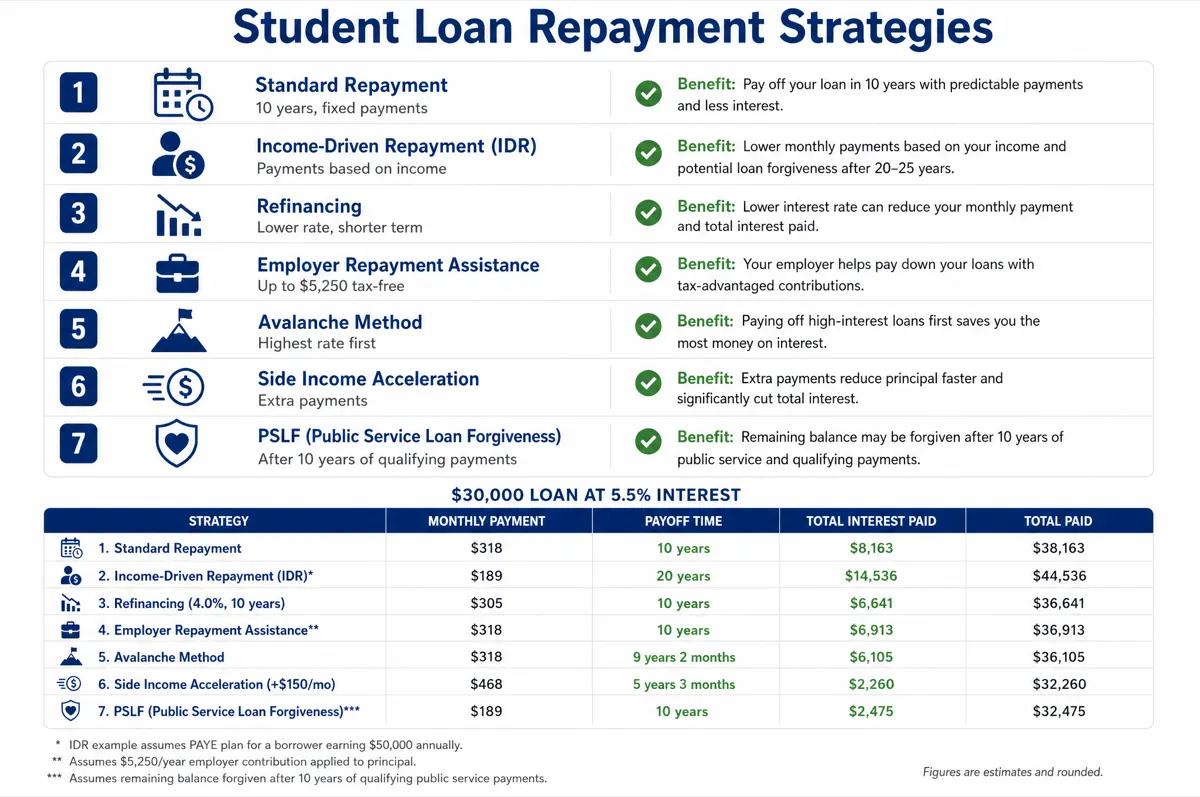
All 7 Strategies Side by Side
Use this comparison to match a strategy to your income level, career path, and monthly budget. All figures assume $40,000 in federal Direct Loans at 5.5%.
| Strategy | Monthly Payment | Timeline | Total Interest | Best For |
|---|---|---|---|---|
| Standard (baseline) | $434 | 10 years | $12,040 | Default; predictable |
| Income-driven (SAVE) | $217 | 20-25 years | $22,080* | Low income; PSLF track |
| Refinancing (4.0%, 7yr) | $547 | 7 years | $5,936 | Good credit; stable income |
| Employer assistance | $437 (employer) | 6.5 years | $8,760 | Employer offers benefit |
| Avalanche ($600/mo) | $600 | 7 yr 4 mo | $9,680 | Multiple rate loans |
| Side income blast | $934 | 3 yr 9 mo | $4,480 | Fastest debt-free |
| PSLF (IDR + forgiveness) | $217 | 10 years | $0 forgiven* | Public service career |
*IDR interest shown before forgiveness. PSLF forgives remaining balance tax-free after 120 qualifying payments. All calculations use $40,000 at 5.5%. Use our calculators for your exact numbers.
Case Study: Marcus, 26, $45K Salary in Atlanta
His Situation
- Degree: B.S. in Computer Science, state university
- Gross salary: $45,000/year ($3,375/month take-home)
- Total student debt: $38,500 across 4 federal loans
- Weighted average rate: 5.6%
- Standard monthly payment: $418
- Rent: $1,100/month (shared apartment)
- Other monthly expenses: $1,450
- Available for extra loan payments: $400/month
His 4 Loans
- Direct Unsub (senior): $7,500 at 5.5% ($81/mo min)
- Direct Unsub (junior): $7,000 at 5.3% ($75/mo min)
- Direct Sub (soph): $5,500 at 4.5% ($57/mo min)
- Direct Sub (fresh): $18,500 at 6.0% ($205/mo min)
Marcus's Analysis
Marcus ran all seven strategies through the Student Loan Calculator. Standard repayment costs $11,660 in interest over 10 years. IDR reduces his payment to $197/month but extends the timeline to 20+ years with $19,720 in projected interest. Refinancing to 4.0% was quoted by two lenders, but his credit score of 685 only qualified him for 5.0% — saving only $1,440 versus standard, not enough to justify losing federal protections.
His employer, a mid-size tech company, confirmed they offer $5,250/year in student loan assistance after 6 months of employment. Marcus negotiated to have it applied to his highest-rate loan ($18,500 at 6.0%). Combined with his own $400/ month in extra payments directed via avalanche, he projects clearing all four loans in 5 years and 2 months with $6,930 in total interest — saving $4,730 and nearly 5 years versus standard repayment.
Marcus's Chosen Strategy: Employer Assistance + Avalanche
Marcus combined Strategy 4 and Strategy 5. His employer sends $437.50/month directly to his 6.0% loan. He adds $400/month from his own budget, also targeting the 6.0% loan. The $18,500 loan clears in approximately 18 months. He then redirects the combined $837.50/month plus freed minimums to the 5.5% loan, followed by 5.3% and 4.5%.
| Milestone | Month | Remaining Balance | Interest Saved |
|---|---|---|---|
| Start | 0 | $38,500 | - |
| 6.0% loan paid off | 18 | $16,840 | $1,420 |
| 5.5% loan paid off | 28 | $10,130 | $2,890 |
| 5.3% loan paid off | 38 | $4,280 | $3,810 |
| All loans paid off | 62 | $0 | $4,730 |
Marcus will be completely debt-free by October 2031 — 62 months from his September 2026 start date. Total cost: $45,430 ($38,500 principal + $6,930 interest). Starting in month 63, he redirects the $818/month ($418 standard + $400 extra) toward building a $15,000 emergency fund and maxing out his Roth IRA. Tracking his compound interest growth, that $818/month invested at 7% for 30 years grows to approximately $993,000 by age 56.
Your Step-by-Step Student Loan Payoff Plan
Follow these six steps in order, regardless of which strategy you choose. The first two steps take less than an hour and provide the data you need to make an informed decision.
Inventory every loan with balance, rate, and servicer
Log into studentaid.gov to see all federal loans. Check your credit report for any private loans. Record the exact balance, interest rate, monthly minimum, and current servicer for each. Marcus found all four loans in 15 minutes.
Check if your employer offers repayment assistance
Email HR or check your benefits portal. If the benefit exists but you have not enrolled, sign up immediately — every month of unclaimed employer payments is $437.50 left on the table.
Run your numbers through the calculator
Enter your exact loan details into our Student Loan Calculator to see standard payment timelines, then test different extra payment amounts. The difference between $50 and $200 extra per month can be 2-4 years off your payoff date.
Choose your strategy from the comparison table
Match your situation: low income + public sector = PSLF. Good credit + private sector = refinancing. Employer benefit available = employer assistance + avalanche. Want speed above all = side income acceleration. Budget is tight = IDR as a temporary bridge.
Automate payments and specify "apply to principal"
Set up autopay for a 0.25% interest rate discount on federal loans. When making extra payments, explicitly instruct your servicer to apply them to principal — not to advance your due date. Without this instruction, servicers may apply extra payments to future interest instead of reducing your balance.
Redirect freed payments to investing once debt-free
When your final loan hits $0, immediately redirect the full former payment to an emergency fund (3-6 months of expenses), then to retirement accounts. Marcus's $818/month, invested at 7% for 30 years, grows to $993,000. The sooner you are debt-free, the longer your money compounds.
Calculate Your Student Loan Payoff Plan
Enter your exact loan balances, interest rates, and monthly budget to see how each strategy affects your payoff timeline and total interest cost.
Frequently Asked Questions
What is the fastest way to pay off student loans?
The fastest method is making extra payments toward principal using the avalanche approach (targeting highest-rate loans first) combined with side income. On a $40,000 balance at 5.5%, increasing payments from $434/month to $800/month cuts the payoff timeline from 10 years to 4 years and 8 months, saving $5,687 in interest. Adding $500/month in side income on top of standard payments clears the debt in 3 years and 9 months.
Should I refinance my student loans in 2026?
Refinancing makes sense if you can lower your interest rate by at least 1% and you do not need federal protections like income-driven repayment or Public Service Loan Forgiveness. In August 2026, private refinancing rates range from 4.5-7.5% depending on credit score and term. On a $40,000 balance, refinancing from 5.5% to 4.0% over 7 years saves $3,940 in interest. However, refinancing federal loans into a private loan permanently forfeits IDR eligibility, PSLF, and federal forbearance options.
Is income-driven repayment a good idea?
IDR plans (SAVE, PAYE, IBR) are ideal if your income is low relative to your debt or if you are pursuing PSLF. Payments are capped at 5-10% of discretionary income, and remaining balances are forgiven after 20-25 years. The downside: you pay more total interest over the longer term. On a $40,000 balance, IDR at $217/month costs $22,080 in interest over 25 years versus $12,040 on the standard plan. Use IDR as a bridge during low-income periods, not as a permanent strategy unless pursuing forgiveness.
How does the avalanche method work for student loans?
List all loans by interest rate from highest to lowest. Make minimum payments on everything, then send all extra money to the highest-rate loan. When that loan is paid off, roll its payment to the next highest-rate loan. On a typical $40,000 portfolio with loans at 6.8%, 5.5%, and 4.5%, avalanche saves $340 more than snowball (smallest balance first) over the payoff period. The savings increase with larger rate spreads and longer timelines.
Does employer student loan repayment assistance really help?
Yes. Since the Consolidated Appropriations Act of 2020 (extended through 2025 and made permanent in some proposals), employers can contribute up to $5,250 per year toward employee student loans tax-free. On a $40,000 balance, $5,250/year from your employer reduces the payoff timeline from 10 years to approximately 6.5 years, saving $3,280 in interest. About 17% of employers offered this benefit in 2025, up from 8% in 2021. Ask your HR department if this benefit is available.
Related Guides
Debt Avalanche vs Snowball Method: Which Gets You Debt-Free Faster?
Compare debt avalanche and snowball methods with a real $38,000 debt portfolio. See which saves more money and which keeps you motivated to finish.
How to Pay Off $10,000 in Credit Card Debt: 5 Proven Strategies
Pay off $10,000 in credit card debt with 5 proven strategies. Compare timelines, total interest, and see which approach fits your situation best.
Compound Interest: 5 Real-Life Examples That Show Its Power
See compound interest in action with 5 real examples: $500/month for 40 years, credit card debt traps, student loans, and the Rule of 72 explained.