Why Tipping Matters in the United States
Tipping is woven into the fabric of American service culture in a way that surprises many visitors from abroad. In the United States, tipped workers in restaurants, bars, salons, and delivery services often earn a base wage well below the federal minimum wage, with tips making up the majority of their take-home pay. A server earning $2.13 per hour in a state that follows the federal tipped minimum may depend on an 18% to 20% gratuity on a $75 dinner check just to reach a livable hourly rate for that shift. When you leave an appropriate tip, you are not simply rewarding good service — you are completing the compensation model that the industry was built on.
For diners and consumers, tipping also affects your monthly budget in ways that are easy to overlook. A couple who dines out twice per week at $60 per meal and tips 20% spends roughly $1,248 per year on gratuities alone — before drinks, tax, or delivery fees. That is real money that belongs in your discretionary spending category alongside entertainment and travel. Tracking tipping as part of your overall spending plan helps you avoid end-of-month surprises. Use our 50/30/20 Budget Calculator to see how dining and tipping fit into your wants allocation, and adjust your restaurant frequency or tip percentage if gratuities are pushing you over budget.
How Tipping Works in the United States
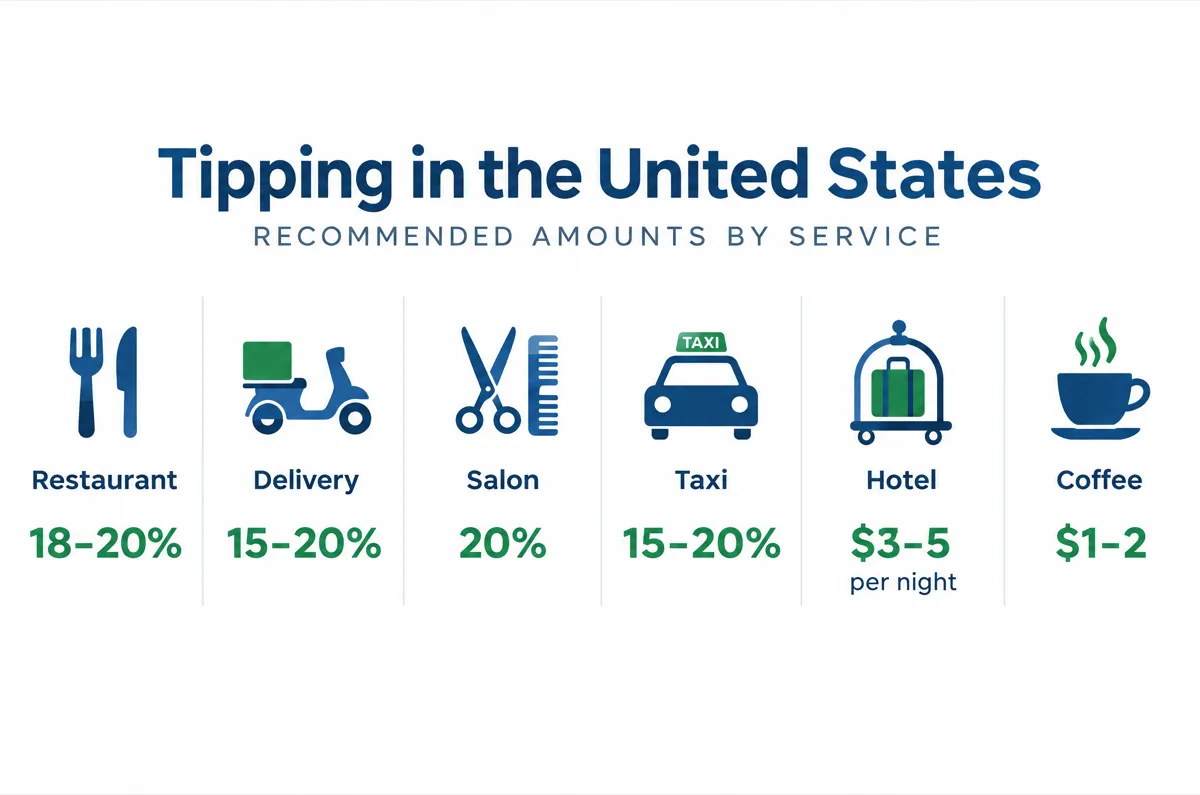
Standard restaurant tipping in the U.S. falls between 15% and 20% of the bill, with 18% widely considered the baseline for satisfactory service and 20% or more reserved for exceptional experiences. These percentages apply to sit-down dining where a server takes your order, refills drinks, and handles the check. Fast-casual counter service — where you order at a register and pick up your food — typically does not require a tip, though many payment screens now prompt for one anyway.
Delivery drivers, rideshare operators, hotel housekeeping staff, and salon professionals each operate under different norms. Food delivery through apps like DoorDash or Uber Eats generally expects 15% to 20% of the order total, with a $3 to $5 minimum on small orders. Rideshare tipping runs 15% to 20% of the fare, though a flat $2 to $5 is common on short trips under $15. Hotel housekeeping typically receives $2 to $5 per night left on the pillow or desk, not as a lump sum at checkout. Understanding these service-specific benchmarks prevents both under-tipping — which directly reduces a worker's income — and over-tipping out of uncertainty.
Sales tax adds another layer of complexity. In most states, the amount printed on your receipt includes tax on top of the food and beverage subtotal. A $100 dinner in Chicago with 10.25% sales tax becomes $110.25 before tip. Whether you calculate 20% on $100 or $110.25 changes your tip by $2.05 — small on one meal, but meaningful over hundreds of dining occasions per year. The calculator above lets you enter your pre-tax bill amount so you can tip consistently on the subtotal, which is the approach most etiquette experts recommend.
Key Concepts for Tipping
Pre-tax vs post-tax tipping. Etiquette guides and many restaurant industry standards recommend calculating your tip on the pre-tax subtotal, not the total after sales tax is added. Tax is a government levy, not a cost of service, and tipping on the tax amount effectively increases your gratuity rate without benefiting the server. On a $120 pre-tax bill with $10.80 tax (9%), tipping 20% pre-tax means $24.00 in gratuity. Tipping 20% post-tax on $130.80 yields $26.16 — an extra $2.16 that adds up across frequent dining. When the check arrives, look for the subtotal line or ask your server if you are unsure.
Service quality adjustments. Standard percentages are starting points, not rigid rules. Exceptional service — attentive without being intrusive, accurate orders, timely refills, and genuine warmth — warrants 20% to 25%. Mediocre service with long waits or repeated errors might justify 15%, though many diners still tip 18% to avoid penalizing a server who may be covering too many tables through no fault of their own. Truly poor service — rude behavior, completely wrong orders with no apology — may warrant speaking with a manager rather than simply reducing the tip to zero, since many restaurants pool or share tips among staff.
Group dining auto-gratuity.Restaurants commonly add an automatic gratuity of 18% to 20% for parties of six or more. This charge appears on your bill as "gratuity" or "service charge" and is legally distinct from a voluntary tip in some jurisdictions. Before adding an extra tip on top, read the check carefully. If 20% auto-gratuity is already included on a $500 group bill, you have already paid $100 in gratuity — adding another 20% would double-pay. You may still leave an additional amount for outstanding service, but the baseline is covered.
Case Study: Client Dinner in Chicago
Marcus, a 34-year-old sales manager in Chicago, takes his team of 6 out for a client dinner. The bill comes to $420 before tax. Tax at 10.25% adds $43.05, making the subtotal $463.05. Marcus wants to tip on the pre-tax amount at 20%: $420 x 0.20 = $84 tip. Total: $420 + $43.05 + $84 = $547.05. Split 6 ways: $91.18 per person.
If Marcus had tipped 20% on the post-tax total instead, his gratuity would have been $463.05 x 0.20 = $92.61 — $8.61 more than his intended amount. Over a year of monthly client dinners at similar price points, that difference alone exceeds $100. Marcus uses the tip calculator before the meal to set expectations with his team about per-person cost, including tax and gratuity, so no one is surprised when the check arrives.
Standard Tipping Percentages by Service
| Service | Low (Acceptable) | Standard | Generous | Notes |
|---|---|---|---|---|
| Restaurant dining | 15% | 18-20% | 25%+ | On pre-tax amount |
| Delivery (food) | $3-5 minimum | 15-20% | 25%+ | Higher for bad weather |
| Salon/Barber | 15% | 20% | 25%+ | On total service cost |
| Taxi/Rideshare | 10% | 15-20% | 25%+ | $2 minimum for short rides |
| Hotel housekeeping | $2/night | $3-5/night | $10+/night | Leave daily, not at checkout |
| Coffee/Counter | $0 | $1-2 | Round up | Not expected but appreciated |
Practical Tipping Tips
- Calculate before you sit down. On a $85 bill with 18% tip, you owe $15.30 in gratuity for a $100.30 total. Knowing this upfront prevents the awkward mental math at the table and helps you decide whether to order that extra appetizer.
- Use the reference table for quick decisions. The calculator above shows tip amounts at 15%, 18%, 20%, 22%, and 25% for any bill size. Glance at the row closest to your preferred percentage rather than doing multiplication on your phone.
- Split fairly when dining in groups. Divide the total (bill plus tip) by the number of people, not just the food subtotal. On a $100.30 total split two ways, each person pays $50.15 — including their share of the tip. One person covering the full tip and splitting only the food creates confusion and often shortchanges the server.
- Budget for tips as a line item. If you dine out $400 per month on food and drink before tip, add 18% ($72) to your dining budget for a realistic $472 monthly restaurant spend. Our 50/30/20 budget rule guide explains how to fit dining into your wants category without crowding out savings.
- Tip in cash when possible for direct delivery. App-based tips do reach drivers, but cash tips at the door guarantee immediate compensation and are especially appreciated during peak hours when drivers handle multiple orders in rain or snow.
Understanding your hourly earning power also helps you gauge whether your tipping habits align with your income. A worker earning $65,000 per year takes home roughly $31 per hour before taxes on a standard 2,080-hour work year. Use our Salary to Hourly Calculator to convert your annual salary to an hourly rate and compare it against your average tip spending per hour of dining or delivery.
FAQ
How much should you tip at a restaurant? Standard restaurant tipping in the United States is 18% to 20% of the pre-tax bill for good service. Fifteen percent is acceptable for adequate service, while 25% or more signals exceptional care. On an $85 dinner, that range translates to $12.75 at 15%, $15.30 at 18%, $17.00 at 20%, and $21.25 at 25%.
Do you tip on pre-tax or post-tax amount? Most etiquette experts and servers expect tips calculated on the pre-tax subtotal. Tipping on the post-tax total inflates your gratuity by the tax percentage — on a $100 bill with 8% tax, post-tax tipping at 20% costs $2.16 more than pre-tax tipping. Check your receipt for the subtotal line before calculating.
How do you calculate tip when splitting a bill? First add the tip to the full bill amount, then divide the total by the number of people. For a $85 bill with 18% tip ($15.30), the total is $100.30. Split between two people, each pays $50.15. Split four ways, each pays $25.08. The calculator above handles this automatically when you enter the number of diners.
Is it rude not to tip in the US? In sit-down restaurants and other tipped service industries, yes — failing to tip is widely considered rude because servers depend on gratuities for the majority of their income. At counter-service coffee shops or fast-casual restaurants where tipping is optional, skipping a tip is not considered offensive, though small tips of $1 to $2 are appreciated. Context matters: a mandatory service charge on a large group bill already covers gratuity, so an additional tip is optional rather than expected.