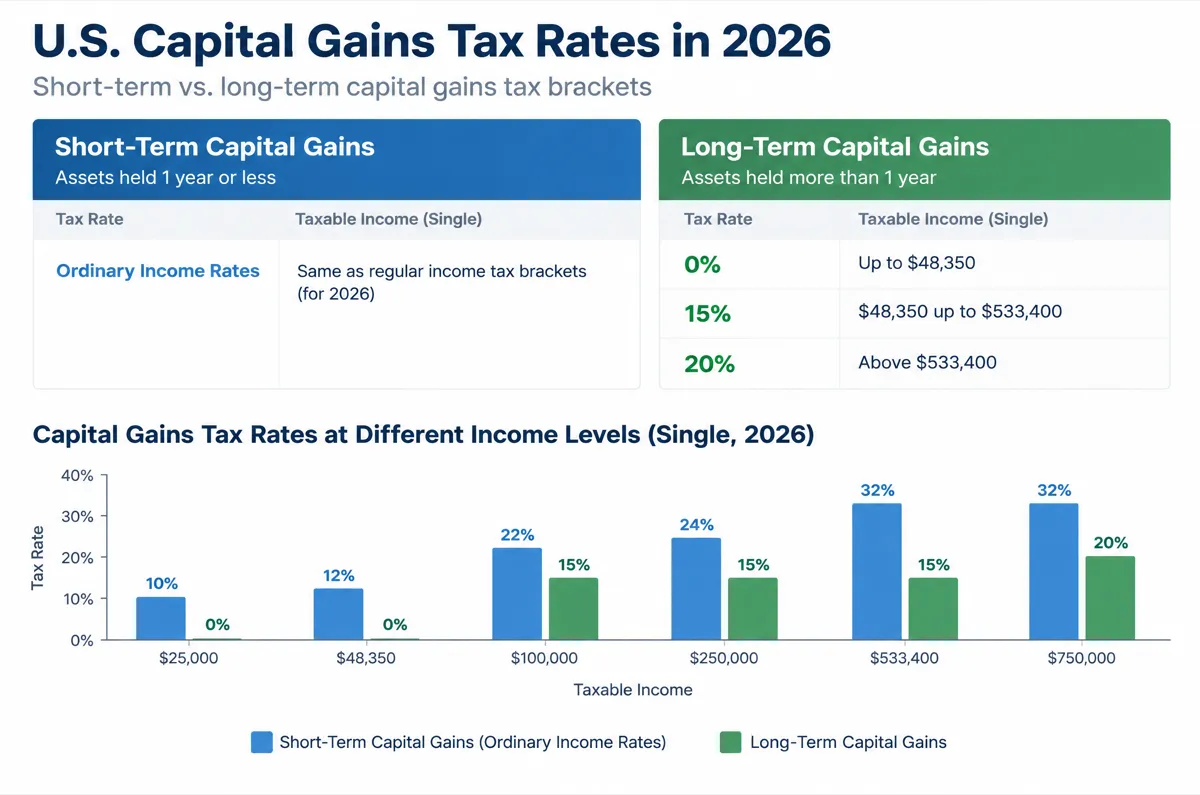
Whether you sold stock, cryptocurrency, rental property, or a business asset in 2026, the capital gains tax rate 2026 you pay depends on two factors: how long you held the asset and your total taxable income. Short-term gains on assets held one year or less are taxed as ordinary income at rates up to 37%. Long-term gains on assets held more than one year qualify for preferential rates of 0%, 15%, or 20%. For most middle-income investors, the difference between selling one month too early and holding for 13 months can mean paying $2,000 to $4,000 more in federal tax on the same $25,000 profit.
Quick Answer
Short-term capital gains (held one year or less) are taxed as ordinary income at rates from 10% to 37%. Long-term gains (held more than one year) are taxed at 0%, 15%, or 20% depending on income. Most taxpayers pay 15% on long-term gains. Holding investments at least 366 days before selling is the single easiest way to cut your tax bill.
What Are Capital Gains?
A capital gain is the profit you realize when you sell an asset for more than you paid for it. The formula is straightforward: Sale Price − Purchase Price = Capital Gain. If you bought shares of an index fund for $12,000 and sold them for $19,500, your capital gain is $7,500. If you sold for $10,000, you have a $2,000 capital loss instead — and losses can offset gains on your tax return.
Capital gains apply to nearly every investment asset: stocks, bonds, mutual funds, ETFs, cryptocurrency, real estate, collectibles, and business interests. The IRS does not tax unrealized gains — you only owe tax when you actually sell. That is why many long-term investors hold positions for decades: deferring the sale defers the tax bill, and your money continues compounding in the meantime. Before selling any position, run the numbers with our Investment Return Calculator to see how the after-tax return compares to your original investment thesis.
Your cost basis matters as much as the sale price. Cost basis includes the purchase price plus commissions, and it can be adjusted upward for reinvested dividends or capital improvements on real estate. Getting cost basis wrong is one of the most common mistakes investors make — overstate it and you underpay tax (risking an audit); understate it and you overpay. Brokerage firms report cost basis for stocks purchased after 2011, but older positions and crypto require your own records.
Short-Term vs Long-Term Capital Gains
The holding period is the dividing line that determines your tax rate. Sell an asset within 365 days of purchase and the gain is short-term — taxed at your ordinary federal income tax rate, which ranges from 10% to 37% in 2026. Hold the asset for at least 366 days and the gain becomes long-term, qualifying for the reduced rates of 0%, 15%, or 20%.
The one-day difference is not symbolic — it is financial. A single filer earning $120,000 who realizes a $20,000 gain pays $4,800 in federal tax if the gain is short-term (24% marginal rate) but only $3,000 if it is long-term (15% rate). That $1,800 savings requires nothing more than waiting until day 366 to click sell. Mark your purchase dates in a spreadsheet or use your brokerage's lot-tracking tools to avoid accidentally triggering short-term treatment.
2026 Long-Term Capital Gains Tax Rates and Brackets
The capital gains tax rate 2026 for long-term gains uses separate brackets from ordinary income. These thresholds apply to your total taxable income, including the gain itself. For single filers in 2026:
- 0% rate: Taxable income up to $48,350
- 15% rate: Taxable income from $48,351 to $533,400
- 20% rate: Taxable income above $533,400
For married couples filing jointly, the brackets are roughly double:
- 0% rate: Taxable income up to $96,700
- 15% rate: Taxable income from $96,701 to $600,050
- 20% rate: Taxable income above $600,050
A retiree with $35,000 in Social Security and pension income who sells stock for a $10,000 long-term gain would have total taxable income around $45,000 — entirely within the 0% bracket, meaning zero federal capital gains tax on that sale. The same retiree with $55,000 in ordinary income would pay 15% on most of the gain because they exceed the $48,350 threshold.
High earners face an additional layer. The 3.8% Net Investment Income Tax (NIIT) applies when modified adjusted gross income exceeds $200,000 for single filers or $250,000 for married filing jointly. This surtax stacks on top of the 15% or 20% long-term rate. A single filer with $300,000 in income who realizes a $50,000 long-term gain pays 15% ($7,500) plus 3.8% NIIT ($1,900) on the gain — $9,400 total, an effective rate of 18.8%.
2026 Short-Term Capital Gains Tax Rates
Short-term gains do not get preferential treatment. They are added to your ordinary income and taxed at the same federal brackets that apply to your salary. For 2026, the seven ordinary income brackets for single filers are:
- 10%: $0 to $11,925
- 12%: $11,926 to $48,475
- 22%: $48,476 to $103,350
- 24%: $103,351 to $197,300
- 32%: $197,301 to $250,525
- 35%: $250,526 to $626,350
- 37%: Above $626,350
Because short-term gains stack on top of your existing income, they are typically taxed at your highest marginal rate — not your average rate. An engineer earning $145,000 who flips a stock position within six months pays 24% on the entire short-term gain, even though their average tax rate on salary alone is closer to 18%. Use the Income Tax Calculator to model how a short-term gain shifts your effective tax rate before you execute a trade.
Case Study: David's Tech Stock Sale in Seattle
David is a 42-year-old software engineer in Seattle earning $145,000 per year in W-2 salary. In March 2024, he bought 200 shares of a tech stock at $85 per share, investing $17,000 total. By July 2026, the stock had climbed to $142 per share. He sold all 200 shares for $28,400.
David held the shares for 28 months — well beyond the one-year threshold — so his entire profit qualifies as a long-term capital gain. His gain calculation: $28,400 (sale proceeds) minus $17,000 (cost basis) = $11,400 long-term capital gain.
David's adjusted gross income for 2026 is $156,400 ($145,000 salary + $11,400 gain). As a single filer, he falls squarely in the 15% long-term capital gains bracket (income between $48,351 and $533,400). His federal capital gains tax: $11,400 × 15% = $1,710.
Now consider the alternative. If David had sold in January 2025 — just 10 months after buying — the same $11,400 profit would be a short-term gain taxed at his 24% marginal ordinary income rate. Tax owed: $11,400 × 24% = $2,736. Waiting an extra 14 months to cross the one-year mark saved David $1,026 in federal tax alone — nearly 60% more than he would have paid on a short-term sale.
Washington State has no state income tax, so David owes only federal capital gains tax. If he lived in California, he would owe an additional 9.3% to 13.3% state tax on the gain regardless of holding period — making the long-term vs short-term distinction even more valuable. Always factor in state taxes when evaluating a sale; nine states (including Texas, Florida, and Nevada) impose no state income tax on capital gains.
Capital Gains Tax on a $25,000 Gain by Income Level
The table below shows federal tax on a $25,000 capital gain for single filers at five different income levels. Short-term tax uses the marginal ordinary income rate at each income level. Long-term tax uses the 2026 preferential brackets, including partial 0% treatment where applicable.
| Taxable Income (Single) | Short-Term Tax | Long-Term Tax | Savings from Holding |
|---|---|---|---|
| $40,000 | $4,785 | $2,498 | $2,287 |
| $60,000 | $5,500 | $3,750 | $1,750 |
| $100,000 | $6,000 | $3,750 | $2,250 |
| $150,000 | $6,000 | $3,750 | $2,250 |
| $250,000 | $8,000 | $3,750 | $4,250 |
The pattern is clear: at every income level, holding for more than one year produces meaningful savings. The benefit is largest for high earners — a single filer at $250,000 saves $4,250 on the same $25,000 gain. Even at lower incomes, the $40,000 earner saves $2,287 by qualifying for long-term treatment, partly because a portion of the gain falls in the 0% bracket.
6 Strategies to Minimize Capital Gains Tax
1. Tax-loss harvesting. Sell losing positions to offset gains from winners. If you have $15,000 in gains and $10,000 in losses, you pay tax on only $5,000 net gain. Unused losses carry forward indefinitely. You can also deduct up to $3,000 of net capital losses against ordinary income each year. Be aware of the wash-sale rule: repurchasing the same security within 30 days before or after the sale disallows the loss.
2. Hold investments for at least one year.As David's case shows, crossing the 366-day mark can save 9 to 13 percentage points on your tax rate. Before selling any profitable position, check the purchase date. If you are within weeks of the one-year mark, waiting is almost always worth it unless the stock is in free fall.
3. Use tax-advantaged accounts. Gains inside a 401(k) or traditional IRA grow tax-deferred — you pay ordinary income tax only when you withdraw in retirement. Gains inside a Roth IRA grow completely tax-free if you meet the five-year rule and are age 59½ or older. Maxing these accounts before investing in taxable brokerage accounts is the most powerful long-term tax strategy available.
4. Claim the primary home sale exclusion. Single filers exclude up to $250,000 of gain; married couples exclude up to $500,000. You must have owned and used the home as your primary residence for two of the five years before the sale. A couple who bought for $350,000 and sells for $800,000 has a $450,000 gain — entirely tax-free under the exclusion.
5. Gift appreciated assets to lower-income family members. If your adult child is in the 0% long-term capital gains bracket (taxable income under $48,350), gifting appreciated stock lets them sell at 0% federal tax. You can gift up to $19,000 per recipient per year (2026 limit) without triggering gift tax. This works best when the recipient is genuinely in a lower bracket — not as a sham transaction.
6. Donate appreciated stock to charity. Instead of selling stock and donating cash, transfer shares directly to a qualified charity. You avoid capital gains tax on the appreciation and deduct the full fair market value if you itemize. Donating $10,000 of stock with a $4,000 cost basis saves you $1,500 in capital gains tax (at 15%) plus provides a $10,000 charitable deduction — a double benefit that cash donations cannot match.
Understanding your return before taxes is just as important as minimizing the tax itself. Our guide to calculating ROI walks through how to measure investment performance after fees and taxes, and our dividend investing guide explains how qualified dividends receive the same preferential long-term rates as capital gains.
Estimate Your Capital Gains Tax
Use our free calculator to see how much you owe on stock sales, real estate, and other investments.
Open Income Tax CalculatorFrequently Asked Questions
What is the capital gains tax rate for 2026?
For 2026, long-term capital gains are taxed at 0%, 15%, or 20% based on taxable income and filing status. Single filers pay 0% when income is up to $48,350, 15% from $48,351 to $533,400, and 20% above $533,400. Short-term gains are taxed as ordinary income at rates from 10% to 37%. High earners with modified adjusted gross income above $200,000 (single) or $250,000 (married filing jointly) may also owe an additional 3.8% Net Investment Income Tax on investment income.
Do I pay capital gains tax on my primary home?
You may owe no capital gains tax if you meet the IRS exclusion. Single filers exclude up to $250,000 of gain; married couples exclude up to $500,000. You must have owned and lived in the home as your primary residence for at least two of the five years before the sale. Gains above those thresholds are taxed at long-term rates. A couple who bought for $400,000 and sold for $950,000 would pay tax on only $50,000 of their $550,000 gain.
How do I calculate capital gains on stocks?
Capital gain equals sale proceeds minus cost basis. Buy 100 shares at $50 ($5,000 basis), sell at $80 ($8,000 proceeds), and your gain is $3,000. Subtract commissions and adjust for reinvested dividends. The holding period determines the rate: under 366 days is short-term; 366 days or more is long-term. Brokerages report cost basis for most stock purchases, but verify older positions and crypto trades against your own records.
Are there ways to avoid capital gains tax legally?
You cannot eliminate capital gains tax on taxable accounts entirely, but several strategies reduce what you owe. Hold for more than one year for lower rates. Harvest losses to offset gains — up to $3,000 of net losses can offset ordinary income annually. Invest in 401(k) or Roth IRA accounts. Donate appreciated stock directly to charity. Use the $250,000/$500,000 primary-home exclusion. Gift appreciated assets to family members in lower tax brackets.
Do I pay capital gains tax on crypto?
Yes. The IRS treats cryptocurrency as property. Selling crypto for dollars triggers a capital gain or loss: sale price minus purchase price. Swapping one crypto for another is also taxable. Mining and staking rewards are taxed as ordinary income when received; selling those coins later creates a separate capital gain. Crypto held over one year qualifies for long-term rates; anything sold within a year is short-term and taxed at ordinary income rates up to 37%.