Guides / Everyday Finance
How Much Should You Tip? The Complete 2026 Tipping Guide by Service
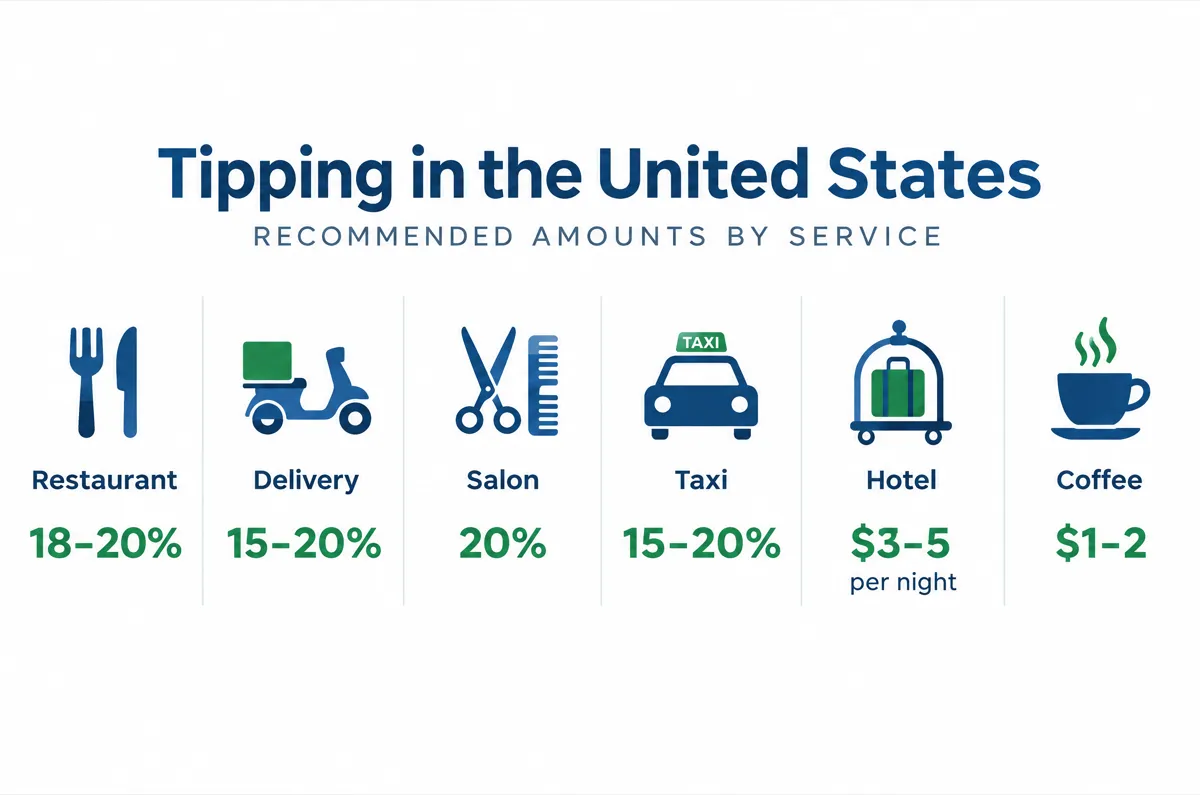
Tipping in the United States is not optional generosity — it is how millions of service workers earn a livable wage. A server earning $2.13 per hour in a tipped-minimum state depends on your 18-20% gratuity to make rent. Yet the rules differ dramatically by service type: what is standard at a steakhouse is excessive at a coffee counter, and what works for a couple's dinner breaks down at a six-person group table. This guide gives you specific dollar amounts and percentage ranges for every common tipping scenario.
Last updated: September 2026
TL;DR - Quick Reference
| Service Type | Standard Tip | Example ($) |
|---|---|---|
| Restaurant (sit-down) | 18-20% pre-tax | $24 on $120 bill |
| Group dinner (6+) | 18-20% (auto-gratuity common) | $70 on $350 bill |
| Coffee shop (counter) | $1-$2 flat | $1.50 on $7.50 order |
| Food delivery | 20% ($5 minimum) | $9 on $45 order |
| Hair salon / barber | 20% of service total | $13 on $65 service |
Use our Tip Calculator to compute exact amounts for any bill size, party count, or tip percentage.
Restaurant Dining
Full-service restaurant dining is the highest-standard tipping category in the United States. Servers in tipped-minimum states earn as little as $2.13 per hour before gratuities, making your tip the majority of their take-home pay for that shift. The widely accepted baseline is 18% for satisfactory service and 20% for good service, calculated on the pre-tax subtotal.
On a typical $120 dinner bill, the math breaks down cleanly:
- 15% (acceptable): $18.00 — adequate service, no major issues
- 18% (standard): $21.60 — the baseline most etiquette guides recommend
- 20% (good): $24.00 — attentive service, accurate orders, timely refills
- 25% (exceptional): $30.00 — memorable experience, dietary accommodations, or outstanding care
The difference between acceptable and generous is only $12 — roughly the price of a single appetizer — yet it meaningfully affects a server's earnings across a full shift.
Pre-Tax vs Post-Tax Tipping
Etiquette experts recommend calculating your tip on the pre-tax subtotal, not the total after sales tax. Tax is a government levy, not a cost of service. On a $120 bill with 8% sales tax ($9.60), tipping 20% on the after-tax total of $129.60 costs an extra $1.92 compared to tipping on $120. While modest on one meal, that difference exceeds $100 over a year of monthly client dinners at similar price points.
Counter Service vs Sit-Down
Fast-casual counter service — where you order at a register and pick up your food — typically does not require a tip, though many payment screens now prompt for one anyway. Sit-down dining where a server takes your order, refills drinks, and handles the check is where 18-20% is expected and essential.
When to Tip More or Less
Standard percentages are starting points, not rigid rules. Exceptional service — attentive without being intrusive, accurate orders, and genuine warmth — warrants 20-25%. Mediocre service with long waits might justify 15%, though many diners still tip 18% to avoid penalizing a server covering too many tables. Truly poor service — rude behavior or completely wrong orders with no apology — may warrant speaking with a manager rather than reducing the tip to zero, since many restaurants pool or share tips among staff.
Key Insight
Tip on comped or discounted items at their full pre-discount price. If a manager comped a $25 appetizer due to a kitchen error, calculate your tip as if that item were still on the bill. The server provided the same service regardless of the comp.
Group Dinners
Group dinners with friends, family, or colleagues introduce unique tipping and splitting challenges. A $350 bill for six people averages $58.33 per person before tip. Adding a 20% gratuity of $70 brings the total to $420, or $70 per person all-in — a clean number that includes fair compensation for a server managing a large table.
A server managing a six-person table handles roughly three times the order complexity of a couple — coordinating timing, refills, dietary requests, and separate drink orders — yet receives the same percentage tip. The absolute dollar amount ($70 vs $24 for a couple's dinner) partially compensates for the extra workload.
Auto-Gratuity Thresholds
Most restaurants automatically add 18-20% gratuity for parties of six or more, though some set the threshold at eight guests. On a $350 bill, auto-gratuity at 18% equals $63 and appears as a line item on your receipt. This charge is legally distinct from a voluntary tip in many jurisdictions. Always review your bill before adding an additional tip to avoid double-tipping — adding another 20% on top of an included 18% gratuity would overpay by $70.
If auto-gratuity is already included, you may still leave an additional 2-5% in cash for outstanding service ($7-$17.50 on a $350 bill). This is a common and appreciated gesture for large parties without overpaying.
Per-Person Calculation and Check-Splitting
The fairest approach: add the tip to the full bill, then divide the total by the number of people. On a $350 bill with 20% tip ($70), each of six people pays $70.00. Splitting only the food subtotal and leaving one person to cover the entire tip creates confusion and often shortchanges the server.
When guests ordered unevenly — some had appetizers, premium entrees, or multiple drinks — itemized splitting is fairer. Calculate each person's food and drink subtotal, add their proportional share of tax, then apply the tip percentage to their individual amount. Venmo and payment apps simplify collection, but designate one person to calculate the total including tip and tax, then request a fixed amount from each guest rather than leaving tip calculation to chance.
Corporate Dining Etiquette
For corporate team dinners, the host typically covers the full bill and tip. Budget $75-$85 per person (including 20% gratuity and tax) when planning group dining events at mid-range restaurants. If you are the host, calculate the expected total before the meal and communicate per-person cost to attendees so no one is surprised when the check arrives.
Coffee Shops and Counter Service
Coffee shop tipping has become one of the most debated etiquette questions since digital payment terminals started presenting tip prompts for counter service. Unlike sit-down restaurants where tipping is essential, coffee shop tips are appreciated but not universally expected. Baristas typically earn at or above minimum wage, and the interaction lasts under two minutes instead of an hour-long dining experience.
For a $7.50 latte order, common approaches include:
- Flat $1: 13.3% — perfectly reasonable for a standard order
- 15% calculated: $1.13 — total $8.63
- 20% calculated: $1.50 — acknowledges extra craft
- Round up to $8: $0.50 — acceptable for drip coffee or grab-and-go
Digital Tip Screen Etiquette
Payment terminals often display tipping options of 15%, 20%, and 25% on a screen facing the customer while the barista watches, creating social pressure to select a higher amount. These defaults are set by the payment processor, not the coffee shop. Selecting a custom tip, choosing the lowest option, or tapping no tip are all acceptable for standard counter service orders. There is no social obligation to select the highest option — $1 on a $5-$8 coffee purchase is a perfectly reasonable tip.
Frequency Impact: The $260/Year Question
Regular customers who tip $1 per visit at their daily coffee shop spend roughly $260 per year (5 visits per week, 52 weeks). At $1.50 per visit, that rises to $390 per year. At daily visits with a $1.50 tip, the annual cost reaches $547.50. These amounts are worth budgeting for if you visit frequently — they belong in your discretionary spending category alongside dining and entertainment.
Barista Complexity Factor
If a barista makes a complex custom drink — multiple modifications, specific temperature, alternative milk preparation — a 20% tip acknowledges the extra craft involved compared to a standard pour. For large catering orders ($50+) from a coffee shop, a 15-20% tip is appropriate since staff prepares multiple drinks simultaneously and may arrange delivery or setup. Drive-through tipping is optional and less common; if a tip jar is present, $1 is generous but not expected.
Food Delivery
Food delivery tipping has shifted significantly with app-based services like DoorDash, Uber Eats, and Grubhub. Delivery drivers use personal vehicles, pay for their own gas and insurance, and often earn minimal base pay per delivery — typically $2-$4 before tips. For a $45 food delivery order, a 20% tip of $9.00 is the current standard.
The $5 Minimum Rule
Many delivery experts recommend a $5 minimum tip regardless of order size. A $3 tip on a $15 order may not justify the driver's time and fuel costs. The percentage-based norm of 20% works for larger orders, but the absolute dollar amount matters more for small orders because drivers bear vehicle wear, gas, and unpaid time between deliveries.
Driver Visibility of Tip Amount
Most delivery platforms show your tip to drivers before they accept the order. A $9 tip on a $45 order makes your delivery more attractive and likely results in faster pickup and more careful handling. A low pre-tip may result in longer wait times or fewer available drivers willing to accept the delivery. You can often adjust the tip after delivery on some platforms if service was exceptionally good or poor, but the initial tip amount strongly influences driver behavior.
Bad Weather Premium (25-30%)
Rain, snow, and extreme heat significantly increase delivery difficulty and risk, warranting a 25-30% tip rather than the standard 20%. On a $45 order, that means $11.25-$13.50 instead of $9.00 — an extra $2.25-$4.50 that meaningfully acknowledges the driver's effort in hazardous conditions. Drivers who accept orders during storms often face reduced order volume and higher expenses, making generous tipping especially important.
Distance Factor and App Fees
Ordering from a restaurant 10+ miles away typically means the driver spends 30-45 minutes on your delivery alone. A $12-$15 tip (27-33% on $45) better reflects the distance commitment than a flat percentage. For apartment or office deliveries requiring parking, elevators, or security checkpoints, add an extra $2-$3 beyond your standard tip.
App delivery fees ($3-$8) and service charges go to the platform, not the driver. Your tip is separate compensation for the person who physically delivers your food. A typical $45 order with $5 delivery fee, $3 service charge, and $9 tip totals $62 — the tip is the only portion that directly rewards the driver's effort.
Pickup orders placed through delivery apps do not require a tip because no delivery service is provided. If a restaurant employee brings the order to your car in a curbside pickup arrangement, a $2-$3 tip is a courteous gesture but not expected.
Hair Salon and Personal Services
Tipping your hairstylist or barber is customary in the United States, with 20% being the widely accepted standard for salon services. On a $65 haircut and styling service, a 20% tip of $13.00 brings the total to $78.00. The tipping expectation applies whether you visit a budget-friendly chain or an upscale salon.
Multi-Service Tipping
If your salon charges $65 for a cut and $40 for color (total $105), tip 20% on the full $105 ($21.00) rather than calculating separate percentages for each service. The total amount reflects the stylist's full effort across a 2-3 hour appointment. For color treatments, highlights, or complex styling, many clients tip 25% ($16.25 on a $65 service) to reflect the extended time and skill.
When a salon assistant washes and conditions your hair separately from the stylist who cuts it, a $3-$5 cash tip directly to the assistant is customary in addition to the main stylist's 20% tip. Hand the assistant tip in cash at the shampoo bowl rather than adding it to the credit card transaction, as assistants may not receive a share of card-based tips processed through the salon's payment system.
Holiday Tipping
Holiday tipping for your regular stylist equals the cost of one full service — $65 in this scenario — typically given in December as cash or a gift card. This annual bonus acknowledges the ongoing relationship and is separate from your regular 20% tip at each appointment. If you visit multiple times per year, the holiday tip is in addition to your per-visit gratuity, not a replacement for it.
Tipping Salon Owners
Historically, salon owners were exempt from tipping because they set prices and keep the full service fee. Modern etiquette has shifted, and most guides now recommend tipping owners the same 15-20% as employed stylists. If the owner provides the service personally and you would tip an employee stylist for the same work, extending the same gratuity is appropriate and appreciated.
How Tipping Adds Up: Annual Budget Impact
Tipping affects your monthly budget in ways that are easy to overlook. A couple who dines out twice per week at $60 per meal and tips 20% spends roughly $1,248 per year on restaurant gratuities alone — before drinks, tax, or delivery fees. Tracking tips as a budget line item prevents end-of-month surprises. Use our 50/30/20 budget rule guide to see how dining and tipping fit into your wants allocation.
| Service | Frequency | Avg Tip | Annual Cost |
|---|---|---|---|
| Restaurant dining | 2x per week | $12 (20% on $60) | $1,248 |
| Coffee shop | 5x per week | $1 flat | $260 |
| Food delivery | 1x per week | $9 (20% on $45) | $468 |
| Hair salon | 1x per month | $13 (20% on $65) | $156 |
| Group dinners | 1x per month | $12 (share of $70) | $144 |
| Total | — | — | $2,276 |
Based on a typical active consumer. Adjust frequencies and amounts to match your habits. If you dine out $400 per month on food and drink before tip, add 18% ($72) to your dining budget for a realistic $472 monthly restaurant spend.
Calculate Your Tip in Seconds
Enter any bill amount, tip percentage, and number of diners to get exact gratuity amounts and per-person splits — for restaurants, group dinners, delivery, salons, and more.
Frequently Asked Questions
Should I tip on the pre-tax or post-tax total?
Most etiquette experts and servers agree that tips should be calculated on the pre-tax subtotal, not the total after sales tax. Tax is a government levy, not a cost of service. On a $120 bill with 8% sales tax ($9.60), tipping 20% pre-tax means $24.00 in gratuity. Tipping 20% post-tax on $129.60 yields $25.92 — an extra $1.92 per meal that adds up across dozens of restaurant visits each year. Look for the subtotal line on your receipt before calculating.
Do I need to tip at coffee shops?
Coffee shop tips are appreciated but not universally expected the way restaurant tips are. Baristas typically earn at or above minimum wage rather than the $2.13 federal tipped minimum, and the interaction lasts under two minutes. A flat $1-$2 tip on a $5-$8 order is perfectly reasonable for counter service. Digital tip screens often present 15%, 20%, and 25% options, but there is no social obligation to select the highest amount. For complex custom drinks or large catering orders ($50+), a 15-20% tip is more appropriate.
How much should I tip a food delivery driver?
The current standard for food delivery is 20% of the order total, with a $5 minimum regardless of order size. On a $45 order, that is $9.00. Drivers see tip amounts before accepting orders on most platforms, so lower tips may result in longer wait times. In bad weather (rain, snow, extreme heat), bump to 25-30% ($11.25-$13.50 on a $45 order). For deliveries 10+ miles away, consider $12-$15 (27-33%) to reflect the driver's time and fuel costs.
Should I tip the salon owner?
Historically, salon owners were exempt from tipping because they set prices and keep the full service fee. Modern etiquette has shifted, and most guides now recommend tipping owners the same 15-20% as employed stylists. If the owner provides the service personally and you would tip an employee stylist for the same work, extending the same gratuity is appropriate. On a $65 service, that means $13.00 at 20%.
How much do Americans spend on tips annually?
A typical American who dines out twice per week at $60 per meal and tips 20% spends roughly $1,248 per year on restaurant gratuities alone. Add daily coffee shop tips ($260/year at $1 per visit, 5 days per week), monthly salon visits ($156/year at $13 per tip), and weekly food delivery ($468/year at $9 per order), and total annual tipping easily reaches $2,100-$2,500 for an active consumer. Tracking tips as a budget line item prevents end-of-month surprises.