Guides / Savings & Investment
Simple vs Compound Interest: What’s the Difference and Why It Matters
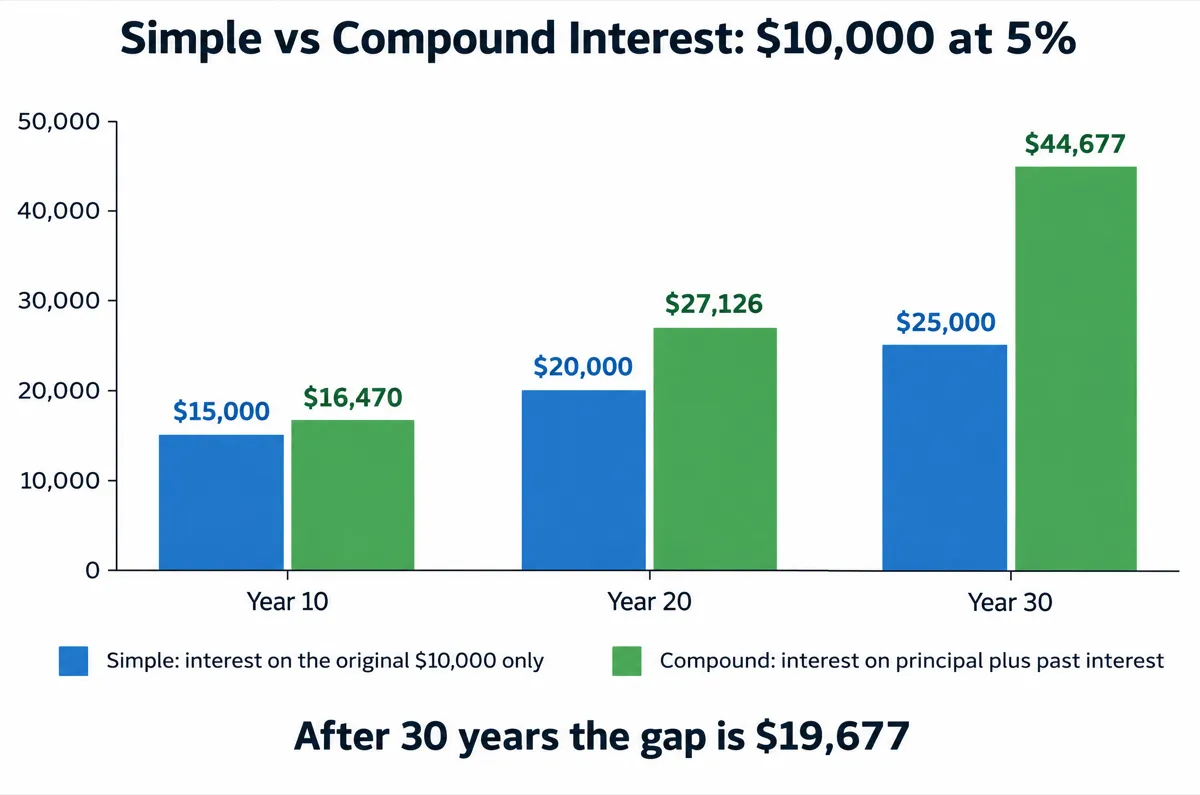
A savings account advertises 5% and a loan offer also says 5%, but they are not the same 5%. One may add interest to your balance every day and then charge interest on that interest. The other may charge interest only on the money you still owe. On $10,000 over 30 years, the two methods differ by $19,677. This guide shows the formulas, the real-world examples, and how to tell which method your own accounts use.
Last updated: November 2026
TL;DR - Quick Answer
- Simple interest is charged only on the original principal: $10,000 at 5% for 10 years earns $5,000.
- Compound interest is charged on principal plus past interest: the same $10,000 compounded monthly earns $6,470, and after 30 years the gap is $19,677.
- Credit cards and savings accounts compound. A 22.36% card APR costs about 25.05% a year if you never pay the balance.
- Auto loans, federal student loans, and mortgages accrue simple interest on the unpaid balance, so extra payments save interest at your stated rate, with no compounding (student loans can capitalize unpaid interest at set events).
- Rule of thumb: compounding helps you when you save and hurts you when you carry a balance, so pay down the highest effective rate first.
Run the math yourself with the Simple Interest Calculator and the Compound Interest Calculator.
The Two Formulas
Simple interest multiplies the original amount by the rate and the number of years. Compound interest grows the balance each period, so the next period’s interest is calculated on a larger number.
Simple: I = P × r × t, so the balance is A = P × (1 + r × t)
Compound: A = P × (1 + r ÷ n)n × t
- P is the principal, the amount you deposit or borrow.
- r is the annual rate as a decimal (5% is 0.05).
- t is the time in years.
- n is how many times per year interest compounds: 1 for annual, 12 for monthly, 365 for daily.
Worked example with $10,000 at 5% for 10 years. Simple: $10,000 × (1 + 0.05 × 10) = $15,000, so the interest is $5,000. Compounded monthly: $10,000 × (1 + 0.05 ÷ 12)120 = $16,470, so the interest is $6,470. The compounded account earns $1,470 more from the same rate and the same deposit, because every year after the first earns interest on the previous years’ interest.
Why the Gap Keeps Growing
Simple interest adds the same $500 every year. Compound interest adds a larger amount each year, so the lines start together and then pull apart. Here is $10,000 at 5% at five time horizons.
| Years | Simple | Compound, annual | Compound, monthly | Compound, daily | Monthly minus simple |
|---|---|---|---|---|---|
| 1 | $10,500 | $10,500 | $10,512 | $10,513 | $12 |
| 5 | $12,500 | $12,763 | $12,834 | $12,840 | $334 |
| 10 | $15,000 | $16,289 | $16,470 | $16,487 | $1,470 |
| 20 | $20,000 | $26,533 | $27,126 | $27,181 | $7,126 |
| 30 | $25,000 | $43,219 | $44,677 | $44,812 | $19,677 |
Two things stand out. First, time does the heavy lifting: in year 1 compounding adds only $12, but by year 30 it adds $19,677. Second, the compounding frequency barely matters next to time and rate: daily instead of annual compounding adds just $198 after 10 years. For the same reason, the Rule of 72 (divide 72 by the rate to estimate the doubling time) works only for compounding, and our compound interest examples guide applies it to retirement saving and debt.
APR vs APY: The Same Rate With Two Labels
The label tells you which kind of rate you are looking at. APR (annual percentage rate) is the stated yearly rate and usually ignores compounding. APY (annual percentage yield) is the amount you actually earn in a year once compounding is included. Federal rules require banks to disclose APY on deposit accounts, and the formula is APY = (1 + r ÷ n)n − 1.
| Stated rate | Compounding | Effective yearly rate |
|---|---|---|
| 5.00% | Annually | 5.00% |
| 5.00% | Quarterly | 5.09% |
| 5.00% | Monthly | 5.12% |
| 5.00% | Daily | 5.13% |
| 22.36% card APR | Daily | 25.05% |
The card row is the one that costs money. Card issuers divide the APR by 365 to get a daily periodic rate, apply it to the balance each day, and add the interest to the next day’s balance. The Federal Reserve’s G.19 report puts the average APR on accounts that were assessed interest at 22.36% for August 2026, so a balance left alone for a year grows by about 25.05%, not 22.36%. Our Credit Card Payoff Calculator models this with your actual payment.
Sources CFPB: What is a daily periodic rate on a credit card?, CFPB, Regulation DD (12 CFR 1030) Appendix A: APY calculation, Federal Reserve G.19 Consumer Credit (Aug. 2026 data, released Oct. 7, 2026). Checked November 2026. Effective yearly rate = (1 + APR ÷ 365)^365 − 1, assuming no payments and no new purchases.
Which Method Does Your Money Actually Use?
Most consumer products fall into one of two groups: balances that grow on interest (cards, savings) and balances that accrue interest only on what is still owed (most installment loans). The table shows how the common ones work and what rate to expect today.
| Product | How interest is charged | Quoted as | Benchmark |
|---|---|---|---|
| Credit card | Compounds daily: the daily periodic rate (APR ÷ 365) is applied to a balance that includes yesterday’s interest | APR | 22.36% APR on accounts assessed interest (Aug. 2026), about 25.05% a year after daily compounding |
| Savings, money market, CD | Compounds on the schedule the bank sets (daily or monthly is common); the account must disclose APY | APY | National average 0.38% savings and 1.76% 12-month CD (FDIC, Oct. 19, 2026); competitive online accounts pay well above that |
| Auto loan (simple interest) | Interest accrues daily on the unpaid principal only; none is added to the balance | APR | 7.54% on a 60-month new-car loan at commercial banks (Fed G.19, Aug. 2026) |
| Federal student loan | Simple daily interest (balance × rate ÷ 365.25); unpaid interest can capitalize at specific events | Fixed rate | 6.52% for undergraduate Direct Loans first disbursed July 2026 to June 2027 |
| Fixed-rate mortgage | Interest accrues on the remaining balance and is paid each month, so it is simple interest on a shrinking balance | Rate and APR | 7.40% 30-year average (Freddie Mac, October 15, 2026) |
| Precomputed (add-on) loan | Total interest is calculated up front on the full original principal and spread evenly across payments | Add-on rate (check the APR) | Uncommon for auto loans, per the CFPB; it penalizes early payoff |
The practical difference is what happens when you pay extra. On a simple-interest auto loan, every extra dollar of principal stops earning interest at the stated rate the next day, so $1,000 of extra principal at 7.54% saves about $75 in a year. On a credit card, the same $1,000 saves about $250 in a year because it also stops the compounding. Use the Auto Loan Calculator or the Student Loan Calculator to see the payoff date move.
Sources Federal Reserve G.19 Consumer Credit (Aug. 2026 data, released Oct. 7, 2026), FDIC National Rates and Rate Caps, October 2026, Federal Student Aid, 2026-27 Direct Loan interest rates (June 4, 2026), Federal Student Aid: interest accrual and capitalization, CFPB: simple interest vs precomputed interest on an auto loan, Freddie Mac PMMS (Oct. 15, 2026). Checked November 2026. The auto-loan benchmark is the G.19 60-month new-car rate at commercial banks for August 2026, released October 7, 2026.
The Loan Trap: “Simple” Interest That Is Not
The words “simple interest” mean two different things. In a textbook, simple interest is the formula I = P × r × t on a fixed principal. On a loan, a “simple interest loan” means interest accrues daily on the balance you still owe, which is the borrower-friendly version. The CFPB contrasts it with precomputed interest, where the total interest is worked out immediately on the full amount borrowed and spread evenly across the payments. The CFPB calls that method uncommon and notes it benefits the lender if you pay early.
| $22,000, 60 months, quoted 7.54% | Monthly payment | Total interest | True APR |
|---|---|---|---|
| Simple-interest loan (balance-based) | $441.25 | $4,475 | 7.54% |
| Precomputed add-on loan (hypothetical) | $504.90 | $8,294 | 13.38% |
Same quoted rate, but the add-on version charges $3,819 more interest because it ignores that you owe less every month, and its true APR is about 13.38%. The add-on row is a hypothetical to show the mechanism. Before you sign, compare the APR on the loan disclosure, not the “rate,” and ask whether the loan is simple interest or precomputed and whether early payoff is penalized.
Case Study: Where Maya’s $6,000 Tax Refund Works Hardest
Maya Ortiz, 31, is a marketing manager in Columbus, Ohio. She gets a $6,000 federal tax refund and has four places it could go: a $6,000 credit card balance at 22.36% APR, a $22,000 simple-interest auto loan at 7.54%, a federal student loan at 6.52%, or a high-yield savings account paying a hypothetical 4.00% APY. The question is which choice improves her finances most over the next 12 months. The table assumes the card balance would otherwise sit unpaid for the year, which is the upper bound; her actual payments would make the card figure smaller, but the ranking holds.
| Where the $6,000 goes | Method | Effective yearly rate | 12-month benefit |
|---|---|---|---|
| Pay off the credit card | Compounds daily | 25.05% | $1,503 |
| Prepay the auto loan | Simple, on balance | 7.54% | $452 |
| Prepay the student loan | Simple daily | 6.52% | $391 |
| Save at 4.00% APY (illustrative) | Compounds | 4.00% | $240 |
| Leave it at the 0.38% national average | Compounds | 0.38% | $23 |
Paying the card is worth $1,503, more than three times the next best use. A reader who treated 22.36% as simple interest would estimate only $1,342, understating the cost by $161. Maya clears the card first. After that, the 7.54% auto loan beats the 6.52% student loan and the savings account on rate, though she keeps a cash cushion before prepaying anything. Federal loans also carry protections, such as income-driven repayment, that disappear if you refinance them into a private loan, and autopay on a federal loan currently cuts the rate by 1 point, which trims the student-loan figure to about $331. Our guide to paying off credit card debt walks through the card payoff step by step.
Sources Federal Reserve G.19 Consumer Credit (Aug. 2026 data, released Oct. 7, 2026), Federal Student Aid, 2026-27 Direct Loan interest rates (June 4, 2026), Federal Student Aid: auto pay 1% interest rate reduction. Checked November 2026. The savings yield is an illustration, not a quote. The 1-point autopay reduction applies to Direct Loans originated after July 1, 2012 when the borrower is enrolled in auto pay by December 31, 2026, and it runs through June 30, 2028.
Student Loans and Mortgages: Simple Interest, Different Traps
Federal student loans accrue simple daily interest using the formula balance × rate ÷ 365.25. On $12,000 at 6.52% that is $2.14 a day, or $3,130 over four years in school if nothing is paid. The trap is capitalization: Federal Student Aid says unpaid interest on a Direct unsubsidized loan is added to the principal when a deferment ends, and in certain income-based repayment exits, after which interest accrues on the larger balance. Paying the accrued interest before that point keeps the principal unchanged.
A fixed-rate mortgage works differently. On a $300,000 loan at 7.40% the first month’s interest is $1,850.00 of the $2,077.14 payment, so only $227.14 reduces the balance. The interest is calculated on a shrinking balance and paid every month, so it never compounds, but it is front-loaded, which is why extra payments early in the term save the most. The amortization schedule guide shows the full 30-year split.
Savings Side: Interest Paid Out vs Reinvested
You can also choose simple or compound behavior on a deposit. A $15,000 certificate of deposit at 4.00% for 5 years that pays its interest out to your checking account earns $3,000, which is simple interest in effect. If the interest stays in the CD, it earns $3,250, which is $250 more. The gap is modest over 5 years and grows with time, so for long-term money leave interest invested. For the best current deposit rates, see our high-yield savings vs CD guide.
Step-by-Step: Find Out Which One You Have
- Read the label. A rate called APY on a deposit account already includes compounding. A rate called APR on a card or loan is the stated yearly rate and does not. If you only see “interest rate,” ask which one it is.
- Convert everything to an effective yearly rate. Use (1 + r ÷ n)n − 1. A 22.36% card compounded daily is 25.05%, and a 5% account compounded monthly is 5.12%. Compare offers on that number.
- Ask whether a loan is simple interest or precomputed. Look for the phrases “simple interest,” “daily accrual,” or “precomputed” in the contract, and confirm there is no prepayment penalty. If the payment looks too low for the quoted rate, the interest may have been computed on the original principal.
- Check for capitalization. On student loans, view accrued interest on your servicer dashboard and pay it before a deferment ends or you change repayment plans.
- Target the highest effective rate first. Pay down balances that compound (cards) before balances that accrue simple interest (auto, student, mortgage), unless a lower-rate loan has a penalty or protection you would lose.
- Put savings where interest compounds, and leave it alone. Choose the highest APY you can get with FDIC or NCUA insurance, keep interest invested, and avoid withdrawals that restart the compounding clock.
Run Your Own Numbers
Compare simple and compound growth on your own balance, rate, and time frame.
FAQ
Is simple interest better than compound interest?
It depends on which side of the account you are on. For money you save or invest, compound interest is better: $10,000 at 5% for 10 years earns $5,000 with simple interest and $6,470 with monthly compounding. For money you borrow, you want the lowest interest that accrues, so a loan that charges simple interest on the declining balance is better than one that compounds on unpaid interest. Credit cards compound daily, which is why a 22.36% APR costs about 25.05% a year if the balance is never paid.
Does a mortgage use compound interest?
A standard fixed-rate mortgage accrues interest on the remaining balance and you pay that interest with each payment, so interest never piles up on interest. On a $300,000 loan at 7.40% the first month’s interest is $1,850.00 of a $2,077.14 payment, and the other $227.14 reduces the balance. Compounding only enters if a payment is smaller than the interest due, which is rare and usually disclosed. Our amortization schedule guide shows how the split shifts over 30 years.
How much does compounding frequency matter?
Less than most people expect. On $10,000 at 5% for 10 years, annual compounding grows to $16,289, monthly to $16,470, and daily to $16,487. The difference between annual and daily compounding is $198 over a decade, while moving the rate from 5% to 6% or adding 10 more years changes the result by thousands. Compare accounts on APY, which already includes the compounding frequency, and spend your effort on rate and time.
Do federal student loans compound?
Federal student loans accrue simple daily interest: balance times rate divided by 365.25. On $12,000 at 6.52% that is about $2.14 a day, or $3,130 over four years of school if nothing is paid. Interest does not compound while it accrues, but it can capitalize: when unpaid interest is added to the principal, for example at the end of a deferment on an unsubsidized loan, later interest accrues on the larger balance. Paying accrued interest before one of those events avoids the jump.
What does APY tell me that APR does not?
APY includes how often interest compounds and APR does not. Regulation DD defines the annual percentage yield as the total interest earned on an account over a 365-day period, based on the rate and the frequency of compounding. A 5% rate compounded monthly is a 5.12% APY, and a 22.36% card APR compounded daily works out to 25.05% a year. When you compare two offers, convert both to the same yearly measure first.
Related Guides
Compound Interest: 5 Real-Life Examples That Show Its Power
See compound interest in action with 5 real examples: $500/month for 40 years, credit card debt traps, student loans, and the Rule of 72 explained.
High-Yield Savings Account vs CD: Which Is Better in 2026?
Compare high-yield savings accounts vs CDs with October 2026 rates. See when each wins, a $30,000 comparison, and the optimal split strategy.
How to Pay Off $10,000 in Credit Card Debt: 5 Proven Strategies
Pay off $10,000 in credit card debt with 5 proven strategies. Compare timelines, total interest, and see which approach fits your situation best.