Guides / Pay & Career
Salary vs Hourly Pay: Which Is Better for You in 2026?
You have two offers for the same logistics coordinator role: $52,000 salaried (exempt) or $25.00 per hour (non-exempt). The headline numbers match, since $52,000 ÷ 2,080 hours = $25.00 per hour, but your choice changes overtime pay, how paid time off affects cash flow, and what happens when steady 45-hour weeks replace a 40-hour expectation. This guide walks through the formulas, federal and California exempt rules, BLS compensation benchmarks, take-home pay with 2026 federal tax tables (including the new overtime deduction), and an Austin case study so you can compare offers on your own terms.
Last updated: November 2026
Quick Answer
Salary vs hourly is a toss-up only when hours stay at 40 and benefits are equal. At $52,000 versus $25.00, gross pay is identical at 40 hours, but 5 hours of weekly overtime lifts hourly gross to $61,750 while exempt salary stays flat. Unpaid time off costs an hourly worker without PTO about $3,400 per year versus a salaried colleague who keeps full pay. Compare effective hourly rates (pay divided by hours worked), put a dollar value on health coverage, and confirm exempt status against the federal $35,568 salary floor, or $70,304 in California.
Why Salary vs Hourly Decisions Trip People Up
Employers often frame salary as "stable" and hourly as "flexible," but stability is just a fixed numerator. The denominator (hours worked, overtime eligibility, and paid leave) moves the outcome more than the label. BLS Employer Costs for Employee Compensation show private employers spent 30.0% of total compensation on benefits in June 2026 (wages were 70.0%), so two offers with the same gross wage can still diverge by thousands once health premiums and retirement match enter the picture.
Roughly 55.6% of U.S. wage and salary workers were paid by the hour in 2024 (80.3 million workers, per the BLS Characteristics of Minimum Wage Workers report). Most of the rest are salaried, but a salaried title does not automatically mean exempt from overtime. The federal salary floor for the white-collar exemptions is $684 per week, the level the Department of Labor lists after a federal court vacated the higher 2024 threshold in November 2024.
Core Formulas for Salary vs Hourly
Nominal hourly equivalent (salary): divide annual salary by 2,080 paid hours (40 hours × 52 weeks).
Hourly equivalent = Annual salary ÷ 2,080
Example: $52,000 ÷ 2,080 = $25.00 per hour before taxes. This matches the convention in our Salary to Hourly Calculator and is the number recruiters use when they say the offers "are the same."
Effective hourly rate: divide gross annual pay by the hours you actually work.
Effective hourly = Annual pay ÷ (Hours per week × 52)
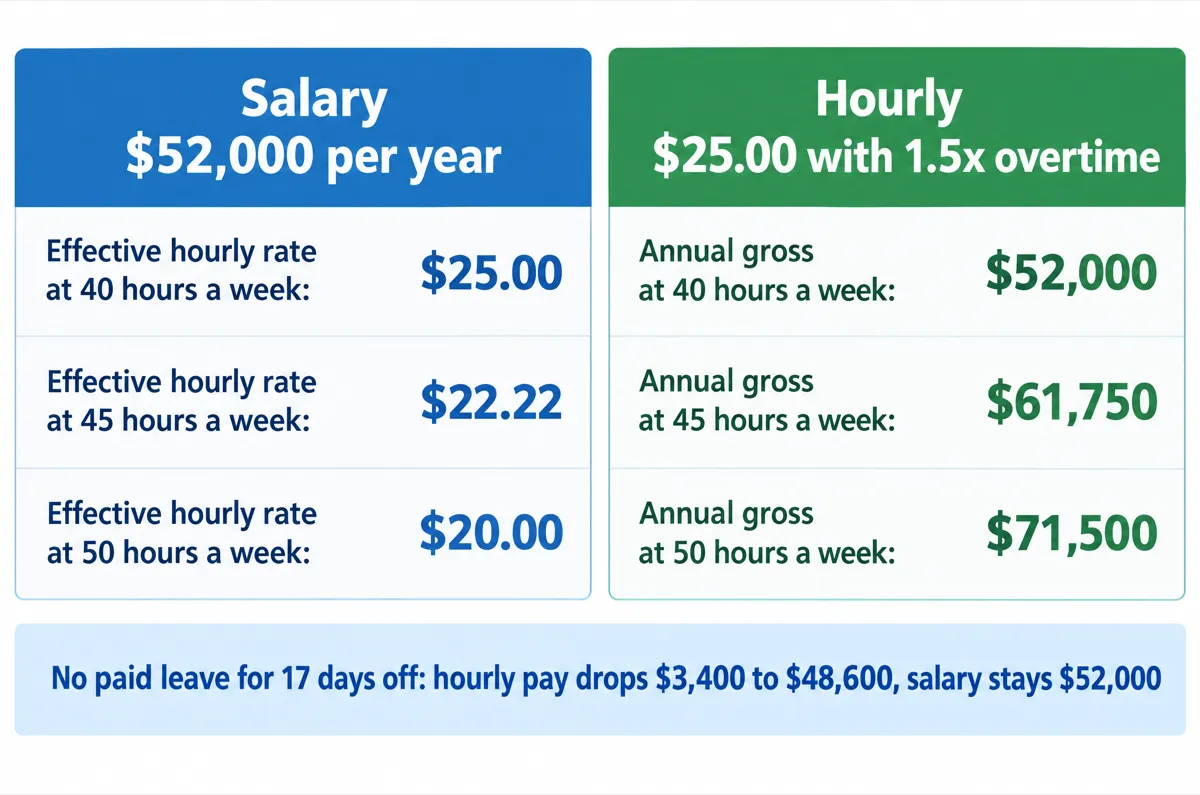
A $52,000 exempt employee averaging 50-hour weeks earns an effective $20.00 per hour worked. A non-exempt worker at $25.00 on the same schedule grosses $71,500 and works at an effective $27.50 because FLSA overtime kicks in.
FLSA overtime (non-exempt): for hours over 40 in a workweek, pay at least 1.5× the regular rate.
OT pay = 1.5 × Regular rate × Hours over 40 per week
Five overtime hours at $25.00 add $187.50 per week, or $9,750 per year. That is the difference between $61,750 and $52,000 in the comparison table below.
Paid-time-off adjustment: salaried workers usually keep full salary during approved PTO. Hourly workers without paid leave only earn for hours on the clock, so their paid hours can fall below 2,080 even on a 40-hour schedule.
With 17 days off (8 paid holidays and 9 vacation days after one year, the BLS private-industry averages in the March 2026 benefits survey), worked hours drop to 1,944. Salary still pays $52,000; hourly with no PTO pays $25 × 1,944 = $48,600, a $3,400 gap before overtime.
Gross Pay Comparison: $52,000 Salary vs $25.00/Hour
The table computes annual gross and effective hourly rates for 40-, 45-, and 50-hour average weeks, assuming the hourly worker is paid for 52 full weeks and earns 1.5× for every hour over 40. The last row shows what happens when an hourly employee has no paid leave for the BLS-average 17 days.
| Avg hours / week | Salary gross | Hourly gross (1.5× OT) | Salary effective $/hr | Hourly effective $/hr |
|---|---|---|---|---|
| 40 | $52,000 | $52,000 | $25.00 | $25.00 |
| 45 | $52,000 | $61,750 | $22.22 | $26.39 |
| 50 | $52,000 | $71,500 | $20.00 | $27.50 |
| PTO lens: with 17 paid days off the salary works out to $26.75 per hour actually worked ($52,000 ÷ 1,944). An hourly worker with no paid leave for the same days grosses $48,600, $3,400 less. | ||||
When Does Overtime Make Hourly Beat Salary?
Exempt salary does not increase when weeks run long, so an hourly offer below the salary's per-hour equivalent can still win once overtime starts. The table fixes the salary at $52,000 ($25.00 per hour on paper) and asks how many average weekly hours each hourly rate needs to reach the same gross, with every hour past 40 paid at 1.5×.
| Hourly offer | Gross at 40 hours | vs $52,000 salary | Avg hours / week to match |
|---|---|---|---|
| $22.00 | $45,760 | $6,240 below | 43.7 (3.7 OT hours) |
| $23.00 | $47,840 | $4,160 below | 42.4 (2.4 OT hours) |
| $24.00 | $49,920 | $2,080 below | 41.2 (1.2 OT hours) |
| $25.00 | $52,000 | Even | 40 (each OT hour is extra) |
| $26.00 | $54,080 | $2,080 above | Ahead at 40 hours |
The pattern: every $1 an hour you give up versus the salary's per-hour equivalent costs $2,080 a year, while each weekly overtime hour earns back $1,794 a year at $23.00 an hour. A $2 shortfall therefore takes about 2.4 overtime hours a week to close, but only if that overtime is actually scheduled and paid.
Exempt vs Non-Exempt: Federal Rules in November 2026
The Fair Labor Standards Act generally requires overtime at 1.5× for non-exempt workers. The executive, administrative, and professional exemptions require a duties test plus a minimum salary of $684 per week ($35,568 annually), the figure on the DOL salary-level page after a federal court vacated the 2024 increase. Highly compensated employees face a $107,432 total annual compensation test that still includes at least $684 per week paid on a salary basis.
California sets a higher floor. Labor Code section 515 requires a monthly salary of at least twice the state minimum wage for full-time work (40 hours a week): $16.90 × 2 × 2,080 = $70,304 since January 1, 2026. California also requires daily overtime after 8 hours in a day, not only weekly hours over 40, so a misclassified salaried worker in Los Angeles can be owed more than under federal law alone.
Sources DOL FLSA salary-level thresholds (2019 rule in effect), California DIR, minimum wage FAQ ($16.90 per hour from Jan. 1, 2026), California Labor Code section 515 (exempt salary of two times the state minimum wage). Checked November 2026. Local minimum wages and state daily overtime rules can go beyond these figures; confirm classification with your state labor agency.
Benefits: What BLS Says Employers Spend
In June 2026, BLS reported private-industry employer compensation cost $46.89 per hour worked: wages $32.82 (70.0%) and benefits $14.07 (30.0%). For full-time private workers, paid leave alone cost employers $4.40 per hour worked, 8.1% of the $54.00 total. Salaried and hourly full-time jobs often differ most in how much of that paid leave actually reaches the worker.
On access, 80% of private-industry workers had paid vacation and 81% had paid holidays in March 2026. Among those with paid vacation, the mean after one year of service was 9 days, and paid holidays averaged 8 days. KFF estimates employers contributed $7,885 toward the average single health premium in 2025, a dollar figure worth adding when a salaried package includes subsidized medical and an hourly quote does not.
Sources BLS Employer Costs for Employee Compensation, June 2026 (released Sep. 9, 2026), BLS Employee Benefits in the United States, March 2026 (released Sept. 25, 2026), BLS series: average paid vacation days after 1 year, private industry, BLS series: average paid holidays, private industry, BLS Characteristics of Minimum Wage Workers, 2024 (hourly-paid share), KFF 2025 Employer Health Benefits Survey (Sep. 2025). Checked November 2026. Benefit access is not the same as participation; employer cost averages include workers who do not enroll in every plan.
Case Study: Daniela, 29, Austin, TX
Daniela is an operations analyst in Austin choosing between two offers for the same role at regional distributors. Both jobs run about 43 hours in a typical week. Offer A is a $58,500 exempt salary with 17 paid days off (8 holidays + 9 vacation days, the BLS averages) and employer-paid health insurance worth about $7,885 a year (the KFF 2025 employer share of an average single premium). Offer B is $27.50 an hour, non-exempt, with 5 paid days off and no premium subsidy. Texas has no state wage income tax, so the federal-only math below is her whole tax picture.
Gross pay. Offer B pays 40 regular hours plus 3 overtime hours at 1.5×: $27.50 × (40 × 52 + 1.5 × 3 × 52) = $63,635. She expects to be away 12 days a year and Offer B pays only 5 of them, so 7 unpaid days × 8 hours × $27.50 = $1,540 comes off, leaving $62,095. That is $3,595 above the salary. Per hour of a 43-hour week, the salary works out to $26.16 and the hourly job to $27.77, even though the salary looks like $28.13 on paper ($58,500 ÷ 2,080).
Take-home pay. Using the 2026 standard deduction of $16,100, the single-filer brackets in CalcWise tax data, and employee FICA, the salary leaves about $49,185 a year ($4,099/month). The hourly job leaves about $52,331 ($4,361/month), which includes the federal overtime deduction on her $2,145 of overtime premium and is worth $257 of that. After tax, Offer B is $3,146 a year ahead.
Health coverage. The salaried job also carries employer health insurance worth roughly $7,885 a year. Daniela would have to replace that herself on the hourly job (your own premium will differ; this is the KFF average employer share, not a quote). Counting it, Offer A is ahead by about $4,739. On gross pay alone the hourly job passes the salary at about 41.4 hours a week, so at her expected 43 hours it looks like the winner. Gross is the wrong finish line when one offer includes insurance: after tax, the hourly job only catches up at about 45.8 hours a week.
Budget check. Under our 50/30/20 budget rule guide, needs take up 50% of take-home pay: $2,049 a month on salary versus $2,180 on hourly. That $131 monthly difference is smaller than the $657 a month the health subsidy is worth.
Daniela's decision: unless the hourly employer offers health coverage or she can get a plan for much less than $7,885 a year, the salary wins on total compensation even though the hourly job pays more cash. If she expects overtime to hold at 45.8 hours a week or more, or Offer B adds benefits, the answer flips. Either way, the hourly upside only exists while overtime is scheduled, recorded, and paid.
How to Compare Two Pay Offers in Six Steps
- Convert salary to a nominal hourly rate: annual ÷ 2,080. If the salary is $58,500, that is $28.13/hour on paper.
- Estimate real hours from the job description, team norms, and what current employees say. Find your number in the comparison table (40, 45, 50, or your own).
- Add PTO: count paid days on each offer. For hourly roles without paid leave, multiply unpaid days × 8 hours × the hourly rate and subtract it.
- Check exempt status against $35,568 federal and any higher state threshold (for example $70,304 in California). If the duties fail the test, overtime is owed regardless of the salary format.
- Model take-home with federal and state withholding. Our example uses a single filer with no state tax, so add your state in the Paycheck Calculator.
- Value benefits in dollars: employer health contributions, retirement match, and tuition perks. Compare total compensation, then stress-test the 50/30/20 budget with the lower take-home figure. If either role allows freelance work on the side, 1099 income follows different tax rules; see our self-employment tax guide.
Federal Take-Home: Same Gross, Different Labels
Pay type does not change how the IRS taxes W-2 wages; only the gross amount, withholding elections, and the overtime deduction do. On $52,000 gross (salary or a 40-hour hourly week), a single filer using the 2026 standard deduction of $16,100 owes federal income tax on $35,900 of taxable income, plus employee Social Security (6.2% up to $184,500) and Medicare (1.45% on all wages). Estimated annual take-home is about $43,962 ($3,664/month) with no state tax.
Overtime lifts gross, and with it FICA and the federal brackets. At 45 hours on $25.00, gross of $61,750 leaves roughly $52,186 ($4,349/month), about $8,224 more than the $52,000 salary path in this no-state example. That gap funds debt payments or savings goals: our save $50,000 in 3 years guide shows how an extra $685 a month changes a plan, but only if the overtime stays on the paycheck instead of fading after onboarding.
The overtime deduction. For tax years 2025 through 2028, the IRS lets overtime earners deduct the premium part of FLSA overtime (the "half" in time-and-a-half) up to $12,500 a year, or $25,000 on a joint return, phasing out above $150,000 of modified adjusted gross income ($300,000 joint). It applies whether you itemize or take the standard deduction, it does not reduce Social Security or Medicare tax, and your employer must report the amount on your W-2. In the 45-hour example the premium is $3,250, which cuts federal tax by about $390 and is already included in the $52,186 above. Exempt salaried workers get no overtime pay and therefore no deduction.
Sources IRS federal income tax rates and brackets, SSA contribution and benefit base, IRS: What to know about the No Tax on Overtime deduction, IRS: Questions and answers about the deduction for qualified overtime compensation. Checked October 20, 2026. Federal tax figures come from CalcWise tax data (single filer, standard deduction, FICA); state and local income tax are not included. The overtime deduction is modeled only for incomes below the phase-out.
Salary Culture vs Hourly Reality on the Job
Salaried schedules often absorb extra meetings without extra pay; hourly rosters may restrict overtime but pay when schedules run long. A $52,000 coordinator logging 48-hour weeks during a systems rollout works at an effective $20.83, well below the $25.00 they thought they negotiated. The same person hourly at $25.00 would gross $67,600 if every hour beyond 40 is paid at time-and-a-half.
Union contracts and public-sector jobs sometimes blend formats: a salaried base plus overtime premiums, or hourly pay with guaranteed hours. When in doubt, ask for the written compensation policy and the FLSA classification before you sign. DOL enforcement uses the $684-per-week test and the actual duties, not the job title on the offer letter.
For reverse conversions that start from an hourly quote, use the Hourly to Salary Calculator to see annualized pay at your expected overtime and compare it against salaried benefit packages before you negotiate.
Run Your Own Numbers
Convert offers, estimate take-home, and see whether your necessities fit the 50/30/20 split.
FAQ
Is salary or hourly better?
Neither label wins by itself: gross pay, hours, overtime rules, and benefits decide. At a matched $25.00/hour and $52,000 salary, both gross $52,000 at 40 hours. If the hourly role is non-exempt and you average 45 hours, gross rises to $61,750 while a salaried exempt colleague still earns $52,000, lifting the hourly effective rate to $26.39 versus $22.22 on salary. If the hourly job has no paid time off, 17 unpaid days cut gross to $48,600, which is why PTO policy matters as much as the pay type.
Do salaried employees get overtime?
Most exempt salaried workers do not receive overtime under the Fair Labor Standards Act if they meet the duties test and earn at least $684 per week ($35,568 per year) under the federal rule, or $70,304 per year in California, where the floor is twice the $16.90 state minimum wage for full-time work. Non-exempt salaried employees must receive 1.5× their regular rate for hours over 40 in a workweek. An exempt employee at $52,000 working 50-hour weeks still earns $20.00 per hour worked, while a non-exempt hourly worker at $25.00 at 50 hours grosses $71,500 for an effective $27.50.
How do I convert salary to hourly?
Divide annual salary by standard paid hours, usually 2,080 (40 hours × 52 weeks). $52,000 ÷ 2,080 = $25.00 per hour before taxes. For an effective rate, divide by the hours you actually work: with 17 paid days off (8 holidays + 9 vacation days, the BLS private-industry averages), worked hours fall to 1,944, so the same salary equals $26.75 per hour worked. Use the CalcWise Salary to Hourly Calculator for your exact figures.
Is $25 an hour a good salary?
$25.00 per hour at 40 hours is $52,000 gross per year, the same nominal rate as a $52,000 salary. BLS reported average hourly earnings of private employees at $37.81 in September 2026 and a median of $24.51 in the May 2025 occupational employment survey, so $25.00 sits slightly above the national median but below the recent average. A single filer keeps about $43,962 per year after federal tax and FICA (about $3,664/month, with no state income tax in this example), which leaves $1,832 a month for needs under a 50/30/20 budget. A few overtime hours per week, or employer health coverage worth about $7,885 a year (KFF 2025 survey), can matter more than the $25.00 headline rate.
How much overtime makes hourly pay beat salary?
It depends on how far the hourly rate sits below the salary's per-hour equivalent. At $25.00 versus $52,000 the offers tie at exactly 40 hours, so every overtime hour is extra. At $24.00 an hour you need about 41.2 hours a week to reach $52,000; at $23.00 you need 42.4; at $22.00, 43.7. Overtime is paid at 1.5× the base rate, so each extra weekly hour adds $1,950 a year at $25.00.
Is overtime pay taxed differently in 2026?
Overtime is still wages: Social Security and Medicare tax apply to every dollar, and employers still withhold federal income tax. What changed is a federal income tax deduction for the premium part of FLSA overtime (the "half" in time-and-a-half), worth up to $12,500 per return ($25,000 if married filing jointly) for tax years 2025 through 2028, phasing out above $150,000 of modified adjusted gross income ($300,000 joint). At $25.00 an hour and 45-hour weeks the premium is $3,250 a year, which lowers a single filer's federal tax by about $390. Exempt salaried workers have no FLSA overtime, so the deduction only helps on the hourly path, and your employer has to report the amount on Form W-2 (box 12, code TT).
Sources BLS Employment Situation (Sep. 2026, released Oct. 2, 2026), BLS OEWS national table, May 2025 (released May 15, 2026). Checked November 2026. Average hourly earnings are a preliminary monthly estimate for all private employees; the OEWS median covers all occupations.
Related Guides
The 50/30/20 Budget Rule Explained with Real Examples
Learn the 50/30/20 budget rule with real examples at $50K, $75K, and $100K income. Includes a case study, category breakdowns, and when the rule doesn't work.
Self-Employment Tax Explained: What Freelancers and 1099 Workers Must Know
Learn how self employment tax works in 2026: the 15.3% rate, Social Security wage base, deductible half, quarterly payments, and strategies to reduce what freelancers owe.
How to Save $50,000 in 3 Years: 1, 2 & 3-Year Plans
Saving $50,000 in 3 years takes about $1,295 a month at 4.50%. See the monthly math for 1 to 5 years, the income you need, and a real case study.