Guides / Small Business Finance
Break-Even Analysis: How to Know When Your Business Starts Making Money
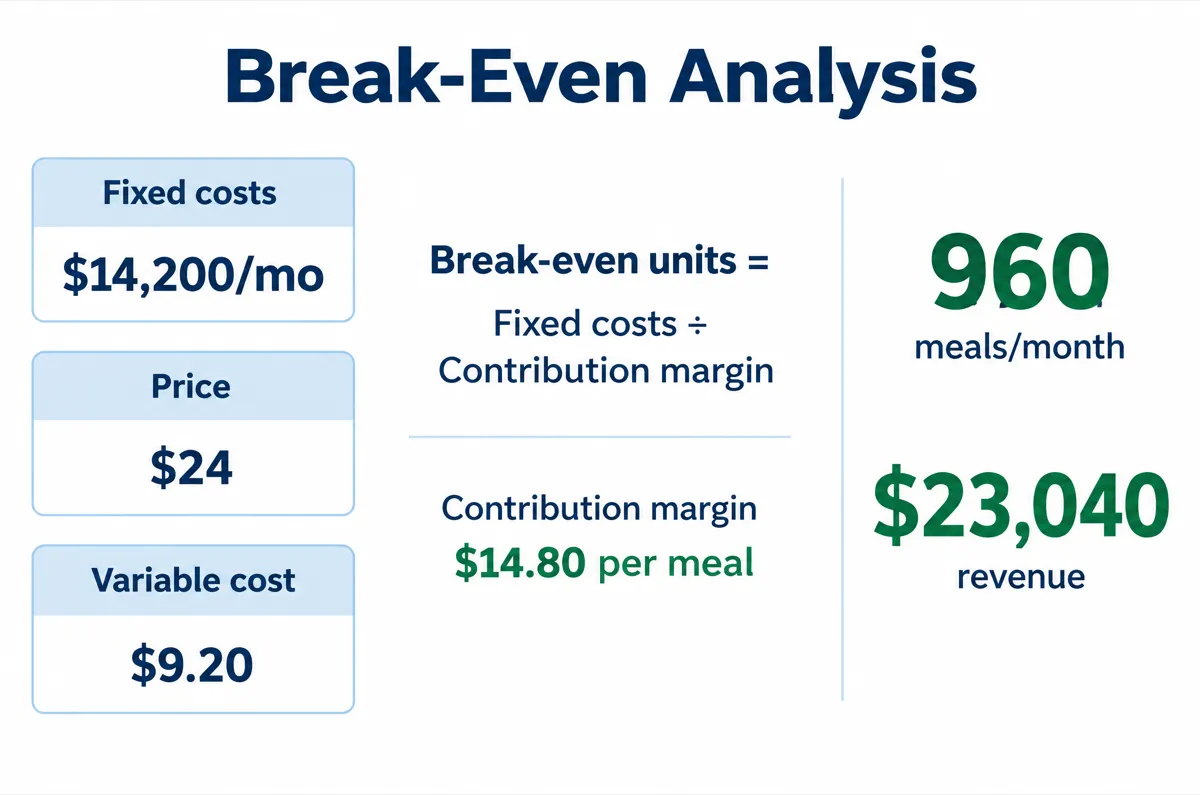
Priya is negotiating a $6,800-per-month lease for a second bowl-shop location, but her current store sells only 820 meals a month against a break-even of 960. She needs a number before the build-out: how much revenue clears every cost? Break-even analysis finds the sales volume where total revenue equals total costs. The core formula is Break-Even Units = Fixed Costs ÷ (Price − Variable Cost per Unit), where price minus variable cost is the contribution margin. This guide walks through dollars vs units, contribution margin ratio, target profit, marketplace fees, and what the textbook model leaves out.
Last updated: November 2026
TL;DR — Quick Answer
- Units: Break-Even Units = Fixed Costs ÷ Contribution Margin. Example: $10,000 ÷ ($50 − $25) = 400 units.
- Dollars: Break-Even Revenue = Fixed Costs ÷ Contribution Margin Ratio (50% here) = $20,000.
- Textbook check: $35,000 fixed costs at a 40% margin ratio → $87,500 revenue; $2,500 fixed costs at $8.00 contribution margin → 313 downloads.
- Run your model: Use the Break-Even Calculator for price scenarios, target profit, and volume tables without rebuilding the spreadsheet.
What Is Break-Even Analysis?
Break-even analysis answers one question: how much do you need to sell before profit starts? Below break-even, each sale only recovers part of your overhead. Above it, every additional unit keeps its full contribution margin. For a division with $35,000 in fixed costs and a 40% contribution margin ratio, break-even revenue is $87,500, the standard textbook setup.
The SBA Office of Advocacy reports that from 1994 through 2022 about 49.2% of new employer establishments survived five years (BLS Business Employment Dynamics data). Knowing your break-even will not change industry survival rates, but it explains why many owners discover too late that rent, payroll, and loan payments require more volume than they planned.
Break-Even in Units vs Dollars
Units formula: Break-Even Units = Fixed Costs ÷ (Price per Unit − Variable Cost per Unit). Variable cost is everything that scales with output: ingredients, packaging, fulfillment, per-order payment fees, and sales commissions. Fixed costs stay the same whether you sell 10 units or 10,000: rent, salaried payroll, insurance, loan payments, and base software subscriptions.
Dollars formula: Break-Even Revenue = Fixed Costs ÷ Contribution Margin Ratio, where Contribution Margin Ratio = (Price − Variable Cost) ÷ Price. A $50 product with $25 variable cost has a $25 contribution margin and a 50% ratio, so $10,000 in fixed costs require $20,000 in revenue (400 units). Service businesses can treat each billable hour or project as a unit with the same math.
Target profit: Units for Target Profit = (Fixed Costs + Target Profit) ÷ Contribution Margin. Priya wants $6,000 monthly profit on top of costs, so she must cover $20,200 ÷ $14.80 = 1,365 meals ($32,760 revenue), not merely the 960 meals at break-even.
Worked Examples: Dollars, Units, and Product Lines
Given $35,000 fixed costs and a 40% contribution margin ratio
Revenue = $35,000 ÷ 0.40 = $87,500. You do not need the selling price to solve in dollars — only the margin ratio. If you also know price is $50 and variable cost is $25, the ratio checks out: $25 ÷ $50 = 50%, a wider margin than the 40% in the textbook example, so it needs less revenue per fixed dollar.
Mobile app: $2,500 fixed expenses, $8 contribution margin per download
Break-even downloads = $2,500 ÷ $8.00 = 312.5, rounded up to 313 because you cannot sell a fraction of a download. Download 314 contributes another $8.00 straight to profit once fixed server and contractor costs are covered.
Break-even in sales dollars for a product line
When finance asks for break-even in dollars, use the margin ratio form. With $10,000 fixed costs and a 50% ratio, break-even sales are $20,000. Multi-product firms can compute one ratio per SKU, or a blended ratio weighted by expected sales mix — the calculator on CalcWise handles single-SKU models; mix changes require a weighted contribution margin before you divide into fixed costs.
Contribution Margin and Operating Leverage
Contribution margin is the cash each sale sends toward fixed costs after variable expenses. Priya earns $14.80 per $24.00 bowl (61.7% margin ratio). Raise price by $1.00 without changing food cost and break-even falls by 61 meals at current costs. Cut variable cost by $0.50 per bowl and break-even drops by 31 meals.
Businesses with high fixed costs and high contribution margins carry more operating leverage: once you pass break-even, profit accelerates. At exactly break-even, operating income is zero, so leverage ratios blow up — that is why managers pair break-even with margin of safety (actual sales minus break-even sales). Priya's 820 meals produce $2,064 in monthly loss because she is 140 meals below break-even. Her sales sit 17.1% below the break-even line, a margin of safety of -17.1%.
Compare contribution margin across offers with the Margin Calculator before you run break-even, especially when shipping or processing fees differ by channel.
Break-Even When Platforms Take a Cut
Marketplace fees belong in variable cost, not fixed cost, because they scale with orders. Etsy charges $0.20 per listing, 6.5% on the order total, and for US sellers a payment processing fee of 3% + $0.25 per order (Etsy Help Center, checked November 2026). On a $28.00 candle with $8.50 in materials, fees near $3.11 shrink contribution margin to $16.39 and lift break-even from 52 to 62 units at $1,000 monthly fixed costs, which is 10 extra sales per month just to offset fees.
Amazon's US referral fee for most general categories is 15% of the total sale price with a $0.30 minimum per item (sell.amazon.com pricing, November 2026). On a $42.00 SKU with $22.00 landed cost, the fee is $6.30, cutting contribution margin from $20.00 to $13.70 and pushing break-even from 340 to 497 units when fixed costs are $6,800. This counts the referral fee only; Fulfillment by Amazon fees, storage, and advertising would raise variable or fixed costs further. If you sell both direct-to-consumer and on Amazon, run separate break-evens: your Shopify site may have lower variable cost but higher ad spend in fixed costs.
Sources SBA Office of Advocacy, FAQs About Small Business (Feb. 2026) — 49.2% five-year survival, Etsy Help Center — fees and US payment processing (3% + $0.25), Amazon Sell — referral fees by category (15% most general categories). Checked November 2026. Survival rates cover employer establishments in BLS Business Employment Dynamics; nonemployer and sole-prop outcomes differ.
Case Study: Priya's Fast-Casual Bowl Shop in Denver
Priya, 41, owns a fast-casual bowl shop in Denver. Her monthly fixed costs total $14,200: rent $6,800, salaried kitchen lead $4,200, insurance $620, utilities $980, and equipment loan $1,600. Variable cost averages $9.20 per bowl ($5.10 food, $0.90 packaging, $0.65 card processing, $2.55 hourly labor). The average check is $24.00, so contribution margin is $14.80 (61.7% of price).
Break-even meals = $14,200 ÷ $14.80 = 959.5, rounded to 960 bowls monthly ($23,040 revenue). In October 2026 she sold 820 bowls — $19,680 in revenue — and lost $2,064 because she was 140 meals short of break-even. To pay herself $6,000 after all costs, she needs 1,365 bowls ($32,760), which is 545 more than she sells today.
The second location adds $6,800 of monthly rent. Rent alone lifts combined fixed costs to $21,000 and break-even to 1,419 meals, so the new shop must sell at least 460 meals a month just to cover its own rent, before it pays for staff, insurance, or utilities. Her current shop is still 140 meals short of break-even, so the first job is lifting sales there. Pair break-even with the ROI guide when the expansion requires upfront capital: ROI tells you if the payoff beats other uses of cash; break-even tells you the minimum sales to avoid bleeding cash.
Three Business Models Compared
The table stacks three business shapes with different fixed-cost burdens. Margin of safety compares each owner's actual monthly volume with break-even; all three examples are illustrative.
| Model | Fixed/mo | Price | Variable | BE units | Actual vol. | Margin of safety |
|---|---|---|---|---|---|---|
| Freelance brand designer | $2,400 | $450 | $60.00 | 7 | 9 | 22.2% |
| Amazon seller (referral fee only) | $6,800 | $42 | $28.30 | 497 | 890 | 44.2% |
| Weekend food truck | $5,600 | $14 | $5.60 | 667 | 780 | 14.5% |
Weekend food truck: at 780 meals the operator is 113 meals above break-even (a 14.5% margin of safety). Two canceled 100-meal weekend days would drop volume to 580, below the 667-meal threshold, because fixed commissary and truck-loan costs keep running.
Step-by-Step: Build Your Break-Even Model
- List fixed costs for one month. Include rent, insurance, salaried payroll, loan payments, and base subscriptions. Split annual bills into monthly amounts ($12,000 insurance ÷ 12 = $1,000 per month).
- Find variable cost per unit. Add materials, packaging, shipping labels, marketplace fees, and per-unit labor. For Etsy, add listing, transaction, and processing fees to variable cost, not fixed cost.
- Compute contribution margin and ratio. Margin = price − variable cost; ratio = margin ÷ price. Use the margin calculator if you have multiple SKUs.
- Solve units and revenue. Units = fixed ÷ margin; revenue = fixed ÷ ratio (or units × price). Compare both answers — they should match within rounding.
- Add target profit if needed. Add desired owner pay or investor return to fixed costs before dividing.
- Stress-test price and volume. Run ±10% price in the Break-Even Calculator and compare margin of safety to slow months. Side businesses should also budget taxes and quarterly estimated payments — see our self-employment tax guide for how net profit turns into IRS payments.
Side Hustles, Freelancers, Restaurants, and E-Commerce
Freelancers treat billable projects as units. A designer charging $450 per project with $60 of stock assets and subcontracting and $2,400 in monthly fixed costs breaks even at 7 projects a month, fewer than two a week. Landing 9 projects leaves a 22.2% margin of safety. Track unbilled hours in fixed cost if you pay yourself a draw regardless of sales.
Restaurants and food trucks mix high fixed rent with low per-meal margins. Priya's model is tight: a $1.00 increase in chicken cost across the menu without a price change can wipe $820 from monthly contribution if she sells 820 bowls.
E-commerce should model fees per channel. After Amazon's 15% referral, the SKU in the table needs 497 units versus 340 on a direct site — a gap of 157 orders before profit. Use the ROI Calculator on ad spend only after you know break-even units so you do not scale a negative margin.
Savings runway: If the business loses $2,064 per month, a $15,000 personal emergency fund covers about 7 months of operation at today's volume — tie runway goals to the Savings Goal Calculator if you are funding the shop from W-2 income.
What Break-Even Analysis Does Not Capture
The textbook model assumes one price, one variable cost per unit, and a clean split between fixed and variable costs. Real businesses break those assumptions quickly. Semi-variable costs (utilities that step up after certain hours, card processing with a flat per-transaction fee) need either average variable cost or a multi-step model. Price changes and discounts mean your contribution margin ratio is an average, not a constant. Product mix shifts when customers buy high-margin drinks with low-margin entrees. Income and sales taxes sit below operating profit — break-even is pretax cash coverage, not after-tax owner pay.
Time value of money matters when fixed costs include loan principal paydown you modeled as expense but investors treat as balance-sheet movement. Cash vs accrual timing can show profit on paper while payroll due Friday drains the account. Break-even is a monthly operating snapshot; use it with cash-flow planning when seasonality swings volume by 30% or more.
Run Your Own Numbers
Model break-even units, revenue dollars, target profit, and price sensitivity in one place.
Open Break-Even CalculatorFAQ
How much revenue must I earn if fixed costs are $35,000 and the contribution margin ratio is 40%?
Divide fixed costs by the contribution margin ratio: $35,000 ÷ 0.40 = $87,500 in break-even revenue. At a 40% margin ratio, every $1 of revenue contributes $0.40 toward fixed costs, so you need $87,500 in sales before profit begins. If your average selling price is $50, that equals 1,750 units at that price point.
How many downloads does a mobile app need if fixed expenses are $2,500 and contribution margin is $8 per download?
Break-even units = $2,500 ÷ $8.00 = 312.5, rounded up to 313 paid downloads per month. Each download after 313 contributes the full $8.00 toward profit. Treat app-store commissions the same way as Etsy or Amazon fees: subtract per-download platform charges from price (or add them to variable cost) before dividing fixed costs by contribution margin.
What is break-even in sales dollars for a division?
Use Break-Even Revenue = Fixed Costs ÷ Contribution Margin Ratio. Example: $10,000 fixed costs and a 50% contribution margin ratio (price $50, variable $25) yield $20,000 in break-even revenue, equal to 400 units. Division-level break-even works the same way if you assign that division its own fixed and variable costs.
How do Etsy or Amazon fees change break-even?
Treat each sale's platform and payment fees as variable cost. On Etsy (US), a $28.00 item with materials costing $8.50 also pays about $3.11 in listing, 6.5% transaction, and 3% + $0.25 processing fees, cutting contribution margin from $19.50 to $16.39 and pushing monthly break-even from 52 to 62 units at $1,000 fixed costs. A $42.00 Amazon SKU with a 15% referral fee adds $6.30 per unit, raising break-even from 340 to 497 units when fixed costs are $6,800.
What is margin of safety in break-even analysis?
Margin of safety measures how far actual sales sit above break-even: (Actual Units − Break-Even Units) ÷ Actual Units. Priya sells 820 bowls monthly against a break-even of 960, so her margin of safety is negative (-17.1%), meaning she is still 140 meals short and loses about $2,064 per month at current volume. Hitting break-even is only the first hurdle; margin of safety shows cushion before a sales dip turns profit back into a loss.
Related Guides
How to Calculate ROI: Formula, Examples, and Common Mistakes
Learn how to calculate return on investment (ROI) with the simple formula, five real-world examples across marketing, real estate, and stocks, plus common mistakes that inflate your numbers.
How to Save $50,000 in 3 Years: 1, 2 & 3-Year Plans
Saving $50,000 in 3 years takes about $1,295 a month at 4.50%. See the monthly math for 1 to 5 years, the income you need, and a real case study.
Self-Employment Tax Explained: What Freelancers and 1099 Workers Must Know
Learn how self employment tax works in 2026: the 15.3% rate, Social Security wage base, deductible half, quarterly payments, and strategies to reduce what freelancers owe.